
Power Intro to Kontakt 5
Here is a 38 Min look at what makes Kontakt 5 a monster power-house of a sample playback plug-in. Also showing how cool it is to take samples from other Kontakt 5 libraries and load them into the MegaMacho Drums Interface for tons of sonic mayhem! MegaMacho Drums comes out July 1st, 2013!
Reason 7 – Product Presentation
Last week Sonic State had a visit from Ryan Harlin – he’s the guy behind Propellerheads Music Making Month and also puts together the ongoing video content for Propellerheads.
“He showed us around the new features in the just released Reason 7, including (finally) the introduction of MIDI, some neat mixer functions – Spectrum EQ, bussing and parallel processing, plus the new audio processing module – Audiomatic.”
John Bowen Solaris Demo
Here is a demo of the Solaris synth by John Bowen (www.johnbowen.com).
“I have this fantastic synt for a week now and worked with it for 6 evenings. I started building my own sounds right away and in this demo you can hear a sound that uses vector and wavetable synthesis. Everything is played live using the keyboard, the joystick, the 4 part switch buttons and the pitch and modulation wheel. This synth is the king of evolving sounds!”
For better audio quality go to SoundCloud:
http://soundcloud.com/insanic4/solari…
The general concept behind the Solaris synthesizer is to implement something like a giant wall-sized modular system entirely in software where you can select among several completely different types of oscillators and filters, exquisitely modelled after the components culled from a variety of legendary vintage synthesizers of yesteryear and even some current virtual analog innovations of today. With up to four oscillators, four filters, four amplifiers, four four-input mixers, six envelope generators, one looping envelope generator, five LFOs, two vector mixers and still more of these software modules available in each program, the Solaris synthesizer becomes absolutely unrivalled in terms of versatility and programmability.
Cubasis Demo: Recording Audio using Audiobus
A quick demo of recording Audio into Cubasis using Audiobus. In this video Ryan Hemeon has downloaded the master tracks to a Nine Inch Nails song (Wish from the Broken Album) and opened them in Cubasis..
“I remove the guitar from the song and record my own using the Apogee Jam, Ampkit and Audiobus. After recording I play the song through, add a few FX and mess with the mixer a tiny bit.
I used ‘picture in picture’ so you can see me playing the guitar as well. I will doing more PiP videos from now on. I liked how it turned out. 
Expect some more Cubasis tutorials soon. They are on their way!”
Time machine: ROLAND TR-505 Vintage Drum Machine 1986
The Roland TR-505 is a little programmable digital drum machine from 1986. This demo shows some of AnalogAudio1’s own patterns.
Accent is programmable. It’s some kind of mini-combination of a TR-707 and TR-727 since it has percussion sounds in addition. It has similar sounds. It has MIDI but no single outputs and no Roland SYNC-Interface. Shuffle functions available.
A cheap (budget) drum machine. It features 16 drum tones which unfortunately, are only mediocre samples. Its memory contains 48 patterns and 6 songs. Unlike its TR cousins it does not have individual drum tone outputs. There is no drum tone editing capability either. It does however feature extensive MIDI implementation, even the pads will transmit MIDI data. The 505 works well with a computer and sequencer or as a stand alone drum machine. It is extremely basic and unexciting but does make a good starter or play-along drum machine.
Roland V-Combo VR-09 Keyboard Demo
Roland keyboard specialist Ed Diaz demonstrates the Roland V-Combo VR-09 Performance Keyboard at Kraft Music.
About the keyboard in Roland’s own words:
Travel-ready, affordable, and outfitted with top-level Roland sounds, the V-Combo VR-09 is the ideal all-in-one solution for performing keyboard players. Dedicated piano, organ, and synth sound engines—organized in three intuitive blocks on the front panel—provide all the essential tones you need, right under your fingertips. The powerful real-time controls give you maximum expression on stage, with nine sliders for tone shaping and a large array of knobs and buttons for tweaking the seven simultaneous effects and various parameters. Other great features include an onboard looper, a drum section stocked with a library of rhythms for practice and jamming, and more. With its versatile sound selection, inspiring operation, and smart user interface, the V-Combo VR-09 is a dream come true for gigging musicians.
- Professional keyboard with instant-access operation for performing musicians
- Light and mobile; battery or AC power
- Pro-quality acoustic and electric pianos, including grand piano with 88-note stereo multi-sampling
- SuperNATURAL-powered Virtual Tone Wheel organ with nine harmonic bars, plus newly developed transistor-type ‘60s organ tone
- Wide range of synth tones, from vintage classics to modern essentials
- Seven simultaneous effects with dedicated real-time controls
- Looper and built-in rhythm patterns; WAV/MP3/SMF song playback via optional USB memory
- Free VR-09 Editor app available for iPad
Roland MIDI system from the 80’s
Movie demonstrating the Roland MIDI system, with MKB-300, MKS-80, MKS-30, TR-707, MSQ100 and MPU-401 and IBM PC with Personal Composer.
Video by Tom Gjertsen, Gustring Studio, Music by Brynjulf Blix. Narration by Kjell Kjær.
ROLAND TR-707 Vintage Drum Machine 1985
The Roland TR-707 is a classic programmable digital drum machine from 1985. This demo shows some of my own patterns and the programming.
Accent is programmable. It has MIDI and also the Roland SYNC-Interface. It has single outputs for the drum sounds. It also has a little built in mixer, which is very nice. The TR-707 has fifteen digitally sampled sounds and also shuffle functions.
The TR-707 was a staple in early house music, particularly with acid house. It was also used in the eighties in pop music.
Time machine: HOHNER STRING PERFORMER String Machine 1977
This german early eighties string keyboard was one of the last variations on building a string ensemble keyboard with or without some extras added. The Hohner String Performer is a string machine made in Germany. It has strings in 3 footages (CELLO, VIOLA, VIOLIN), which are mixable via volume faders. Also CLAVICHORD and PIANO presets, all free mixable. Each half of the keyboard has these features. A bass preset can be added to the left half of the keyboard. Like most string machines, the keyboard is split in the middle so that you can adjust the volumes seperately for the lower and upper part of the keyboard. The sliders for adjusting the volume of each basic sound works upside-down, like drawbars, i.e. you pull the slider towards yourself for raising the volume of a sound. Also, each sound can be muted with a corresponding button. The Performer has a minimal amount of control for adjusting the sound: only the release (called “sustain” on the Performer) time can be controlled. Also, the ensemble effect is a part of the string sound and cannot be switched off or variated. Fortunately, the string sound is really good.
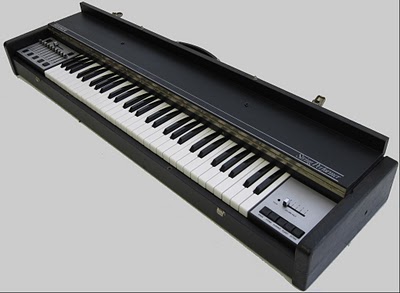
“On the right, there is a simple monophonic preset synthesizer with 4 presets: BRASS, STRING, CLARINET and PLANET. To be honest, I didn’t know that a planet could be a musical instrument – but Hohner should know
The String Performer is fully polyphonic and has a decent analog string tone. It is quite large and heavy.”
Kinetik Laboratories Drone demo
Kinetik Labs produces some really interesting hardware machines for Drone Music. At the last Turin Synth Meeting, Andrea Reali and Claudio Granzieri plays and demonstrates their pretty dense drone instruments. Enjoy.
DATAMASKIN

