
Unleash the Beast – Bit Beast Synth Demo
A demo song of the Bit Beast synthesizer. All sounds (including drums) are made with the Bit Beast and recorded into Ableton Live. Some minor FX were added to some tracks (reverb, delay, EQ).
The Bit Beast utilizes a method of tone generation commonly called ‘bit banging’. It turns a digital bit on and off at the frequency of specific notes. This method of creating sounds is typical of old videogame and computer systems. The processor that reads the MIDI signal and ‘bit bangs’ the notes is the same one used by the Arduino UNO (ATMEGA328P-PU). All the code is written and compiled in the Arduino software. This means that anyone with an Arduino UNO can edit and tweak the code. This will allow musicians to customize their synth to some degree, and expand upon the base functionality.
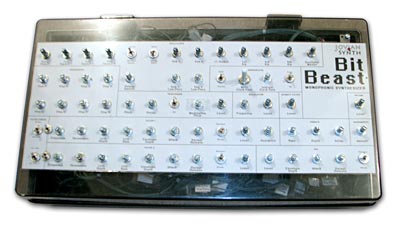
The notes are then chopped up and processed using CMOS logic chips. The effects created are common in the DIY realm, but seldom available in commercially available synthesizers.
The sound then passes through two analog voltage controlled filters. Both filters are unique designs that offer very different sounds. Filter 1 is a 12db state variable filter with low-pass and band-pass modes and overdrive control. Filter 2 is a 6db filter with low-pass and high-pass modes and a squelchy distorted resonance. The filters can be configured in parallel or two different serial configurations. Both filters have their own LFO and envelope generator.
The final step that the sound passes through is an analog VCA with a dedicated envelope generator.
More info on the Bit Beast here: http://www.joviansynth.com/bit-beast.php
The Bit Beast is not currently in production. The estimated cost is about $500-$600. Please send us an email if you would like to be notified when more information and availability is known – info@joviansynth.com
SUPERNOVA II Synth Demo – Experimental noise and chip tunes
Experimental noise / ambient drone soundscape played live on Novation Supernova 2 keyboard synthesizer. Utilizing comb filter, reverb, Q Norm, resonance, LFO and filter adjustments.
Performed live, no external processing. Excerpt from a longer session.
Computer / chiptunes-style ambient drone soundscape music played live on Novation Supernova 2 keyboard synthesizer.
Utilizing LFO (sample & hold), reverb, resonance, and filter adjustments.
Performed live, no external processing. Excerpt from a longer session.
Yamaha SY20 Sounddemo – Rare Yamaha Monophonic Analog synthesizer of 1982
Yamaha SY20 Sounddemo (springreverb effect)
Copyrights Volker Hein – 2013
More information visit www.tastronauten.de
The SY20 was Yamaha’s last analog synthesizer model before committing to digital FM synthesis with products like the DX-series. It is an all-analog mono-synth that came out in 1982 but was never commercially sold outside of Japan, making it very rare. In fact, it was originally intended to be an “educational” synth to help students learn about synthesis. However, as most of the controls are labeled in Japanese characters, you will already need to be familiar with analog synthesizers (or Japanese) to grasp the SY20.
Despite being a rather simplistic looking mono-synth, the SY20 is a surprisingly refined and expressive synth. There are 20 preset sounds, arranged in two banks of ten. They include all the customary attempts at emulating the acoustic sounds of piano, woodwinds, stringed and brass instruments. The presets can be combined with the manual synthesizer control sections, which are very simply and logically laid out: VCO, VCF, and VCA, and each section can be individually switched on or off. There is an LFO to modulate each of these three sections for pitch, filter and tremolo effects. There is also Portamento and a one-octave Transpose knob that is notched in half-tone steps (it can be used to quickly transpose what you are playing to different keys).
The VCO section offers one oscillator with Square and Saw waveforms. A slider is used to mix between the two waveforms. The oscillator pitch can be set from 2′ to 32′. There is also Pulse-Width modulation and White Noise. The VCF offers three filter modes: low pass, and two band pass modes. The filter sounds really good, though it is not self-oscillating. The typical cutoff and resonance controls are accompanied by ADSR envelope controls for a nice contoured filter effect. The VCA section offers the standard ADSR controls as well.
While the main synthesis sections are all nicely laid out and straight forward, the real expressive potential comes from a few other simple but effective features. The 44-note keyboard supports after touch, which can be sent to the VCF, the VCA and the LFO for adding filter, volume and modulation effects using keyboard pressure. They can be combined in any way and with as much (or little) depth as needed for the desired effect. There are also three global effects: Portamento, Sustain and Brilliance.
The SY20 has a mono audio output, headphone jacks in the front and rear, and a built-in speaker! Unfortunately there is no CV/Gate and the MIDI specification was still a year away from being published, so it can not be hooked up to any sequencing equipment—you’re gonna have to play this one the old-fashioned way.
The SY20 has a lot to offer. It sounds really good—warm, pure, expressive and wholly analog. It is incredibly rare. It is the last analog synthesizer Yamaha designed before going digital. And it is covered mostly in Japanese characters. All these qualities combine to make it an historic and unique piece in any collection and it will definitely get used often, it may even become the “go-to” mono-synth for anybody lucky enough to own one!
Jomox Akasha synth prototype at NAMM
Juergen of Jomox demonstrates the Jomox Akasha at the Big City Music booth at NAMM 2013.
More coverage at http://www.catsynth.com
Audulus Demo – Custom Step Sequencer Demo
With Audulus, you can build synthesizers, design new sounds, or process audio. All with low latency real-time processing suitable for live performance. Audulus’s user interface is clean, simple, and easy to learn, allowing you to focus on sound.
“I made an improved version of the standard step sequencer that comes with Audulus, it includes controls for start, stop, swing and step and sequence length. This is a demo of a song using made using it, all sounds are coming from the standalone version and shows how Audulus can be used to create custom performance setups.”
Linn Drum LM-2 Vintage Drum Machine Overview
The LinnDrum was the second machine from Linn Electronics. It’s basically an upgraded version of the original LM-1 with added crash and ride cymbals to the kit. The LinnDrum uses samples of acoustic drum sounds. At the time, they sounded great and much more realistic and they were a fresh alternative to the analog drum sounds of the ’80’s drum machines. The LinnDrum also had a handy upgrade option, a well designed layout and interface, and live drum trigger inputs.
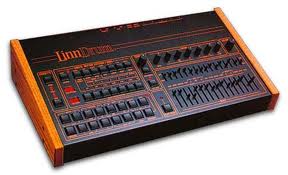
The LinnDrum had beefed up the sampled sounds from 28 to a 35kHz sample rate. It features 15 sounds including bass, snare, rimshot, hihat, crash, ride, three toms, cabasa, tambourine, high and low congas, cowbell, and clap. Up to 12 sounds are available simultaneously. Individual controls are available to tune, pan, and mix each drum sound via dedicated knobs and sliders. An Accent is available for the kick, snare and hats. The handy upgrade options involve inserting new chips containing new sets of sampled drum sounds created by many session drummers of the time.
The sequencer had some innovative features (for the time) such as swing, quantizing and memory storage! Two-bar patterns can be recorded in real or step time, with or without quantizing. There are 56 user patterns for storing your drum patterns. There are also 42 preset drum patterns. Patterns can be arranged into Songs for which there are 49 memory locations. Old songs and patterns can be off-loaded to cassette tape for storage. Designed for the studio, there are 15 individual outputs for each sound around the back as well as external sync and trigger but no MIDI (unless modified by a 3rd party). The LinnDrum’s features made it the most professional drum machine of its time.
Checking out Cakewalk Sonar X2
Brandon from Roland walks us through Cakewalk Sonar X2 and its ability for multitouch mixing on touch screens.
Cakewalk marcomm pitch:
From getting a great tone to releasing the final mix, today’s musicians must master every element of the music production process. SONAR X2 is there every step of the way and takes each element to the next level of power and usability. And thanks to the revolutionary Skylight user interface, SONAR X2 lets you move seamlessly among the elements, instantly going from recording to editing to mixing and back again. And do it all with a single Smart Tool. It’s genius.
Sub Phatty Demo With Huston Singletary
Sound and preset designer Huston Singletary describes the sound and architecture of the new sub Phatty as viscously rich and super intuitive. “This is on another level”.
The Yamaha CS-50- The Sub-Oscillator (L.F.O.)
Here is a demonstration of the sound and functionality of the low frequency oscillator of the Yamaha CS-50.
Blofeld iPad Editor Demo
Video description below:
This is a quick demo of my custom midi editor template for the iPad app ‘TB Midi Stuff’
https://itunes.apple.com/en/app/tb-midi-stuff/id480953919?mt=8
The free editor download link is in the TB Midi Stuff forum here, note that it’s easy for you to edit and customise within the app if you like:
http://www.thiburce.com/TBStuff/forums/viewtopic.php?f=19&t=125&p=416…
Thanks to Fabien (app developer) for such a great midi control framework.
DATAMASKIN

