
Midi Fighter Twister: Traktor Deck Drum Sequencer Demo
Sign up and learn more here: http://www.djtechtools.com/2013/11/03…
On the surface, each Midi Fighter Twister is equipped with 16 endless encoders, each with a push state, plus a full ring of LEDs. Capped off with 2 full-color LEDs at the bottom, each encoder can transform into a wide range of displays and functions depending on the mapping, configuration, or page. This provides infinite levels of control with clear visual feedback similar to a touch screen, while maintaining the tactile feel of a real knob.
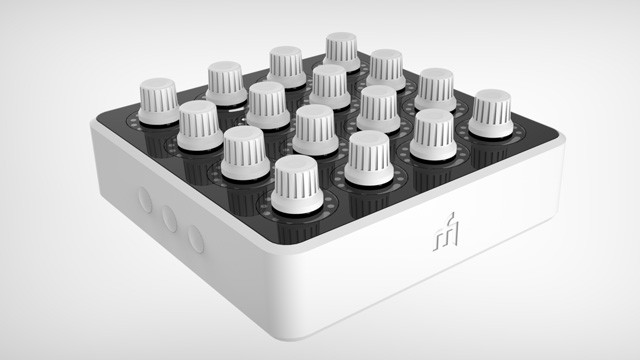
The possibilities – from Ableton control to Traktor effects – are endless, but to really showcase the potential of this dynamic work surface we decided to go a little nuts and create something totally next level.
The Bleep Drum – now with MIDI
The Bleep Drum has been upgraded with full MIDI control.
Now you can trigger the four samples, toggle noise and reverse modes, as well as change the pitch of all four samples with any device that can send MIDI.
Retrofit kits available to upgrade any previous Bleep or Dam Drum.
Order now at bleeplabs.com
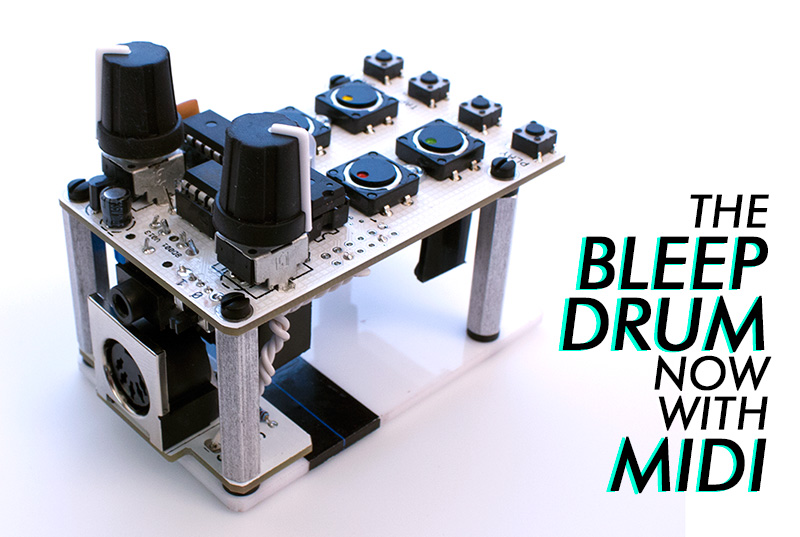
The Bleep Drum is an Arduino based lo-fi rad-fi drum machine designed by Dr. Bleep.
– Four sounds, two with pitch control
– Four selectable sequences
– Record patterns just by playing them
– Tap tempo
– Reverse mode
– Hypernoise 30XX mode
– Stereo 1/8″ output
Anatomy of a Drum Machine: Roland TR-909 Emulator JOMOX 09
massivebeatzzoffers his take on the Roland TR-909 inspired drum machine, the Jomox XBase 09
Built from 1997-2005 this now legendary drum box was first reviewed in June 1997 by SOS (Sound On Sound Magazine) asking: “So what do you get when you cross ’80s retro with ’90s know-how?”
They wrote:
XBase 09 is serious about emulating the Roland TR-909. Like the 909, it is an analog drum machine, and it sounds just like the 909, and more! It offers the same types of analog controls that the TR-808 and TR-909 did such as tuning, level, decay, snap, etc. However it provides more of these controls for more sounds than the originals ever did and has MIDI implementation and Patch memory making the XBase 09 a much more versatile machine than those originals.
Kick and snare are true analog, not emulation and not sampled. The Hihats, cymbal, ride, rimshot, claps and noise sounds are samples but are still quite tweakable. All your edited sounds can be stored into the 100 patches of memory. Use the built-in LFOs to modulate the Bass drum pitch, Snare Tune, Snare Snap, Snare Noise Tune, HiHat Tune or LFO 2.
The XBase 09’s built-in sequencer is also more advanced yet faithful to the style of its mentors. Step or Real-Time programming just like it’s done on the 909 and 808! However, on the XBase, any edits to the sounds will also be stored with the pattern or song! This really liven’s up your beats and allows you freedom and control to do things not easily possible on the original beat boxes! There’s also an extensive Shuffle mode. Of course the XBase 09 is also happy as a simple drum tone module, with all editable controls accessible using MIDI. The controls also send MIDI data when tweaked so you can record real-time edits into your external sequencer.
The XBase09′s editable controls include…
Bass drum — TUNE (controls the pitch envelope amount), PITCH (VCO tuning parameter), DECAY (controls the decay time), HARMONICS (changes the harmonics of the VCO using a diode limiter), PULSE (square wave impulse), NOISE (clap-like sound), ATTACK (controls how much of the PULSE and NOISE mix is added), EQ (smoothes the sound with a filter).
Snare drum — TUNE (controls the pitch of the two oscillators), NOISE TUNE (tunes the noise filter), XSNAPP (controls the proportion of noise), DECAY (noise decay time), DETUNE (detunes the two oscillators), NOISE TUNE (tunes the noise filter).
Sample section — OH DECAY (controls the decay time of the analog volume envelope for sample assigned to OHH), CH DECAY (same but for CHH), HH BAL (controls the volume balance between the samples assigned to OH and CH), TUNE defines the playback speed (pitch) of the sample.
DSI Tempest as a 6-voice polysynth module
No effects added. Tempest stereo outputs to USB audio interface into ableton
This video takes a look at using the Dave Smith Instruments Tempest drum machine as a 6-voice polyphonic synth module.
The DSI Tempest is based on analog voices tailored to percussion, but the drum machine has a lot of synthesis capabilities that go beyond traditional drum synth sounds, as this video demonstrates.
Drum computer MFB Kult – Demo
MFB Kult, a sample based drumcomputer that collect many samples of famous drummachines from the 80’s
In MFB’s own words about the machine:
On the occasion of MFB’s 25th anniversary, we are proud to announce something special. Since 1979 four rhythm machines were developed and produced: MFB-301, MFB-501, MFB-512 and MFB-612. In Germany these devices are very popular, since the inexpensive machines contained interesting rhythms for rock musicians. MFB digitized some of these sounds, and a multiple sounds of other far common rhythm machines. All these samples are packed into the memory of the MFB-KULT. The 192 sounds are divided in 16 sets, whereby each set contains 12 sounds. Since not every each rhythm machine had 12 sounds, a set consists of sounds of up to three rhythm machines. On a keyboard each set has one octave, so that a 4 octave keyboard or each MIDI channel has four sound sets.
Sounds from following drummachines and devices are available: Boss 55, Casio PT-68, Casio VL-1, CR-78, CR-8000, Drumtracks, Drumulator, El. Harmonix, Hohner, Korg DDD1, Korg-220, KPR-77, Linn 1, MFB-401, MFB-501, MFB-512, MFB-612, Pearl SC-40, Rhythm Ace, Simmons Clap, Simmons SDS, TR-606, TR-727, TR-808, TR-909 and Vermona.
With each sound the volume and the panorama can be programmed. Beyond that the Attack time and the release time can be programmed for each sound. Since the sounds cannot be longer than the original sample, with longer release the compression is increased. The sounds can be played naturally also individually over the tracer. The sound can be stopped with an automatic controller .
Additionally an integrated Sequencer is available, which can play some rhythms of the MFB-501. The speed is adjustable. The MFB-KULT has an stereo output. Additionally there is the MIDI IN. As current supply a plug power pack is provided.
The Korg Volca Series: Korg Volca Beats: Performance
Here is a demonstration of the sound and functionality of some of the performance aspects of the Korg Volca Beats.
Macbeth Micromac as a Drum machine
The Micromac-D by Ken MacBeth is a small and powerful, full analog standalone desktop synthesizer such as the eurorack module Micromac-R now including the Kenton MIDI-Interface and some extra features. Unlike his competitors it has three voltage controlled oscillators and a classic Moog lowpass filter, as a tiny desktop synth it could become indeed the bonsai-version of the M5 as the true MacBeth synthesizer!
The desktop version of the Micromac has not just CV and gate inputs to play the synth, but also a MIDI/CV interface from Kenton, who stand for very reliable and stable interfaces… and a few news with the additional LFOs.
3 VCOs: VCO1 and 2 have saw, pulse, triangle and sine waveforms and the pulse width can be voltage controlled by external CVs. A low frequency noise with level control is available as well. VCO 1 can hard sync VCO 2. VCO 3 can be used as a modulation oscillator and can be disconnected from the master CV. Modulation targets are filter cutoff frequency and/or pitch of VCOs 1 and 2. All VCOs have individual outputs, coarse and fine frequency controls, separate CV inputs for controlling frequency and pre-filter level controls.
The filter is a Moog 24dB lowpass filter. It´s input is a mixture of all three VCOs and noise. The cutoff frequency can be controlled by the first envelope generator as well as by an external CV. The filtertracking is switchable between off / half / full.
The envelopes are ADSRs with a switchable release parameter thats time is depending on the decay parameter, just like the Minimoog. The filter envelope can also be used to control VCO2´s pitch what sounds great when VCO2 is synchronised. Furthermore you can invert this envelope´s characteristic. The second envelope modulates the VCA. If an external CV is patched to the VCA the internal modulation is broken up. A momentary button allows manual triggering of the envelopes.
Jomox XBase09 vs Roland TR-909
A quick ‘side by side’ between a Jomox XBase 09 and Roland TR-909… just because this is the one thing everybody always asks about the XBase 09 – “does it sound like a real 909 ?”
Rocking with MFB Tanzbär & International Ensemble
MFB Tanzbär – Dancing Bear (GER), Analog Modular System Tinysizer (GER), moogerfooger MF-104M analog delay (USA), Korg Monotribe (JAP).
Sequenced and recorded with Ableton Live, a bit of reverb added to Monotribe but no other additional effects.
Yamaha RX21L Drum Machine
Well the reviewer ain’t to happy 😉
Craptastic Yamaha drum machine from 1985 featuring Latin sounds. Boring as hell. Get a Roland TR727 instead!
A quick play of the sounds and several patterns.
Quick demonstration of a pair of mid 80’s drum machines. Demo starts out with dry, direct signals from the machines and then I add a little reverb from Alesis MultiMix 8 at the very end. These machines are popular with circuit benders.
DATAMASKIN

