
Kraftwerk: Publikation – Biography by David Buckley
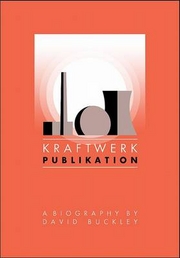
Omnibus Press presents a new and major biography of the first-ever all-electronic pop group, Kraftwerk, one of the most influential bands in popular music history. David Buckley examines the cult enigma that is Kraftwerk! The inner workings of this most secretive of bands are revealed through interviews with friends and close associates. The story of their incredible impact on modern music is traced up to the present day using interviews with a host of musicians, from original electro pioneers such as Gary Numan and the Human League to contemporary acts still in awe of the original Man Machines.
3.5 ‘Tomorrow Belongs To Those Who Can Hear It Coming’
It wasn’t just young would-be musicians who were listening either. The old guard were listening too. In 1975, modern music’s most important icon, David Bowie, was listening hard to Kraftwerk. Receiving an endorsement from Bowie, at the time the most innovative and critically lauded rock star on the planet, was a big deal. It’s hard now to imagine how influential David Bowie was in the seventies and early eighties. Far and away the most sought after interviewee by the UK music press, his every move was scrutinised, his every word picked over by an adoring audience.
Not that 1975 was personally a good year for Bowie. Commercially, he had never been more popular. ‘Fame’, an unlikely collaboration with John Lennon, became his first US number one, and a re-released ‘Space Oddity’ from 1969 would top the UK charts later that autumn. But physically and emotionally, Bowie was a man of shellac, ready to shatter into pieces, addicted to cocaine and obsessed with the occult. However, amongst the nonsequiturs and ridiculous assertions in his interviews, Bowie was, once again, picking up on a massive shift within modern music. He felt that rock, as a statement, was over. His music of the time, dubbed by its creator ‘plastic soul’, was his first attempt to break free from rock cliché. His second attempt, more fully realised, and much more artistically successful, would be just around the corner. ‘Rock ’n’ roll certainly hasn’t fulfilled its original promise,’ he told Anthony O’Grady in August of that year. ‘The original aim of rock ’n’ roll when it first came out was to establish an alternative media speak voice for people who had neither the power nor advantage to infiltrate any other media or carry any weight, and cornily enough, people really needed rock ’n’ roll. And what we said was that we were only using rock ’n’ roll to express our vehement arguments against the conditions we find ourselves in, and we promise that we will do something to change the world from how it was. We will use rock ’n’ roll as a springboard.’ Bowie continues: ‘But it’s just become one more whirling deity, right? Going round that never-decreasing circle. And rock ’n’ roll is dead … It’s a toothless old woman. It’s really embarrassing.’
KRAFTWERK 「OHM SWEET OHM」 in the anime version K-ON
http://youtu.be/toxwJQiXUe4
Kraftwerk collaborates with Japanese animation “K-ON!!”
A nice fan made tribute video using the Kraftwerk’s iconic track ‘Ohm Sweet Ohm’

‘K-On!’ centres around the story of HO-KAGO TEA TIME, a schoolgirl band getting to grips with playing their instruments of choice who become more confident both in music and in life. However, despite improving immensely in a short space of time, the girls do seem to spend most of their time consuming tea and cake! After all, this is a cartoon! It began as a Manga by creator Kakifly and was originally serialised as a 4-panel strip in magazines by publisher Houbunsha. A 13-part Anime was commissioned by Kyoto Animation and originally aired back in 2009.

KRAFTWERK’s legacy actually looms in the music of ‘K-On!’ via an authentic pastiche entitled ‘Virtual Love’ by HAJIME HYAKKOKU which is clearly based on ‘The Model’

Via EC
45 vinyl singles with Kraftwerk on display in UK art-gallery
London’s Vinyl Factory art gallery are putting on an exhibition of Kraftwerk’s iconic 7” single covers.
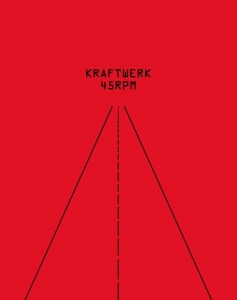
‘Kraftwerk. 45 RPM’ will run from September 13 to October 5, displaying 45 single covers and displaying the group’s unique minimalist sleeve art.
The Chelsea gallery are also publishing a limited edition book of the exhibition, with a print run of only 300 copies, which will catalogue the covers, as well as including an essay by collector Toby Mott and an exclusive 7” single of a rare Kraftwerk interview.
To pre-order a copy of the book, you can visit the VF Editions website right here.
More about the book:
Synth pop: METROLAND – The Passenger (official)
As an introduction to METROLAND’s forthcoming album “Mind the gap”, you can now download the METROLAND single “The passenger” via iTunes, Amazon US, Amazon UK and Amazon DE.
Recommended to fans of KRAFTWERK, KOMPUTER and alike.
The EP features 3 tracks all especially edited for this single release – none of these versions appear on the album, so you are in for an exclusive treat.
Here’s the tracklist:
01 The Passenger (7″ Version)
02 Inner City Transport (7″ Version)
03 The Passenger (12″ Backside Version)
METROLAND’s debut album “Mind the gap” is available as CD/2CD via the Alfa Matrix webshop – pre-orders have been shipped out already but the album will only be officially available on September 7. The limited deluxe 2CD box edition of the album offers you an exclusive VIP audio pass to enjoy the sonic treasures hidden in Zone 2 of the “Mind The Gap” album reinterpreted by prestigious electronic artists in the likes of KOMPUTER, FRANCK KARTELL, KEEN K, NÖVÖ, STERNREKORDER, CELLULOIDE, SOPHIE WATKINS, DARANK, etc.
You can get the 3-track single here:
– iTunes link: http://buyth.at/iuud
– Amazon US link: http://buyth.at/a82uc
– Amazon UK link: http://buyth.at/al38p
– Amazon DE link: http://buyth.at/ahow
Order the full “Mind the gap” album directly at Alfa Matrix (free shipping worldwide):
– CD: http://www.alfa-matrix.com/shop_comments.php?id=2197_0_8_0_C
– 2CD: http://www.alfa-matrix.com/shop_comments.php?id=2198_0_8_0_C
Kraftwerk’s “The Model” on a Waldorf Microwave
for more info and audio clips, please visit my waldorf microwave webpage:
http://www.polynominal.com/site/studio/gear/synth/waldorf_microwave/microwave…
OTO VS THE ROBOTS (KRAFTWERK COVER)
Nice Kraftwerk cover featuring the OTO Bisquit:
oto biscuit+electribe emx (only waveshaper fx)
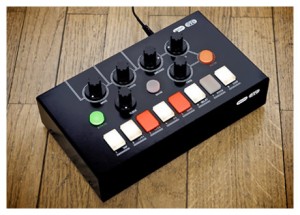
Add depth, texture and organic behavior to synths, basslines, drum machines and virtual instruments from computers with BISCUIT !
Using true 8-bit converters, digital processing and analog resonant filters, Biscuit opens up a wide range of sounds from harsh distortion, digital and aliasing artifacts to warm and fat 8-bit sounds.
Producers, deejays, musicians and sound lovers can use BISCUIT to extend their sound creation possibilties.
Brett Domino plays Stylophone featuring David Bowie, Kraftwerk and more
The Stylophone is a miniature analog stylus-operated synthesizer invented in 1967 by Brian Jarvis and going into production in 1968. It consists of a metal keyboard played by touching it with a stylus — each note being connected to a voltage-controlled oscillator via a different-value resistor – thus closing a circuit. The only other controls were a power switch and a vibrato control on the front panel beside the keyboard, and a tuning control on the rear. Some three million Stylophones were sold, mostly as children’s toys.
The Stylophone was available in three variants: standard, bass and treble, the standard one being by far the most common. There was also a larger version called the 350S with more notes on the keyboard, various voices, a novel ‘wah-wah’ effect that was controlled by moving one’s hand over a photo-sensor, and two styluses.
In the mid-70s a new model appeared which featured a fake wooden effect on the speaker panel, and, more importantly, a volume control. (Previous Stylophones had been infamous for being too loud in quiet situations). This was shortly before the Stylophone ceased production altogether in 1975.
Rolf Harris appeared for several years as the Stylophone’s advertising spokesman in the United Kingdom, and appeared on many “play-along” records sold by the manufacturer.
To hear individual performances, click on the desired song/s at the end of this video.
Doepfer Sneak Peek
Not completely new, but we seemed to have missed it:
An interview with the great man himself, taken from the documentary ‘Totally Wired’. Dieter talks about the inspiration for the A100 series, his collaborations with Kraftwerk, and the future of modular. Unmissable!
‘Totally Wired’ is available on DVD from amazon.com
Sui Sibi Se Se – Of Love and Robots
Background information:
In the studio working on a cover of Kraftwerk’s “The Robots,” which will be featured on the forthcoming Of Love and Robots EP. This (almost) all modular EP features covers of classics by Kraftwerk, Gary Numan / Tubeway Army, Giorgio Moroder, and more.
Sui Sibi Se Se – Of Love and Robots EP. Music for your self.
Karl Bartos and the voice of technology: An exclusive interview with Karl Bartos
Some of weeks ago Karl Bartos toured a couple of cities in Sweden and Steelberry Clones, got an exclusive interview with the synth pop pioneer. Karl, being one of the four members of the classic Kraftwerk line-up and with several legendary compositions on his track record, i.e. Computer World, The Man Machine, Electric Café. To recap some of the more important activities it is worth mentioning that Karl founded the group Elektric Music in 1992, releasing the album Esperanto, and he have collaborations along the way with Bernad Sumner, Johnny Marr and Andy McCluskey. And since Steelberry Clones are in fact based out of Sweden it is worth mentioning his guest appearance with Swedish synthpop act Mobile Homes. After leaving Kraftwerk, some 25 years ago, the music that he and the rest of the band created is still a great inspirational source across numerous musical genres.
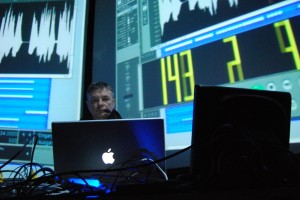
Karl has ventured into many different fields since the Kraftwerk days and has delivered highly acclaimed albums along the way, such as Communication – featuring such songs as “I’m the Message,” “The Camera,” and “Ultraviolet.
In awaiting his new album, due early next year, we wanted to dig a little deeper into the mind of Karl, by asking him about the music creation side of things.
The new album in the works
Karl is now producing a new album, but working in the studio is being like a scientist, tweaking and tuning – composing is the pleasure part! The production process involves starting with beta versions and then continues to work with the songs, improving them and making new versions – even though all twelve songs where set at demo stage. Here Karl adds a remark that stems from his German and Kraftwerk roots – “I go into the studio 8 hours every day”. Producing your own work requires making final decision, fighting yourself.
Being a director and the use of computers
Composing is being like a director of drama – there are roles and dialogue. Making electronic music is like making and acoustic film. For Karl melody and harmony are key ingredients. And while composing the sound is and integral part of the composition. Working with synthesizers for more than thirty years Karl has built up a pallet of sounds in his head which he uses as basis while composing. Whilst there are infinite sound possibilities using electronic instruments – “there are so many sounds, I can’t listen to all of them”, only adding new sounds occasionally. Regarding electronic instruments Karl hasn’t sold any of the his synthesizers and still prefers the old analogs. But just like computers – they are only tools. Like a craftsman that needs different screwdrivers but then he doesn’t love them – “computers are just eating my time”. Many musicians today turn to analog gear as they miss the tactile experience while creating but for Karl the important composing process is done in his head – not turning knobs or clicking on computers. That said the computers are used heavily during production of audio and video, sampling sounds.
Regarding computers, Computer World, the eights studio album to come out of the Kling Klang studio, in these Twitter days we can assume that all these sound bytes like “It’s more fun to compute” would make efficient and highly acclaimed Twitter posts today :-). However, what is more interesting to know is that at the time of the making of the Computer World album Karl and the others had never actually owned or used a computer themselves. “During the making of Computer World we had a closer look at those incredibly smart machines at the IBM affiliate in Düsseldorf”. Remember that the PC was just launched and home computers was if not science fiction very exotic at the time.
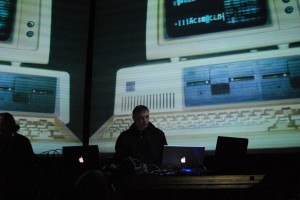
I robovox
The robot voices are a trademark of Bartos music and appears on all his albums where he uses both vocoders and synthetic made voices. They are used for the dramaturgic effect – as “the voice of technology it self, or like the voice God”. The robot voices are then not him self singing and can be used just like the narrator in a film. The voice technology has advanced tremenously the last years with products like Antares Auto Tune, Melodyne, Vocaloid etc and they are used in numerous pop hits, but few has put them as permanent tool on their artistic palette.
Audio information : Kraftwerk’s World Tour 1981
Live at Nagoya Shi Koukai Do, Nagoya, Japan, 13/09/1981
DATAMASKIN

