
Tenori-On Analog Sequencing
Tenori-on MIDI sync to the MFB desktop Filter and the Urzwerg Pro sequencer.
Tenori “drums” are through the MFB Filter & it is sequencing:
1) Moog Minitaur
2) Cwejman S1
3) Moog Slim Phatty
4) Prophet 08
Then the Urzwerg Pro seq. the Polivoks.
No effects were added, but Lots Of EQ!!
A Voice for the Voiceless
In this video one uses a TC-Helicon VoiceWorks, VirSyn HarmonyVoice app, Ableton Live and abunch of Moog and other synth gear to create an interesting vocal performance environment. Analog Control Voltage step sequencing created by Ableton Live and a Moog Multi-Pedal ad an interesting rhythmic dimension.
Learn more at www.experimentalsynth.com
Moog Voyager Filter Step Sequencing
A quick inspirational video showing a nice result from step sequencing the Moog Voyager’s filter cutoff.
Time machine: MOOG MULTIMOOG Analog Synthesizer 1978
Playing the Multimoog with reverb effects from a Lexicon MPX-500 and delay effects from a Roland DEP-5.
The Multimoog is a highly versatile analog monophonic synthesizer. It is basically an extended version of the Micromoog, which came out 3 years before. It features a ribbon controller and a touch sensitive keyboard. It has many interesting modulation routings and has a powerful, analog sound.
The Multimoog has 2 VCOs and a suboscillator. The filter can be modulated by the oscillator B in different ways. It has oscillator sync, noise generator, sample & hold, mixable oscillator waveforms, pulse width modulation, the 24 dB Moog filter and two envelopes. It has all interfacing you would expect from a good monophonic synth: CV / Gate IN and OUT, EXTERNAL SIGNAL IN, VCF IN. You can even play a Moog modular system from the Micromoog keyboard.
Studio Entrance
Another shot of Brian Fedirko’s Moog and Doepfer setup at the studio.
Moog Voyager – The Viking Signature ReFill
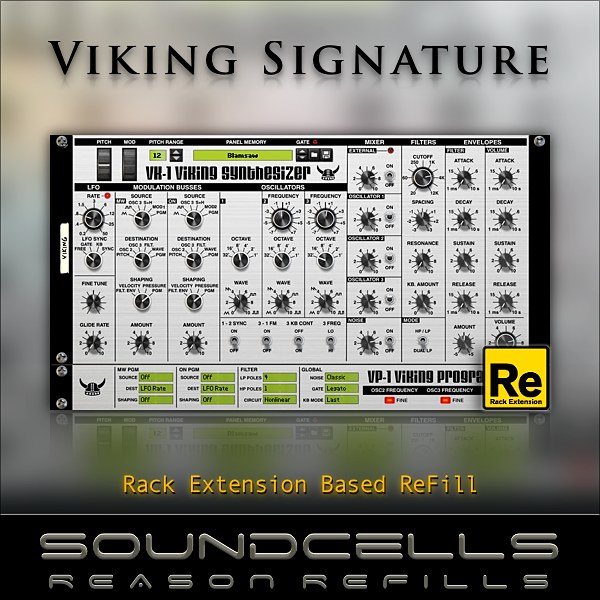
Viking Signature is based on the Viking Rack Extension synthesizer – a great sounding emulation of the Moog Voyager. The Viking Signature ReFill convinces with its funky and soulful leads, authentic sounding bass patches with an awesome bottom end and several wired SFX patches.
If you own Viking be sure to complete your ReFill collection with Viking Signature – a powerful soundset at a ‘knockdown‘ price …
Viking Signature Contents:
• 45 combinator patches.
• 70 Viking patches full of soulful leads and great basses.
• Authentic Moog character for your Reason Rack.
• Well balanced volume settings & carefully assigned modwheel and combinator buttons and knobs
Introductory price is 7.90 ,- EUR (normal price 9.90 ,- EUR)
Hardware treat: Minimoog and Source
Slow improvisation on two classic Moog synths – the Moog Minimoog and the Moog Source
Moog Source – the 15 classic factory patches
Moog’s Source was their first to offer patch memory storage as well as some other new features. It boasted 16 memory locations so you could finally save and recall your synth patches. A casette-tape jack was also implemented to transfer your patches to and from an external tape and free up the on-board memory for additional new patches. But in an effort to modernize with the eighties, the Moog had replaced all buttons, knobs and sliders with flat-panel membrane buttons and a single data-wheel assignment format. At the time, this may have seemed far-out, but in all actuality it is the Source’s downfall.
Parameters are edited not with hands-on sliders and knobs but by assigning a selected parameter to the dedicated data wheel. This is very tedious and does not allow for true hands-on tweaking during performances nor can you adjust different parameters simultaneously or while playing. These days, the membrane buttons don’t always seem to work quite right either. However, those famous monophonic Moog sounds are still inside this synth which has two fat analog oscillators and the legendary 24 dB Moog filter.
The factory patches of the Moog Source, classic mono from 1981
0:10 Program 01 – LEAD 1
0:32 Program 02 – LEAD 2
1:00 Program 03 – HORN
1:31 Program 04 – FLUTE
2:04 Program 05 – CLAV BASS
2:24 Program 06 – VIBES
2:46 Program 07 – STRING BASS
3:07 Program 08 – HARPSICHORD
3:30 Program 09 – ORGAN
4:05 Program 10 – TRILL VOICE
4:54 Program 11 – TAURUS
5:36 Program 12 – SYNTHEVOX
6:29 Program 13 – SAX
6:55 Program 14 – WIND
7:22 Program 15 – SNARE DRUM
7:40 Program 16 – Bonus – modern Electro House synth sound
Playing the Juno 6 and Moog ClusterFlux
“Messing about with a Roland Juno 6 and a Moog Clusterflux.
Juno 6 outputs in mono into the MF-Clusterflux – multitracked 4 times.
The Clusterflux lends a nice evolving texture to the Juno 6, but I think I got carried away and overdid it.”
The Cluster Flux is an ultra-powerful and flexible, sound-sculpting tool for use live or in the studio. Expansive functionality combined with warm, analog sound come from the state-of-the-art all-analog audio signal path. Musical, flexible, playable, and durable, the Cluster Flux is capable of providing classic flanging, chorusing, and vibrato effects, but is also capable of a much wider range of modulated delay line effects than traditional stomp boxes in this class due to the wide range of the front panel controls, the multi-waveform LFO, as well as CV and MIDI Control.
The MF-108M Cluster Flux is more powerful than traditional chorus/flange effects offering musicians the added modulation of multiple LFO waveforms: Sine, Triangle, Square, Saw, Ramp and Random, to create many kinds of new modulated BBD Delay effects. MIDI IN allows control of Delay Time, Range, Feedback, Output Level, LFO Waveform, LFO Rate, LFO Amount and Mix.
Rocking with MFB Tanzbär & International Ensemble
MFB Tanzbär – Dancing Bear (GER), Analog Modular System Tinysizer (GER), moogerfooger MF-104M analog delay (USA), Korg Monotribe (JAP).
Sequenced and recorded with Ableton Live, a bit of reverb added to Monotribe but no other additional effects.
DATAMASKIN

