
TM404 – 303/303/303/303/606
TM404 provides some nice electronic sounds. PS. TM404 is the alias for one of Sweden´s top electronic musicians 😉
Background data:
If you dislike this, you might also dislike:
http://www.youtube.com/watch?v=ykcWdR-ewGw
http://www.youtube.com/watch?v=IaR7gVJn0t8
http://www.youtube.com/watch?v=CW4HOSBZ770
Some silverboxes from the early eighties.
FX:
Roland RE-201
Roland RE-501
Dynacord TAM-21
Dynacord SRS-56
Lexicon Model 200
TC Electronic D-Two
Empirical Labs Distressor
Tube-Tech SMC2B
Monday morning synth session – Lost Spaceship
Video creator “pianoloft” has uploaded this synth session featuring some nice synths:
“drifting throuh soundspaces, useing roland gaia synth, korg er1 and em1, dementia dm7, korg monotron, rainbow machine, synth baby ( dementialabs ), noisemachine (drmoonstien) and a piano.”
Jupiter-8, Juno-60, TR-707 – 1980s style
Background information:
An ’80s synth / dark improvisation in my style utilizing mostly early ’80s Roland synths. I’m using a few “live” performance techniques like acting on the synth volumes and filters in real time. The verses are a bit “straight” but the choruses have a good chord progression and sound nice (if a bit melancholic) with the huge, magic, silky string sound of the JP-8, and the electric bass following on the high notes, wait for them 😉
Equipment:
Roland Jupiter-8 = octave arpeggio synth bass, strings, pad, lead
Roland Juno-60 = pad
Roland TR-707 = drums, arpeggio sync
Fender Jazz = electric bass
Fender Stratocaster = electric guitar
Roland M-10DX = submixing, reverbs, echoes
Cakewalk Sonar X1 PE = recording, effects, compression
Roland Jupiter 6 + Roland Gaia “Super Midi”
Background info below:
In this video I have Midied out of the Jupiter 6 into the Gaia which allows me to play the Gaia through the Jupiter 6. The Jupiter 6 is set on an arpeggio string patch in which I have added some portamento. The Gaia is set on a Sawtooth Synth patch. The two synths sound very good together!
Roland Juno-60
BRUNO ENDER LEE – “Roland Juno-60” – recorded February 2007, every sound is made with Roland Juno-60, on three stereo-tracks, just added some delay & chorus, taken from the CD “Analogue_Syn”
Among the first in Roland’s amazing Juno family! Six analog voices of polyphony and patch memory storage!! The Juno-60 sounds great, however, like the Juno-6 it lacks MIDI control. The Juno-60 includes 56 patches of memory storage. The Juno-60 is still popular due in part to opinions that it sounds better (punchier) than the Juno-106. The Juno-6 and 60 are very rich sounding synthesizers and are great analog machines as long as you can withstand the absence of MIDI control. The JSQ-60 sequencer is an external sequencer controller for the Juno-60 and is usually worth acquiring. Of course nobody can deny that the wooden side panel look is a true sign of Vintage status!
LDB-1 Analog Drum Machine – Roland TR recreation
The Delptronics LDB-1 “Little Drummer Boy” is a modern recreation of the classic analog drum machines of the 80’s, like the Roland TR-606 and TR-808. Our goal was to recreate the warm sounds of the classics, using all analog circuitry — not samples. The brain of the LDB-1 is a powerful digital microcontroller that triggers the analog drum sounds and provides the sequencer, programmability and connectivity features. Eight instruments: Bass, Low tom, high tom, snare drum, woodblock, hand clap, closed hi-hat, and open hi-hat. Easily interfaces with other instruments, synthesizers, DAWs, etc. through analog connections, MIDI, and DINsync. The LDB-1 has all of the features of a classic analog drum machine in a small, affordable package.
Purchase and read more about it at http://www.delptronics.com/ldb1.php
JayB’s sounds for Roland V-Synth III
DOWNLOAD SOUNDBANK HERE: http://www.jaybmusic.net/
“Aaaand a new one. New trance and progressive sounds for Roland V-Synth / XT / GT, inspired by the Trance Around The World and A State Of Trance series. Different camera angle this time and I think this video is somewhat less awesome than usual… Anyway, enjoy this. =) For question, just ask.”
Epic Synth – nice little Juno emulation
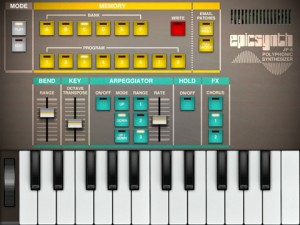
Epic Synth is a polyphonic synthesizer inspired by classic synths of the 1980s. Its beautiful and straightforward interface lets you focus on the essential: the pleasure of creating new sounds! The goal is to explore sound, not interface pages.
Epic Synth’s simple and effective sound architecture stood the test of time. It’s simple enough for beginners to learn about synthesis yet powerful enough to satisfy experienced sound modellers. Epic Synth’s sound engine provides tons of room to create great sounds, from classic leads to juicy acid basses, from 8-bit-like effects to complex evolving sonic textures.
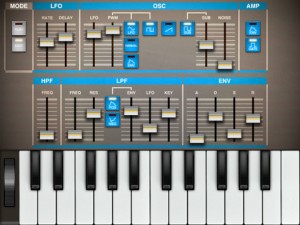
FEATURES INCLUDE
- Universal all: works on iPhone, iPod and iPad
- Takes advantage of the gorgeous Retina display on iPad and iPhone/iPod
- Classic time-tested sound architecture
- Five voices of polyphony (Six on the iPad)
- Arpeggiator with key hold
- Patch memory stores 6 banks of 8 programs
- Single patch sharing via email
- Full memory backup via email
- Pitch bend on iPad and via MIDI
Time machine: Roland Juno-106
Time for a new trip with the time machine. A voyage into the heart of the Roland Juno-106 from the year 1984.
Exploration by Marko Ettlich
1 Osc per Voice + Sub osc
6 Voice Polyphonic
LFO – 1 LFO
Filter – analog lowpass with ADSR envelope
Chorus
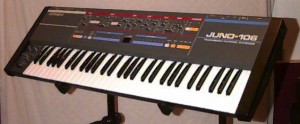
The Juno-106 is a very common and widely used analog polysynth. It continues to be one of the most popular analog synths due to its great sound and easy programmability. It was the next major incarnation of the Juno-series, following the Juno-60. While it has virtually the same synth engine as the Juno-60, the 106 added extensive MIDI control making it one of Roland’s first MIDI-equipped synthesizers. There was also increased patch memory storage, up to 128 patches instead of the 56 patches available in the Juno-60. However, the Juno-60 is often said to have a slight sonic edge over the more advanced 106. The 60 had the ability to modulate oscillator pulse from its envelope and has a “punchier” sound quality.
The Juno-106 is a six-voice polyphonic and programable analog synth with one digitally controlled oscillator (DCO) per voice. While classic monophonic synths used two or three oscillators to create a fatter sound, the Juno-106 uses built-in Chorus to fatten up its sound to dramatic effect. The nature of its DCO meant it was stable and always in perfect tune but still warm and analog. There is an excellent 24dB/oct analog lowpass filter with plenty of resonance and self-oscillating possibilities and a non-resonant highpass filter. The programable pitch/mod bender can be assigned to control the DCO pitch, VCF cutoff, and LFO amount all at once or individually.
The Juno-106 was the first MIDI equipped Juno and its implementation is quite good. There are 16 MIDI channels available and MIDI SysEx data can be transmitted/received from all the sliders and buttons for total remote control and sequencing capability. A switch on the back of the keyboard, next to the MIDI ports allows the user to switch between three types of MIDI modes: Keyboard and Hold data only; Keyboard, Hold, Bender, Patch selection data; or All data (including SysEx). Most users simply set it to MIDI Function mode 3 and forget it.
This synth is incredibly straightforward and very powerful. It’s SH-series derived panel layout is easy to understand and very hands-on. Use it to generate lush pads, filter sweeps, and funky bass lines and leads. The Juno-106 is an awesome learning tool for anyone new to analog synthesis, as well as an electronic musician’s dream for its warm analog sounds coupled with modern features like MIDI and memory – all at a very reasonable price. And still the Juno-106 has an even cheaper alter-ego in the form of the HS-60 – a hobbyist version with built-in speakers.
Roland Jupiter 4 Self Oscillating Filter and Strymon TimeLine ICE mode
Nice video featuring the first Jupiter synth from Roland.
All sounds from Jupiter 4 are produced by its self oscillating filter with VCO waveforem set to “OFF”. Modulating filter with ENV-1 and LFO and adding a little noise from time to time. Strymon TimeLine is being used in ICE mode with 1.5 octave interval.
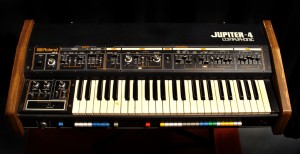
The first Jupiter synth. It was among one of the first poly synthesizers (4 individual voices which could be synced together for one fat monophonic lead), it had a pitch wheel that could be assigned to the VCA, VCF, VCO or all together, there are 8 memory locations and a cool arpeggiator – the arpeggiator can in the Duran Duran classic, “Rio”. It also has a very slow LFO for those ever-so-long filter sweeps. Pretty good for 1978!
Not so cool however, are the 10 preset sounds which sound nothing like the piano, brass or strings they claim to be. The placement of all the preset buttons below the keyboard can be inconvenient, especially while playing it. And as with most old analog synths, the Jupiter-4’s tuning can go out often. Still it is a nice analog synth for creating weird trippy analog sounds.
DATAMASKIN

