
Roland Jupiter 80 Sound Demo
Some scapes made with the Jupiter 80. It’s the first synthesizer designed completely around SuperNATURAL® sound modeling technology, delivering expressive instrumental realism far beyond anything previously possible.
Since the launch of the JUPITER-80, many professional keyboard players and producers have praised its expressive SuperNATURAL sounds and live-performance capability. With the Version 2 software update, the JUPITER-80 offers new features that enhance its synthesis power, and provides more flexibility and creativity for musicians designing their own sounds.
“In my opinion a very warm and good sounding instrument with plenty of usable sounds and a good synth engine. I tried to put almost everything to this demo, but it`s hard and this demo should have one hour :)”
Roland Juno 2 iPad controller with Arduino Ethernet demo
Demo of a custom device build around Arduino in order to control the Roland Alpha Juno 2 via Wifi.
The Arduino connects the Juno2 to the Wifi network of the iPad via an Airport router, an Arduino Ethernet shield and a midi shield.
I used Touch OSC to design the controller.
Touch OSC sends OSC messages (e.g /jun/DCO_Range 2.000) which are translated by the Arduino into Midi SysEx messages.
But the Arduino also translates Midi sysex messages from the Juno 2 into OSC messages (sort of loopback) so that when you change the patch on the Juno2, faders automatically move to the right position !
The code and detailled instructions will soon be published on http://4colors.free.fr
The control design mimics Roland PG300, but better !
YMO cover “Cue” featuring Logic System’s Hideki Matsutake
http://youtu.be/HXHUyo63nBc
シンセサイザー:松武秀樹・相沢舞・飯野賢治
【ニコ生】松武秀樹・相沢舞の『テクノスクール』
http://www.music-airport.com/techno-school/
Mai Aizawa, Kenji Iino, Hideki Matsutake: synthesizer
“Techno School” of Mai Aizawa, Hideki Matsutake Nico [raw]
We can also see Ryuichi Sakamoto’s daughter Miu do the singing 
Pure Analog with the Oberheim OBXa + Roland SH-101
Background details:
I made this track in the mid 80’s with the Oberheim OBXa on a 4-track analog tape recorder Tascam 144.
Everything was played by hand, without a sequencer or MIDI.
The remastering is made with SONAR 8.0
This piece was also featured on our national radio called BRT-2 in 1987 in a special program “maneuvers in het donker” for home made electronic synthesizer music
Star Trek Theme on eowave ribbon by Nori Ubukata
Nori Ubukata plays the star Trek Theme on the eowave Ribbon which controls a Roland 100-M, back tracks are coming from DP.
New bass synth coming to Reason 6.5 (Rack Extension)

AudioRealism has announced that it will be bringing ABL2 – a virtual Roland TB-303 – to Propellerhead Reason as a Rack Extension:
We are happy to announce our first Rack Extension for the upcoming Reason 6.5 release: ABL2 for Reason! Featuring the same 303-engine that ABL2 has. It does not contain a built-in sequencer, but works great with Reason’s Matrix Pattern Sequencer!
Disclaimer: This is a preview only, things may change for the final release.
Pricing and availability are to be announced.
Pterosaur – free synthesizer plug-in for Windows
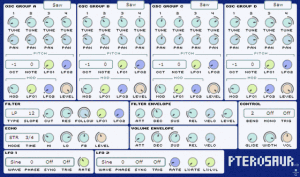
Contralogic has released an updated version of Pterosaur, a free synthesizer plug-in for Windows.
Pterosaur is a 16 oscillator synth. It’s loosely inspired by the classic Supersaw sound of the Roland JP-8000 in that the output of each oscillator can be independently detuned and panned, creating a very rich sound.
The basic waveform produced by the oscillators is a sawtooth wave which can be morphed into a sort of saw/pulse hybrid with the mod control.
Changes in Pterosaur
- Polyphonic mode added.
- More LFO shapes.
- 3 additional oscillator waveforms (sine, triangle and square), all of which can be morphed in the same way as the sawtooth wave in the original version.
Pterosaur for Windows (VST) is available to download at no cost.
Monday electro jam: Synthotronic vs Identotron
“A random jam session in Studio 101 with Synthotronic on synthesizers and Identotron on guitar.”
Equipment used: OSC OSCar, Roland SH-101, Roland SH-09, Waldorf Blofeld, Korg MS2000R, Novation Supernova II, Boss DR-770, Electro-Harmonix Memory Boy, Gretsch customised Pro Jet.
Recorded and mastered in Logic using various Logic plugins.
If you like this, check out the dark electronica musical project: http://www.dicepeople.com/
Moog Taurus 1 + Roland VP330 “Beauty & Beast”
Vintage synth demo track by RetroSound:
bass & lead sounds: Moog Taurus 1 bass pedal synthesizer (1976)
analog strings & choir sounds: Roland VP330 Vocoder Plus (1979)
drums: Roland TR-808 (1981)
recording: multi-track
fx: a little bit delay and reverb
I used in the demo the legendary BASS and TAURUS presets and some self-made sounds (reso-bass and lead sounds).
more info: http://www.retrosound.de and
http://www.facebook.com/pages/RetroSound-Marko-Ettlich/265713782347
Roland RS-202 demo
“The wonderful string chorus ensemble sound of the Roland RS-202, a classic string synth of the 1970s.”
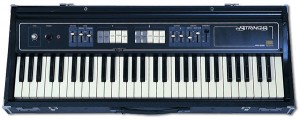
The RS-202 is a string and brass synthesizer released in 1976 that followed the lackluster RS-101. Oddly the RS-202 wasn’t much different than its 101 predecessor. The RS-202 had two new features: a user-controlled delay for the vibrato, and an Ensemble/Chorus effect (that would be seen on dozens of future Roland analog synths for years, including the Junos and Jupiters). It makes the ultimate “disco” string sound.
The RS-202 is fully polyphonic (all 61 keys can play simultaneously). Basically three sound presets are in the RS-202: Strings I, Strings II and Brass. Forget the brass, however, because this machine is all about the strings, and for a time it was considered Roland’s finest string machine. Strings I covers low cello & bass type sounds and Strings II is thinner and in the higher registers for Viola and Violin type sounds.
The keyboard is permanently split into two separate sections, the lower 2 octaves and the upper 3 octaves. Each section has it’s own set of identical controls. These include three white On/Off buttons for each of the three sound presets. This means you can assign any sound to each section, and any combination; For example, set the lower section to Strings II and set the upper section to Strings I+II+Brass if you like. There are also two grey buttons in each section for “Slow Attack” and “Volume Soft”. Each section also has its own sustain slider and there are global brilliance sliders for the brass and string sections independently.
Basic effects included the Ensemble (chorus) effect and Vibrato. A switching-slider is used to select Ensemble I, Ensemble II or Off. The Vibrato effect section had just two sliders: Delay and Speed (depth could not be changed). The Ensemble section did wonders for the sound of this machine; the ‘Ensemble II’ setting introduced a rich chorus, whereas the ‘Ensemble I’ produced the faster, deeper ensemble effect that became an instant classic. Sadly, like most vintage synthesizers the RS-202 is mono (high/low output jacks on back) and provides only a trigger output for an external synthesizer. It’s built-in to a suit-case style housing which made it easily portable.
The RS-202 is a truly vintage and classic machine. Historically, it launched Roland’s signature Ensemble effect. It also sounded fantastic – with or without the ensemble effect engaged. It easily stood up against many competing synths of its time such as the Arp Solina.
DATAMASKIN

