
Free sample pack based on the classic Roland 909
Tape Death has released Jomox XBase-09 Kicks, a free sample pack featuring sounds from the hardware drum machine.
The Jomox XBase-09 is an analog drum machine based on Roland’s 909. The difference is like the Bruce Lee and Chuck Norris fight in Way of the Dragon. They both got kicks, but at the end of the day Bruce Lee broke Chuck Norris’ fucking neck. The 909 is good, but the Jomox is better.
Our new sample pack consists of 53 samples from Hyphae’s XBase-09, created by Hyphae and Megatroid one hazy night in Hyphae’s studio. A secret weapon for years, we’re now sharing them with you cause we’re just good people. You can check out Megatroid’s new Jackie Onassis remix for a taste.

The Jomox XBase-09 Kicks pack is available as a free download (newsletter sign-up required).
Drum machine in action – Roland CR 78 Demo
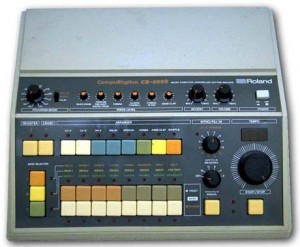
Although primitive by today’s standards, the CR-78 represented an important advance in drum machine technology at the time. The wood effect cabinet and preset rhythms of the CR-78 such as Waltz, Bossa Nova and Rhumba suggest that it was seen by its designers as primarily an accompaniment for an electric organ, but the CR-78 became one of the favorite instruments of Pop and electronic musicians in the late 1970s and early 1980s. Songs that make prominent use of the Roland CR-78 include “Heart of Glass” by Blondie, “In the Air Tonight” by Phil Collins and “Duchess” by Genesis. John Foxx expresses his love for the CR-78 in this interview.

The CR-78 used analog drum voices, which sounded very little like real percussion instruments, but they instead had their own distinctive sounds. The unit also incorporated an early Intel microprocessor to provide digital control of its functions. Previous Roland drum machines had offered only a selection of preset rhythms. The CR-78’s key new feature was that in addition to offering 34 preset rhythms, it provided four programmable memory locations for storing patterns created by the user. These could be created by using step programming with the WS-1 box, which was available as an optional extra.
The CR-78’s front panel allowed the user to customize the preset rhythms by altering the volume balance between bass and treble sounds, canceling some sounds altogether, and adding ring modulation (“metal beat”) to the cymbal sounds. Many of the preset rhythms have a memorable character, and the ability to manipulate them further made the CR-78 a versatile instrument.
No digital control of tempo was provided on the front panel, with only an analog knob for the function. However, the CR-78 would also accept an external V-trig clock, allowing a control voltage to be fed in from another device such as a music sequencer. A selection of preset fills and rhythm variations were also available, either to trigger manually, or automatically every 2, 4, 8 or 16 bars. Some of these fills were used in synth-pop songs such as “Enola Gay” by Orchestral Manoeuvres in the Dark, “Underpass” by John Foxx and “Vienna” by Ultravox.
Roland also produced a simpler drum machine, the CompuRhythm CR-68. This was essentially the same as the CR-78, but without programmable patterns or the ability to fade drum sounds in and out. At the same time Roland also sold the TR-66, a smaller unit which offered fewer preset rhythms and no programmability.
In this video:
Mostly playing around with rhythm selections (incl. A/B variations), voice cancel, tempo, automatic fills, automatic fading, etc.
Roland’s Jupiter 80 enters Europe
Roland has announced the official UK launch date for the new Jupiter 80 synthesizer – Saturday, July 30th – check out the different locations right here:

One of the most revered prefixes in the history of synthesis returns. Welcome the arrival of the JUPITER-80— a live-performance powerhouse that pays homage to its legendary namesake with road-proven hardware and massive sound, yet blasts into the future with advanced SuperNATURAL technology.
The JUPITER-80’s expressive, organic approach to synthesis makes a new world of sound design possible with multilayered SuperNATURAL textures under the control of a full-colour touchscreen and creative hands-on controllers. Experience the metamorphosis of a legend with the all-new JUPITER-80!
Roland SH-101 and CR-8000
The CR-8000 produces classic electronic drum sounds that hint back to the famous CR-78 and TR-808 drum machines. But none of these sounds are editable and there is only one mono audio output making this machine less of a studio-piece of gear and more of a collector’s item. Aside from these limitations it, like other CompuRhythms, has a series of preset patterns in many different styles as well as programmable patterns with 8 storage patches. While the CR-8000 is usually sampled for today’s applications, the thing about the CR-8000 that cannot be captured by sampling the sounds is the swing/groove feel which has its own control knob. The intervals between beats are variable, but also the timbre changes.
In this video:
Short (minimalistic) demo made only with SH-101 and CR-8000. Delay was provided by Boss DE-200. I should note that i modified my CR-8000 with individual outputs. Therefore, your CR-8000 might not sound like this, as each channel was separately EQ-ed (on a Soundcraft desk). No compression was used.
Roland on stage: Lady Gaga – Kern Brantley & Brockett Parsons Interview
Kern Brantley and Brockett Parsons talk about using Roland synths on the Lady Gaga tour.
MoonSatellite – Emergence Part I
Piece composed by MoonSatellite
Instruments : Alesis Andromeda A6 / Moog Minimoog Voyager / Taurus III / Roland SH 201 / MC 808 / Korg R3 / Akai MPC5000
EHX Flanger Hoax / Polychorus / Deluxe Electric Mistress / Deluxe Memory Boy / Stereo Cathedral Reverb / Stereo Electric Mistress / Memory Man With Azarai
Boss RE-20 Space Echo
Featured hardware:
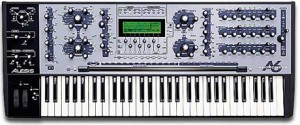
The Alesis Andromeda A6 is a 16-voice, 16-channel multitimbral analog synthesizer by Alesis which was released in 2000 and discontinued in 2010. The Andromeda A6 is a true analog synthesizer using two analog oscillators per voice, sub-oscillators, hard and soft sync and more! It features 16-voice polyphony. With the Andromeda, you’ll find a huge range of tonal possibilities: searing leads, warm pads, fat bass lines, extreme sound effects and more. And of course there are plenty of knobs (72) and buttons (144), even an assignable ribbon controller for addictive hands-on real-time control! The large high-resolution LCD display is excellent and shows you actual rather than relative values of parameters. Andromeda will integrate seamlessly into any studio with its total MIDI control and sync, individual voice outputs, stereo outputs and several audio inputs.
Andromeda is completely analog – no emulation! It features two analog filters per voice that sound great! They are a multimode 2-pole and a 4-pole lowpass. External audio can be routed through these filters too (three 1/4″ jacks)! As for modulation, Andromeda has three LFOs, each with six waveforms and they can be synced to MIDI clock. And there are three 7-stage envelopes with very creative and flexible functions. Also onboard is an extensive mod matrix for enormous freedom in configuring Andromeda’s sounds!
No analog synth would be complete without a set of classic effects and features. Andromeda also offers Portamento with nine slopes and legato functions. A built-in arpeggiator and analog-style sequencer are available, with MIDI sync! There are also some high quality digital effects such as reverbs, chorus, echo, distortion and more! Andromeda comes with 256 breathtaking preset patches plus 128 user. A PCMCIA-format memory card slot allows for additional programs and mixes.
All you can eat synths – live studio performance by Bruno Ender Lee
VELVET VOYAGE – “Music Of The Spheres” – Performed live by Bruno Ender Lee, July 10. 2011
ARP Odyssey (& Doepfer MAQ-Sequencer), MacBeth M5N (Bass), Synthesizers.com Studio-88 (Leads & FX), Moog Little Phatty & Absynth 4 (Leads), Roland Juno-60 (Wind-FX), Roland D-70 & Korg MS2000 (Pads), Moog Etherwave Theremin
Featuring the Roland MKS 30 + PG 200
Short track with the Roland MKS 30 Planet S. All sounds made with the MKS 30. Multitrack recording + external FX.
The MKS-30 Planet S is commonly referred to as a rackmount JX-3P, although it really shares its heritage with the GR-700 guitar synth. The MKS-30 has several advantages over the JX-3P, including simultaneous use of the PG-200 programmer and MIDI, a cartridge slot for storing an additional 64 patches, and velocity response.
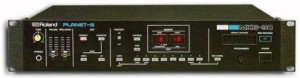
The voice architecure is identical to the JX-3P. The two digitally clocked oscillators use a master clock which is divided by an even integer to achieve the desired pitch. This method never allows the oscillators to produce a pure pitch across the entire range, and is probably accountable for the MKS-30’s somewhat cold sound. The two oscs can be synced together or cross modulated using the METAL setting. I’m not sure what actual process is used, but it definitely sounds metallic. The filter module is the same one featured in the Juno 106, and has both a resonant low pass filter and a variable nonresonant high pass filter. Only one shared envelope is available for VCA and VCF. The LFO provides sine, square, and sample and hold waveforms, and has variable rate and delay.
The PG-200 is the dedicated programmer interface for the MKS-30, JX-3P, and GR-700. The programmer communicates with and is powered by the synth via a 6 pin DIN cable. The PG-200 provides knobs and switches for all parameters such as DCO, VCA, VCF, envelope, and LFO. Unlike the JX-3P, the programmer and MIDI can be used simultaneously with the MKS-30.
How the EMS AKS handles audio through the Hi Input channels
Quick and Dirty patch featuring the EliKing Light sensitive delay soda-POP can and a mildly modded TR-606 drum machine with individual outs.
Wanted to see how the EMS AKS handles audio through the Hi Input channels.
TR 606 outputs:
Snare massaged then to Roland RE-201 Space Echo.
Hihats to EliKing Light sensitive delay soda-POP can.
HiTom Trigger out to AKS #1 (Hi Input Ch.2)
Headphone out to AKS #2 (Hi Input Ch.2)
Main output to AKS #1 (Hi Input Ch.1)
Steiner-Crumar Masters Touch breath controlled resonant analog filter and CV controller puts out voltage from breath, bite and touch. Sooo much fun had the Breath Transducer going out to AKS #2 (Hi Input Ch.1).Only stinky breath is used in this vid!!! No bite or touch.
AKS #2s Signal Output goes into the wet and juicy Crumar filter.
Roland System 100 study
Roland System 100 doing a Buchla impersonation (in the style of Douglas Leedy, Michael Czajkowski, Morton Subotnick). Random voltages are being produced by the Doepfer A118 Random Voltage module and shaped by an A140 ADSR, then fed into the System 100 oscillators and filters.
Shared by mrmdshaw
DATAMASKIN

