
Trans Computer Maschine – freee semi-modular synth
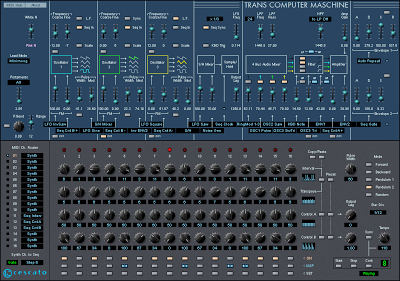
Cescato Musiktechnologie has released version 1.30 of Trans Computer
Maschine plug-in for Windows, a freeware Semi-modular Vintage Lead
Synthesizer + Pattern Sequencer modeled after two legendary mono
synths and a custom analog sequencer from Germany.
New features include:
– Added ‘Envelopes’ gate input indicators.
– Added ‘Filter Cutoff Link’ switch for band-pass use.
– Added ‘Filter’ modulation indicators.
– Added ‘inverted Seq Cnt’ modulation sources.
– Added labels to Sequencer ‘Skip’ buttons.
– Added middle position ‘Preset’ for Sequencer interval row.
– Added ‘MIDI Ch. Router’. input indicators.
– Added mixer ‘Oscillators Waveform’ selection from GUI images.
– Improved Sequencer transport section featuring status display.
http://www.freewebs.com/wallyaudio/index.htm
Expanders for Turing Machine Random Looping Sequencer
Two DIY expander modules for the RLS from Music Thing Modular. Pulses produces seven pulse outputs, related to the master clock and controlled by the main module. Voltages (with the faders) is an eight step sequencer where multiple steps can be active at once, creating very unpredictable patterns.
Patch details:
One pulse output is pulsing the white noise from the RLS module through a QMMG low pass gate, creating the kick drum sound at the start.
The two outputs (normal and inverted) from the voltages module are going into a A156 quantizer, then into two sizes of a DPO oscillator. Each time the note changes, the sine wave outputs are gated through the QMMG.
One more output from the pulse module is triggering the FM bus on the DPO, causing the bleeps and bloops.
Sequencing 4 voices out of the CZ101 using Genome
A bit of experimentation with the CZ101 using Genome to access 4 voices in mono.
Sequential 2.0 – new version of Sinevibes multi-effect sequencer
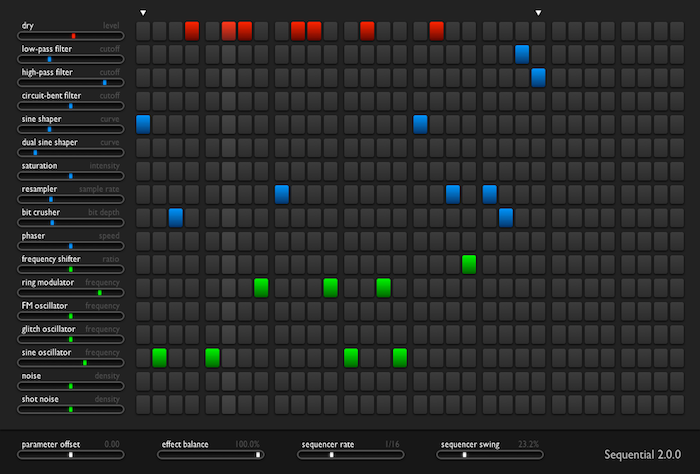
Sinevibes today announced version 2.0 of Sequential, its multi-effect sequencer for OS X.
Sequential features a wide variety of algorithms designed to filter, distort and even synthesise sound. You can ‘add subtle spice or completely warp everything’.
Here’s what’s new in Sequential 2.0:
- Completely new user interface.
- Effect dry/wet balance control.
- Faster and smoother effect switching algorithm.
- Two new effects: phaser and frequency shifter.
- Fixed ring modulator effect losing quality after some time.
- Fixed synchronisation issue when host transport location is a negative number.
- Added required Audio Unit format changes for OS X 10.7 and 10.8.
- Removed support for Power PC processors and OS X 10.5.
- New preset patches.
Sequential works with Logic, GarageBand, Live, MainStage, Maschine, Studio One, ReNoise, Reaper, Bidule and other software that supports Audio Unit effect plugins. It comes in 32/64 bit format for Intel Macs running OS X 10.6 or later, and supports Retina screen resolution.
Sequential 2.0 is available for OS X for US $39.
Sequence – First Look of new MIDI sequencer app for iPhone
Sequence is a new euclidean MIDI sequencer for iPhone // Launching 04 March 2013
The circular patterns of notes in Sequence are generated by an algorithm created by Eric Bjorklund. Originally developed for timing sequences on spallation neutron source accelerators, the musical potential of the algorithm was first recognized by Godfried Toussaint, a researcher interested in musical geometry at McGill University.
The algorithm finds the most ideal temporal distribution of pulses given a number of steps, giving a recognizable performance of western and African rhythms when input with odd and even pulses and steps. In summary, it makes great polyrhythmic techno.
Sequence 1.0 features a collection of about 30 samples for your techno pleasure. The app also sports MIDI output to pipe to your favorite iOS sampler, DAW, or hardware device.
On the roadmap for version 2.0, we’d like to introduce Audiobus support, functions for recording sessions, and the ability to import your own samples. We’ll also probably add OSC and support the iPhone 5 screen.
Minimoog and Sequentix P3 sequencer improvisation
The P3 Sequencer is an 8 track, hardware MIDI sequencer, with a user interface comprised of knobs, keys and LEDs. A sixteen character by two line PLED display provides confirmation of pattern data and access to advanced features and configuration options.
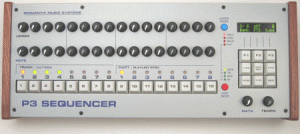
P3 allows real-time control of track mutes and simple pattern or pattern chain selection across multiple tracks, plus analogue-style editing of patterns. Each of its 384 patterns has independent values for note, velocity, tie, gate, length, gate delay, and a combination of up to four MIDI controllers, extra notes, or ‘auxiliary events’, per step.
P3’s unique auxiliary events allow the creation of dynamically self-modifying patterns. They can grab values from other tracks, randomise steps, alter track and global settings, and much more. There are three modulation ‘accumulators’ per track, that can be used as LFOs, perform arpeggiation effects or enable complex pattern progressions.
Furthermore, you can assign front panel knobs to modify or mask these events in real-time, allowing you to create interactive patterns that change predictably as you adjust the knobs – varying in complexity, controlling levels of randomness, even ‘morphing’ from one pattern to another.
A Force-to-scale option provides preset and user-defined scales to keep everything in key (but defeat-able per pattern step if required), and a configurable ‘change mode’ allows patterns with different lengths and/or time-bases to free-run, or be synced to a global bar.
Moog MF 104M & Dual Q960 Sequencer
Two Q960 Step Sequencers are controlled from the same clock source (courtesy of Q962 Sequential Switch…); row A drives oscillator pitch, row B drives MF-104M Delay Time for wild analog delay effects. Audio straight from camera (sorry…), Mario Bianco is playing the Feedback Amount.
New Delptronics Trigger Sequencer Preview
This is a preview of the new trigger sequencer eurorack module from Delptronics which debuted at NAMM 2013.
It is a very compact 8 HP wide. There are 8 trigger outputs and each pattern consists of 8 steps per output. It has 8 pattern memories, which can be played back in any order and combined into chains of up to 100 steps. The revolutionary pattern editing interface enables you to create any pattern with just two knobs.
For more information, or to be notified when the new module is for sale, go to http://delptronics.com
Cubasis video tutorials
In this video tutorials Steinberg shows you how to use Cubasis.
Cubasis is Steinberg’s streamlined, multitouch sequencer for the iPad. Specially designed for quick and easy operation, Cubasis makes recording, editing and mixing a breeze. You can also open your Cubasis projects in Cubase under Windows and OS X! Cubasis places touch-intuitive production tools in your hands, opening up a new world of possibilities for your creativity.
Key features:
- Unlimited audio and MIDI tracks (depending on the device used)
- Over 70 virtual instrument sounds based on HALion Sonic
- Mixer with over 10 effect processors (insert and send effects)
- Over 300 MIDI and audio loops
- Virtual keyboard and virtual drum pads
- Sample Editor and Key Editor
- Export to Cubase, Dropbox, SoundCloud, AudioCopy & email
- Core Audio and Core MIDI compatible hardware supported
- Sequence other Core MIDI apps (MIDI recording only) and run Cubasis simultaneously via background audio
- Import audio from your iTunes music library or using iTunes filesharing, use AudioPaste or set up a Wi-Fi server in Cubasis
Roland MC-202 Vintage Synthesizer Overview
This is an analog synthesizer/sequencer. It sounds very much like the TB-303 and SH-101 bass synths. Sometimes considered the “poor man’s 303”. It has a very evolved form of TB-303 like programming (more like the MC-4) and SH-101 like controls of the VCO, VCF, VCA, LFO, Envelope and Mixer sections. The LCD display is a great feature too.
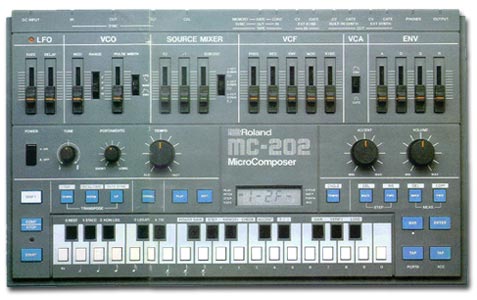
The MC-202 was sort of a next-generation TB-303. So the idea was to program sequence/patterns into it internally which would give you those 303 basslines that we’ve come to love. But programming the MC-202 is a bit too intense and over done for the simple monophonic bass line. However you can control it externally by hooking up a MID-CV/Gate converter. Then you basically have yourself an SH-101!
The sequencer is actually a 2-channel CV/gate sequencer, with both channels being capable of driving a separate external synth. It’s a very useful unit, also, for its DINsync capabilities; it can receive on one port, and send over two, and also can ‘split’ DINsync to branch a sync signal out to multiple devices.
DATAMASKIN

