
For all virtual Moog-fans out there
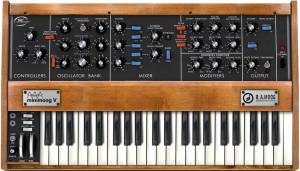
Arturia has released version 2.0 of Minimoog V, a virtual Minimoog synthesizer instrument for Windows and Mac.
| Retromatic
by Larry Hopkins |
Track made using the Minimoog V and the ARP 2600 V. |
| 5 blips house
by Fabrice Gabriel |
11 Minimoog V instances were used in this demo song. Many thanks to the author, Fabrice Gabriel. |
| Elektro side of the minimoog V
by Jean-Michel Blanchet |
12 minimoog V tracks in Cubase SX. No additional samples were used. All the sounds used in this piece are available in a preset bank of the minimoog V plug-in. Many thanks to the author, Jean-Michel Blanchet. |

MAIN FEATURES
- All the parameters of the original minimoog V
- Advanced automation mode ( Minimoog V 2.0 Only )
- Revolutionary preset navigation system called the SoundMap (Minimoog V 2.0 Only )
- New formant-analysis-based FX called the Vocal Filter (Minimoog V 2.0 Only )
- New modulation matrix with up to 6 connections (12 sources and 32 destinations)
- New arpeggiator
- New LFO
- New Chorus and Stereo Delay Effect section
- More than 500 presets created by talented artists and sound designers
- Up to 32 voices of polyphony, and a Unison mode
- 3 voltage controlled oscillators with 5 waveforms
- 1 amazingly sounding 24 dB/octave filter
- 1 VCA
- 1 Mixer
- 1 Noise Generator
- 2 ADSR envelopes
- 1 external audio input and 1 external oscillator and filter modulation input
- Soft clipping function
- No aliasing from 0.1 Hz to 20 kHz
- 64-bit floating point precision
- Sampling rate: up to 96 kHz
Tune in your favorite robo-sounds
[youtube=http://www.youtube.com/watch?v=Qnj2oU8MYCI]
The Voice Box packs a multi-functional vocal synth processor into a tough and compact chassis. Sing, and you’ll have a troupe of backup singers following you in perfect harmony. Or use the built-in vocoder to unleash classic synth-robot sounds.

About:
The Voice Box packs a multi-functional vocal synth processor into a tough and compact chassis. Sing, and you’ll have a troupe of backup singers following you in perfect harmony. Or use the built-in vocoder to unleash classic synth-robot sounds.
Diana Ross had the Supremes, Brian Wilson had the Beach Boys, Kraftwerk had The Robots. You have the Voice Box.
The harmony processor creates 2- to 4-part harmonies directly from your vocals, in the same key as your accompanying instrument. Studio-quality reverb lets you independently add depth to your dry and harmony vocals.
The focused 256-band articulate vocoder, designed by the same EMS genius who made vocoding famous, features adjustable harmonic enhancement and controllable formant shift.
Plug in your mic and your instrument, and let your new voice — or voices — be heard!
Swamped by new synths?
Are you like me starting to feel a bit swamped by all these virtual synths? Every week a new synth is released and very few are mind-boggling to say the least, but I think this one might be on the right track since it has put focus on alias-free oscillators. Make sure to check it out and btw it’s free 

Togu Audio Line has just released TAL-Elek7ro, a new free virtual analog synth with some special features like oscillator hard-sync and frequency modulation. It features alias-free oscillators, newly developed fast envelopes and LFOs with a wide range from 0.1Hz up to 400 Hz. A free routable envelope with attack and decay is available too. This synth is useful for a wide range of sounds from percussion to deep bass sounds.
Features :
– 2 oscillators with hard-sync, PW and FM (saw, pulse, triangle, sine).
– 1 sub oscillator (saw, rectangle).
– 1 noise oscillator.
– 18dB or 12dB non linear analog modelled low pass resonance filter.
– Mono mode, including portamento.
– Poly mode, up to 6 voices (not CPU optimized for poly mode).
– 2 free routable LFOs (0.1Hz – 400Hz, sine, triangle, saw, rectangle, s&h, noise).
– Filter and amplifier ADSR-envelope.
– Free routable AD-envelope.
– Mod-wheel and Pitch-Wheel support.
– MIDI Learn for all pots.
– Velocity to filter contour intensity.
– Panic button.
– Tutorial and installation guide.
– Factory presets.
Studio One may change the rules of the game
Introducing Studio One – The Future of Music Production is Here. a groundbreaking music creation and production application for Mac OS X and Windows XP/Vista that makes audio recording, MIDI sequencing, and audio mastering ridiculously simple right out of the box, yet provides a wealth of professional features.
Fresh code, innovative drag-and-drop MIDI mapping and plug-in management, auto-configuration with PreSonus hardware, insanely good audio, unlimited tracks and plug-ins per track, and a powerful, inventive Start page that literally puts the whole project right in your hands are just a few of the compelling features that make Studio One the next generation in audio software. Far from just another music-production program, Studio One changes the rules of the game, giving you a complete solution from raw tracks to finished master, while supporting the latest standards and technologies.
Studio One is based on a cutting-edge audio engine that delivers unparalleled sound and automatically switches between 32-bit and 64-bit floating-point processing on the fly (even with a 32-bit OS), ensuring the highest quality audio at all times. It is compatible with any ASIO-, Windows Audio-, or CoreAudio-compliant audio interface, including, of course, the entire line of PreSonus interfaces.
[youtube=http://www.youtube.com/watch?v=nIxV-BsqdyY]
Features:
- Elegant single-window work environment
- Powerful drag-and-drop functionality
- Unlimited audio tracks, MIDI tracks, virtual instruments, buses, and FX channels
- Content browser with convenient sort options and preview player
- Integrated mastering solution with automatic mix updating, waveform editing, effects, Red Book CD burning, and digital release
- Automatic delay compensation
- Advanced automation
- 64-bit processing (even on 32-bit machines)
- Easy-to-use sidechain routing
- Awe-inspiring 64-bit effects suite
- Stunning virtual instruments
- User-friendly sampler
- Most intuitive MIDI-mapping system available
- Real-time audio timestretching and resampling
- AU, VST2, VST3, and ReWire support
- K System metering
- Gigabytes of inspiring content
- Compatible with any ASIO-, Windows Audio-,or Core Audio-compliant audio interface
Soon we will know if Trillian is better than Trilogy

Spectrasonics announced and previewed their brand new virtual instrument Trilian, the long awaited successor to their award winning Trilogy bass module.
The recording for Trilian is now complete and, according to Spectrasonics’ Creative Director, Eric Persing, the quality and expression of the new sounds they’ve captured is even better than they had originally planned!
Spectrasonics have also added some new features to the software, which will make a big difference for the end users and, as such, a little more editing and testing time than originally expected is needed to complete the release.
It now has been confirmed that the official release date for Trilian will be *29th June 2009*.
For more information about Trilian please visit: http://www.timespace.com/trilian/
About:
The new instrument has a much larger core library and features highly detailed new acoustic, electric and synth basses – as well as enhanced versions of the classic Trilogy sounds. Sporting a brand new user-friendly interface with numerous software innovations. Trilian is the first 64-bit native software based on Spectrasonics´ STEAM engine and is the first virtual instrument to feature full library integration with the company´s flagship Omnisphere synthesizer.
Cheers Ola
A closer look on the JOMOX Sunsyn
[youtube=http://www.youtube.com/watch?v=Jj-hqEiIjX4]
Jomox Sunsyn, an analog machine made for sound designers. This is probably the most organic sounding newer synth, it can be raw, but also very smooth. It is not emulation of any historic synth and has own unique character. I can imagine that production of such quality instrument is just to expensive.
I would put it to top 5 of ever produced synths sonically. without effects it sound extremely rich, full and cutting through. Presets don’t represent capability of this beast.
Under the hood of Arturia Origin Sonic LAB
A great overview of the Arturia Origin that goes into very good detail.
And what great sounds it can provide, just watch the video, well that is if you like electro bass/trance sounds of course
[youtube=http://www.youtube.com/watch?v=IVj0Kah7bas&eurl]
However, do remember this if you lift the lid on this beast you will soon realize that this is NOT a hardware synthesizer it is a computer softsynth disguised as a hardware synth. But even if we have a PC synth trying to be an analogue beast the fun bit is building new patches – dive deep in to that really nice vintage toolkit. You control the whole process through one one those big encoders with a push switch. I also like the little design features such as the Yamaha filters look like knobs on a CS80.
In essence The Origin is a wonderful thing but it is too digital for an analog fetishist and too analog for a sound experimentalist.
Having a hard time getting your friends to understand what you do?
Whether it be your kids, friends or dates in the pub one often run into the problem of describing what the heck you do when you’re in the studio playing around with your Prophet 5, Oscillators, plug-ins, mixer boards etc, than this little video might come in handy, LOL. It features the veteran sound designer and synth nerd Suzanne Ciani explaining sound, synthesis and music on 80’s childrens TV show ‘3-2-1 Contact’.
Well even you and I might learn something
[youtube=http://www.youtube.com/watch?v=B_tjcshEurc&eurl]
Cheers, even though it is Mondayyyyy, shit four more days before another great weekend
It's not just about paint in the AB-synth
Continuing from yesterday’s focus on weird stuff, for those who didn’t visit the blog yesterday check out the release of the Erectifier, here’s another one. See what you can make of this:
the AB-Synth combines a dual-stage cascading fuzz gain circuit (copped from the Algal Bloom fuzz) with an oscillation mode and an octave down control. What this yields is a pedal that can do Jimi-style super-saturation to stable synth-like bass tones to utterly out-of-control pulsing white noise to everything in between.
Controls include Gain, Level and Texture (from “blistering” to “splattery”). A toggle switch engages “Oscialltion Mode” which adds the “Trip” control for oscillation frequency. Oscialltion Mode turns the insane fuzz into and insane synth fuzz pedal.
Crystal clear isn’t it? Well I will give you some more food for thought – check out the video below of the AB-synth in action:
[youtube=http://www.youtube.com/watch?v=QSmIyEGMcx8&eurl]
Still interested than go here >>
Creating cool sounds on the microKORG
As most of you probably already know I am big fan of KORG and therefore when I saw this on Youtube I just had to make a mirror of it here on my blog, enjoy!
[youtube=http://www.youtube.com/watch?v=jgleogs_ll4&eurl]
Here’s what the authour has to say about it:
“This is my first attempt at creating a program for the microkorg, so I picked up a sound that is easily recognizable. This is certainly not the best Synthex “laser harp” sound recreation around, but it should provide a good start for tweaks and improvements. The idea should work with any two-oscillator analog or analog-modeled synthesizer with oscillator sync, filtering and some kind of pitch envelope for the sync sweep. Actual values used in each parameter are shown in parentheses.”
And here is JM Jarre’s take on it:
[youtube=http://www.youtube.com/watch?v=jAxjzFnEe78&eurl]
DATAMASKIN

