
OP-X PRO-II vs. Oberheim OB-X
A very nice test of the real thing verus the digital version, and below you can read all about it:
http://www.sonicprojects.ch/opxpro2/description.html
A dry 1:1 comparison of the SonicProjects OP-X PRO-II virtual Oberheim VSTi software synth to an Oberheim OB-X Rev.2.
The lower manual in the video is an USB midi master keyboard (an Emu Xboard 61) which drives OP-X PRO-II hosted in Steinberg Cubase 5. No effects or any other treatments were involved, both OB-X and OP-X PRO-II were recorded directly to disk, OB-X over the line inputs of an RME HDSP 9632 which has very neutral sounding converters.
The exact detunings (deviating filter settings, warm up pitch drift, etc.) and the individual pan settings of the voices of OB-X have been copied in every detail before with the voice based tuning features of OP-X PRO-II for a perfect match to the real synth.
To copy the bright sound OP-X PRO-II uses the BRL (brilliant) filter setting (DMP button, second button above voice mutes) which is dedicated to copy the sound character of the early OB-X and allows the filter to open into the ultra sound area and adds some extra shine in the heights.
The used patches can be downloaded here:
http://www.sonicprojects.ch/opxpro2/userarea.html#Newest
The patches as used in the video:
00:02 Preset 04 B3 – Slow Upsweep
02:05 Preset 03 D8 – Resonance Pad
08:01 Preset 05 D2 – Sync Unison
08:26 Preset 01 D4 – Soft Brass
09:53 Preset 06 D6 – Soft Strings
10:44 Preset 02 C7 – Fullanalog Strings
The letter number combinations are the physical memory locations of the patches in the used original synth which were copied with OP-X PRO-II for the comparison.
Since all the original’s exact voice detunings have been copied in every detail too the patches sound almost 100% identical to the ones in the used device, which gives you the opportunity to have its unique characteristic sound at home too!
Some words about the OB-X:
The Oberheim OB-X was Oberheim’s first fully programmable polyphonic synth and is the direct follower to the SEM based 4/6/8-Voice models. Other than the later OB series models (OB-Xa, OB-8) the OB-X still uses the discrete wirings of the SEM for the oscillators and filters and only uses curtis chips for the envelopes.
This gives the synth a very bright and open sound, quite different from its followers OB-Xa and OB-8 which are fully curtis chip based and sound a bit darker and more behaved. The OB-X is the “enfant terrible” of the OB series.
Here’s some very useful info:
http://www.sonicstate.com/synth/oberheim_ob-x/
The featured OB-X is a six voice model (maximum was 8) and it has a lot of detunings going on because of all the wirings and dicreete voltage controlled components which gives the synth a very lively and organic sound.
The voices could be calibrated for a more “perfect” and even sound, but they were left as they are since it simply sounds more exciting like that, featuring some of the magic of the old SEM based 4/6/8-Voice where the never exactly even sounding voices (since they had to be programmed one by one manually) were part of the whole experience, and were the main inspirator for the Separate Voice Design (SVD) engine in OP-X PRO-II which allows to calibrate the voices for an individual sound too.
ARTURIA – Introducing Wurlitzer V
The Wurlitzer V is a high end software recreation of the classic Wurlitzer 200A electric piano.
Unlike sample libraries, its physical modeling engine reproduces the very acoustic properties of reeds, key action and amplification, bringing you high realism while offering maximum flexibility on sound.
As most producers know, the legendary bright and overdriven Wurlitzer sound heard on classic records also comes from the use of fine amplifiers, micing and processing. This is why the Wurlitzer V goes further by putting you in command of a studio from the 70’s, filled with vintage stompboxes and classic tube amps… everything you need to get a true classic vibe!
If you are looking for a lively electric piano combined with inspiring studio tools, the Wurlitzer V is the ultimate package.
More details here : http://www.arturia.com/evolution/en/products/wurlitzer-v

One of the most cult proclaimed keyboard instruments in the history of music is the Wurlitzer Electric Piano. With its rough and phat sound, the Wurlitzer has left an immense mark on several classic recordings with a variety of performers such as Ray Charles, Steely Dan, the Doors, Sun Ra and Queen just to mention a few.
The Wurlitzer’s basic principles were developed in America in the middle of the 1930s by a man named Ben F. Meissner (b. 1890). In 1932 he patent and licensed several new revolutionary electrical ideas e.g. several TV-components, electron pipes and the Wurlitzer principles (the string less piano). Meissner came up with the idea to place electromagnetic pickups on each string inside an ordinary acoustic piano. In order to achieve a more powerful tone he added reeds inside the piano which he blew air into. His concept caused great interest from different piano manufactures around the country, and his ideas were sold to the Everett Piano Company who came to develop his original ideas. They started to work on the concept but what from the start was supposed to be an electric form of a piano, instead became a more electric organ under the supervising of the Everett Piano Company. But the idea had now reached the big jukebox and organ company, Wurlitzer who realized that the invention had a far greater potential. They took over the development of the piano and instead tried to come up with a electric version of a piano more similar to the Rhodes, than to an organ. To achieve their goals they designed a felt dressed hammer which was placed in the piano in order to stroke the metallic reeds. The vibrations from the stroke on the reeds produced a big fat and rich tone, which was picked up by a pickup system converting the tone into electric energy and leading the tone out of the built in speakers on the front of the piano. The Wurlitzer Electric Piano was born.
The Wurlitzer was in some ways relatively similar to the Rhodes regarding it’s construction and it’s design, but it was also in many ways different. The Wurlitzer was a lot lighter than the Rhodes (who weights at least twice as much) and therefore a lot easier to transport and to carry on the road. It also had built-in speakers with a separate monitor speaker, and a built-in tremolo which early Stage models of the Rhodes did not have.
Wurlitzer released their first electric piano in the beginning of the 1950s. The piano received great attention from the branch organizations and in 1956 the first Wurlitzer album was made by Sun Ra and Demons at Play. Another contributing fact which helped launch the piano was Ray Charles elegant Wurlitzer playing on his huge hit “What I’d Say” from 1959 which gave the Wurlitzer increasing attention. The most famous models are the Wurlitzer 100 and its improved version, the Wurlitzer 200 which replaced the 100 in 1969. The Wurlitzer quickly reached great successes, in particular during the 1960s and the 70s. The piano quickly became popular among touring bands who found it to be a lot lighter than the Rhodes and that the Wurlitzer’s sound more easily could fit into a guitar based band than a Rhodes. The Wurlitzer proved to be useful in more pop and rock oriented music were the Wurlitzer’s thicker and rougher tone easily could be used as a replacement to the guitar. As the popularity of the Wurlitzer grew, keyboardists seemed to become more and more divided into two camps, Rhodes or Wurlitzer. The Wurlitzer however, do work very well in soul/funk music as well as in pop and rock. A great example of that is the soul and funk music of legendary Donny Hathaway, who easily fits the Wurlitzer into his music.
Today it is quite hard to get a hold of a Wurlitzer in good condition. They are sadly not the most frequently used keyboard instrument in the music industry and are quite rare these days. However, if you are not into to much rush, got a fat wallet, and are a bit lucky there are some for sale.
Skanner XT – unique and highly distinctive virtual instrument
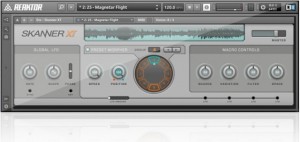
Native Instruments today introduced Skanner XT, a ‘unique and highly distinctive’ virtual instrument, designed by the team behind Reaktor:
With a strong focus on unconventional tone and genuine musical expression, SKANNER XT is both an exceptional library addition for REAKTOR 5 users as well as an excellent sound resource for the free REAKTOR 5 PLAYER. Part sampler, part synth, SKANNER XT utilizes a unique synthesizer architecture to create a wide variety of intense and cutting-edge sounds for contemporary electronic music production and sound design. Two oscillators ‘scan’ a sample, which at low frequencies deliver a scratch sound.
At higher frequencies the oscillators, shaped by the sample waveform, become the dominant force. In this way, Skanner XT provides a broad range of highly distinctive sounds – from heavy and dirty bass tones to morphing soundscapes and organic pads.
About Skanner XT
Developed together with NI synthmeister Stephan Schmitt, Skanner XT offers two interface views for different levels of interaction with the complex architecture under the hood. Besides a simplified page with a preset morpher and four macro controls, a second view provides access to more detailed parameters in order to further explore the sonic potential of the instrument. A morph control option allows for convenient switching between eight different snapshots – producing unpredictable, evolving sounds that range from the ethereal to the extreme.
Skanner XT is available at the NI Online Shop for $59 / 49 EUR. See the NI site for details.
Arturia’s SPARK is here – 30 legendary drum machines in one go
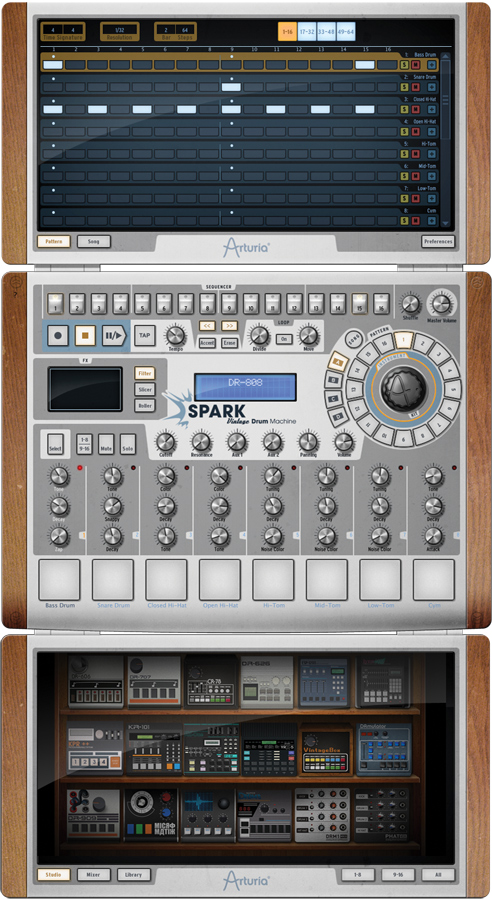
Arturia announces availability of its newly-developed SPARK Vintage Drum Machines (Standalone, VST 2.4 & 3 — 32-bit and 64-bit, RTAS and US — 32- and 64-bit) software instrument, placing 30 legendary drum machines at discerning musicians’ rhythmic fingertips!
As intuitive as it is powerful, SPARK Vintage Drum Machines represents so much more than typical sample players currently on the market; by mixing high-quality samples and virtual analogue synthesis based on Arturia’s advanced propriety TAE® (True Analog Emulation) technology, this software successfully captures the unique electronic musical soul of the 30 different drum machines it emulates: Roland’s CR-78, TR-808, and TR-606; Korg’s Mini Pops 7 and KPR-77; Ace Tone’s Rhythm Ace FR-2L; Yamaha’s MR10; Maestro’s Rhythm King MRK2; Boss’ DR-55; Casio’s VL- Tone and SK-1; Simmons’ SDS; Phatwerk; and Micromatix all get the TAE® treatment, while E-mu’s Drumulator and SP-12; Roland’s TR-909, TR-606, TR-707, TR-727, TR-626, and R8; Oberheim’s DMX; Sequential Circuits’ DrumTraks; Kawai’s R-100; Casio’s RZ-1; Yamaha’s RX5; the LinnDrum; Linn 9000; Pulsator; and Dirty-909 are all sample-based and/or physical modelling hybrids.
- 30 legendary drum machines including: Roland TR-808, TR-707, TR-909, CR-78, Korg KPR-77, Mini Pops 7, LinnDrum, Yamaha RX5, Maestro Rhythm King MKII, Simmons SDS V,…
- Easy workflow: one interface to learn, thirty drum machines to play
- Made for live performance: XY Pad, Beat Looper, Slicer, Real-time automation on all parameters
- 14 high quality effects : Multiband Compressor, Reverb, Bit crusher, Multiband EQ, Chorus, Delay, Distortion, Phaser, Plate reverb, Destroyer, Flanger, Space pan, Limiter, Sub generator
- Spark’s Step Sequencer makes track creation a breeze
- Perfect integration: 16 independant audio outputs, midi I/O
- Unparalleled sound quality based on virtual analog synthesis (TAE®) and high resolution sampling
- More than 1300 pre-programmed patterns
Mark Mosher improvisation on the Saurus virtual synth
My Colorado based electronic music friend Mark Mosher, sent me this nice improvisation that he has made on the Tone2 Saurus synth:
“It’s gorgeous. Checkout this improv vid I made with Saurus. http://www.youtube.com/watch?v=-scMPERoIlQ”
About the video:
This is single patch improvisation recorded in one pass with no edits using Tone2’s virtual Synthesizer Saurus. A single instance of Saurus is used with no other effects or editing other than what is built-into the synth. I’m starting with a factory patch in the “Lead” bank called “1970s Soloist H”. I only touch the computer once during the performance in the middle to turn up the gain in the mod matrix so that LFO modulates pitch.
Prior to recording I mapped all sorts of parameters to my Novation Remote SL MK II Keyboard.
– XY map to Filter and Rez
– Bank 1 of the top 8 knobs are mapped to filter parameters and OSC Balance
– Bank 2 of top 8 knobs are mapped to effects parameters
– Bottom row 8 knobs are MIDI mapped to Oscillator noise type AM/FM, LFO Speed, Glide rate
– The first 4 sliders map to the volume ADSR
– The next 4 sliders map to filter ADSR
I used my projector to paint my wall with Saurus to the knob movement you see on the wall is in real-time and corresponds to my controller movement.
Mark Mosher
Electronic Music Artist, Boulder CO
Synthesist, Composer, Performer
http://www.MarkMosherMusic.com
From our original post on the Saurus:
Tone2 has released a new software synthesizer for Mac & Windows, Saurus.
According to Tone2, Saurus is ‘not just another synthesizer with character, but one that truly represents the analog sound.’
Here’s what they have to say about it:
We carefully measured and modeled the circuits of many classic performance synthesizers, including even single capacitors and resistors to provide an extremely accurate analog model, faithfully capturing the spirit and character of these old machines. All without placing heavy demands on your CPU or budget.
Highlights:
- True Analog Modelling Technology
- High-end sound quality
- Low CPU and high reliability
- Easy-to-use interface
- ‘Unique sounds which no other synthesizer can create’
- Huge sonic range
- Flexibility, expandability
- Ships with 563 presets from 21 sound designers
Features:
- Covers all important aspects of traditional analog synths
- Mono, Legato & Polyphonic modes employing analog voice management
- Two Syncable Oscillators and two Sub Oscillators
- Not just standard waveforms but also a large number of exotic ones
- Pulse Width Modulation and Oscillator Sync applicable to every waveform
- Oscillator Drift, Phase and Noise Modulation controls
- Noise FM, AM and Ring Modulation for Oscillators
- Analog filter with self-oscillation, nonlinearity, 6 filter types, FM and feedback
- LFOs and modulation capable of running at audio-rate
- Arpeggiator with extensive configuration possibilities
- Flexible Modulation Matrix with new features, including a filter
- Programmable gate
- 4x Stereo Unison modes with spread and panning control
- Analog modeled Distortion and Tube amp
- Optional Psycho-Acoustic processing
- High-end quality Effects
Tone2 Saurus is available now for US $119. See the Tone2 site for details, audio samples and a demo version.
u-he DIVA Virtual Analog Synthesizer
Urs Heckman discusses his new synth at MusikMesse. This virtual instrument incorporates multiple elements from vintage analog synths. It draws a lot of CPU, but it sounds really good – the video tells how to get a free trial version.
Saurus – new soft synth with true analog sounds
Tone2 has released a new software synthesizer for Mac & Windows, Saurus.
According to Tone2, Saurus is ‘not just another synthesizer with character, but one that truly represents the analog sound.’
Here’s what they have to say about it:
We carefully measured and modeled the circuits of many classic performance synthesizers, including even single capacitors and resistors to provide an extremely accurate analog model, faithfully capturing the spirit and character of these old machines. All without placing heavy demands on your CPU or budget.
Highlights:
- True Analog Modelling Technology
- High-end sound quality
- Low CPU and high reliability
- Easy-to-use interface
- ‘Unique sounds which no other synthesizer can create’
- Huge sonic range
- Flexibility, expandability
- Ships with 563 presets from 21 sound designers
Features:
- Covers all important aspects of traditional analog synths
- Mono, Legato & Polyphonic modes employing analog voice management
- Two Syncable Oscillators and two Sub Oscillators
- Not just standard waveforms but also a large number of exotic ones
- Pulse Width Modulation and Oscillator Sync applicable to every waveform
- Oscillator Drift, Phase and Noise Modulation controls
- Noise FM, AM and Ring Modulation for Oscillators
- Analog filter with self-oscillation, nonlinearity, 6 filter types, FM and feedback
- LFOs and modulation capable of running at audio-rate
- Arpeggiator with extensive configuration possibilities
- Flexible Modulation Matrix with new features, including a filter
- Programmable gate
- 4x Stereo Unison modes with spread and panning control
- Analog modeled Distortion and Tube amp
- Optional Psycho-Acoustic processing
- High-end quality Effects
Tone2 Saurus is available now for US $119. See the Tone2 site for details, audio samples and a demo version.
Quicksilver 303 Introduction
The Quicksilver 303 CPU upgrade for the TB-303 is now available! For more information please visit http://www.socialentropy.com/quicksilver
The Quicksilver 303 is a complete drop-in replacement for the TB-303 CPU. It includes a completely rewritten operating system that extends and improves both PATTERN and TRACK modes.
The Quicksilver 303 CPU can be used with or without MIDI. So, you can still benefit from the new features of the CPU without drilling any holes in your TB-303!
Of course, there are also great new MIDI capabilities, such as “MIDI Control mode” which allows the 303 to be “remotely controlled” from any device that can send MIDI note messages. The sequencer can send and receive MIDI notes and MIDI clock and you can also record incoming MIDI to patterns in realtime.
Tabletop Updates (HD)
A quick peek at auto-routing, and gesture tweaks
The heart of Tabletop is a modular environment where you can mix and match different devices. Select from over 20 devices including samplers, mixers, effects, sequencers and more. Buy only the gear you need from an expanding catalog.

Tabletop is the first musical environment designed from the ground up exclusively for the iPad. Each device has its own uses, characteristics, personality—ranging from classics like drum pad samplers to touchscreen effects.
- 27 unique devices
- Over 500 sounds (multisample instruments, loops, phrases)
- Record sequences, arrange into songs
- Adjustable quantization (pre- and post-record)
- Recordable parameter automation
- Overdub and replace record modes
- Trigger sequences and patterns live
- Multitouch instruments and devices
- Sampling (internal mic, line in)
- Adjustable tempo with optional swing
- Import your own sound library, save presets
- Support for imported .mid phrases
- Insert and send/return (master) effects
- Undo history
- 44Khz, studio-quality audio
- Share recordings directly to SoundCloud
- Sync 2 iPads running Tabletop or other apps with WIST
- Import sounds from dozens of apps with AudioPaste
- … and much more! See the full feature list
Playing my home-made nearly finished virtual-analog Synthesizer
https://sites.google.com/site/synthaquarium/
Home-made virtual-analog Synthesizer with 3 VCOs, 1 ADSR-Envelope (for VCF and VCA), Waveforms: Sawtooth, Triangle and Pulse (variable pulse width)
DATAMASKIN

