
Latte – new virtual synthesizer instrument
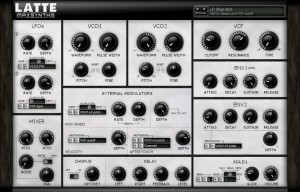
MaxSynths has announced the release of Latte, a virtual synthesizer instrument for Windows.
Latte is inspired by the old synthesizers from the past and is able to produce powerful synth sounds, fat basses, expressive leads, crazy sounds and more.Despite the synth layout looks very simple the modulation options allows to shape the sound in a lot of different ways. One of the most interesting features is the possibility to use the polyphonic aftertouch as a modulation source to create the typical expressive sounds which has been a trademark for the well known synth gurus of the past.
The Saw/Pulse oscillator of Latte, characterized by a powerful and warm sound, has been created specially with the aim to recreate a realistic vintage sound.
Latte features
- 2 Oscillators with custom Saw and Pulse waveforms and noise generator (White and Pink noise).
- 12dB Low Pass/High Pass state variable filter.
- 2 LFOs with assignable destinations.
- Assignable envelope generator.
- Extensive options for external modulation with routable Channel or Poly Aftertouch.
- FX section with Chorus and Delay.
- 16 voice polyphonic.
- Low CPU usage.
Latte for Windows (VST) is available to purchase for 19.90 EUR. A free version (limited to 4 voice polyphony) is available to download.
The Upright – virtual piano instrument for Windows
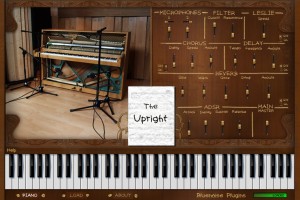
Bluenoise Plugins has released The Upright, a virtual piano instrument for Windows.
The Upright is a great sounding upright piano recorded in a professional studio. The piano recorded is a Hellas. It’s not the most expensive thing made but this particular piano has already been used for several major artist because of its great sound.
The Upright features
- Interface with a smooth look and controls for microphone outputs, a cutoff filter, chorus, leslie, reverb, delay, ADSR and main output.
- Recorded with 4 microphones (2 sets consisting of Neumann KM184 and AKG C414 B-XLS), merged into 2 outputs (left and right). The microphones were sent into a Universal Audio 4010 micpres, then through pristine RME converters into Nuendo
- Samples are raw 24 bit, 44.1 kHz wave files, 4 different velocity layers.
- The sound is left unaltered, this piano can go from sweet sounding to lo-fi.
- Effects included: cutoff filter with resonance, a built in leslie with different speeds, a soft chorus, a great sounding reverb for more room and a delay to create that John Lennon sound we love.
- Easy to use with a logical workflow.
- Includes 10 presets included from the classic upright sound to really old Lennon sounding stuff like Imagine.
- MIDI Learn makes it super easy to use an external controller to control the plugin.
The Upright for Windows (VST) is available to purchase for 23 EUR/$30 USD/£19 GBP.
Forgotten Keys recreate the Korg Rhythm 55B for Kontakt

Forgotten Keys has released FK11: Korg Rhythm 55B, a recreation of the Korg Rhythm 55B for Kontakt 4.2 or later.
The Korg Rhythm 55B (AKA KR-55B) was the 1982 follow-up to the Rhythm 55 released in 1979. The sound generation was identical but there was a doubling of preset rhythms, Intros and Fill-Ins as well as a major overhaul of the existing rhythm patterns.
Key Features
- 12 sounds
- 98 high-quality 24-bit samples
- 96 rhythms (combinable)
- 32 Intros
- 32 Fill-ins
Pricing and Availability:
£5.50
More information:
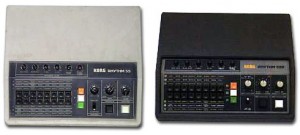
The KR55 was, for its time (1979), an advanced preset rhythm drum machine with up to 96 preset rhythm patterns! These patterns cover the whole gamut of presets (Waltz, Samba, Rhumba, Bossa Nova, Tango, Slow Rock, Swing, Rock, etc.). The KR55 also featured a “swing beat” control to add a variation to the groove. Each drum sound’s level can be individually adjusted for each pattern. It can also be externally controlled via footswitch jack for the Start/Stop and Intro/Fill switches. The KR55B was a black-chassis version released a few years later in 1982 with twice as many rhythm patterns.
Enjoy
Rhythmic Robot releases Boss DR55, Magnus Reed Organ and StyloDrum Kontakt Instruments
Rhythmic Robot have released three new instruments for Kontakt 4.2.3 and later:
- Doctor 55: a sampled recreation of the Boss DR55 analogue drum machine.
- Magnus: a reed organ emulating a 1950s Bakelite Magnus organ and a 1970s plastic version.
- StyloDrum: a glitchy drum machine with four kits sampling scratches, crackles, pops and squeals from vintage Stylophones which have been pitched, looped and trimmed to form electronic drum sounds.


Doctor 55 costs £4.95. Magnus and StyloDrum cost £3.95.
Doctor 55 is a Kontakt version of the Boss DR55 analogue drum machine. It samples the original with great precision at 24-bit. Each of the four original kit pieces (kick, snare, hats and rimshot) are covered, plus an additional “hidden” snare sound that only showed up on the original during programming. This additional snare has been given its own Attack and Decay parameters, hidden on the rear panel, which allow the user to create brushed snare sounds or snares with long decay tails.
Additionally, as usual with Rhythmic Robot drum machines, multiple samples have been taken through the entire travel of the DR55’s “Accent” control. These differently-accented samples can then be accessed either by tweaking the “Accent” control on the GUI panel, or by velocity from a MIDI keyboard (or by drawing velocity automation straight into a DAW lane). Accent amounts change the tonality of the kit pieces considerably, and can be dialed in on a per-kit-piece basis, which of course was not possible on the original instrument (where Accent functioned globally).
The Doctor 55 rounds things out with a Tone control, plus effects control over tube saturation, bit-crushing effects, Drive distortion and an output compressor / limiter for “gluing” and pumping effects.
Features:
- All the sounds of the DR55 captured through the entire travel of the Accent control.
- Kit pieces individually adjustable for level, pan and Accent.
- New “hidden” snare sound sampled, and adjustable for attack and decay.
- Velocity Retrofit button allows incoming velocity to vary the Accent level dynamically (for humanised beats).
- Bitcrusher, tube saturation, distortion and compression / limiting on the outputs.
Magnus is a reed organ instrument sampled from two vintage Magnus reed organs: a Bakelite model from the 1950s, and a red plastic model from the 1970s. The Bakelite model was Magnus Organs’ first ever model and is extremely rare.
Magnus allows the user to blend the “Bakelite” and “Plastic” samples to taste via the front panel controls, and adds Tone and “Electrify” — which brings in tube harmonic distortion to the sound. Attack and Release controls are available for the amplitude envelope, and longer release times invoke a slight pitch drop-off as the sound decays, which mimics the behaviour of a real reed organ having its keys very slowly let up (air pressure through the reeds drops, and the pitch falls as a result). Stereo spread, chorus and phaser effects are available on the rear panel.
Magnus is designed for unusual organ sounds and breathy pad textures.
Features:
- Bakelite 1950s and Plastic 1970s samples can be blended to taste.
- “Electrify” control for adding harmonic distortion; Tone control for high-end roll-off.
- Attack and Decay parameters.
- Original pitch drop-off emulated on long ADSR release settings.
- Stereo spread, chorus and phaser controls on rear panel.
StyloDrum is an analogue drum machine built from sampled scratches, bleeps, bloops, fizzes, noises, crackles, thumps and glitches — all taken from vintage Stylophones. These have been pitch-shifted, looped, trimmed and fiddled with as necessary to turn them into old-school-style analogue hits. StyloDrum incorporates four kits spread over four octaves, each with at least two kicks and two snares. Most have hats, some have crashes, toms, claps or other “classic” sounds. Interspersed are a lot of random scratches, glitches and other Stylophone-based weirdnesses.
Kit pieces can be adjusted in level and pan position, and there’s a comprehensive effects section with Saturation, Drive and “Pump” compression to really kick things into gear. StyloDrum is a unique source of left-field electronic sounds for any genre, with a glitchy, grainy edge.
Features:
- Four kits built entirely of Stylophone scratches, glitches, squeaks and squeals.
- Pan and level controls.
- Tube saturation, Drive distortion and “Pump” compression.
- Unique and unusual electronic elements for any genre.
New 3 oscillator synth from StudioLogic – Sledge
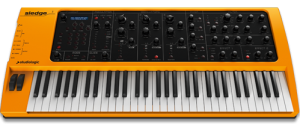
Studiologic, mainly known for their controller keyboards previously, have released their first synthesizer, the Sledge. The Sledge is a 3 oscillator virtual analog synth that includes not only the standard analog waveforms, but a full set of wavetables from the PPG Wave. Also includes a Waldorf-modelled multimode filter, selectable white and pink noise, hard sync, an arpeggiator, fast envelopes, and a basic selection of effects. For many synthesizer enthusiasts, it is the particular interaction of the sound engine and user interface that makes a great instrument. A quick look at Sledge shows you the generous set of controls available to interact directly with the sound engine. When you touch the knobs and switches of the front panel, you will instantly be aware of the meticulous attention to detail our engineers have refined, during many decades building the best electronic keyboards.
You will experience the logical set-up of the synthesizer modules, mirroring the signal flow of a classic analogue synthesizer. But what really distinguishes any synthesizer is its sound. Fortunately, our friends at Waldorf Music have happily shared their experience and know-how on this crucial part of the Sledge Synthesizer.
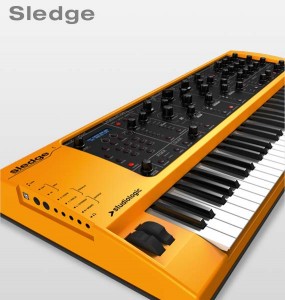
Specifications:
• 32 Pots
• 3 chicken head rotary switches (7 positions)
• 1 rotary encoder with push function
• 2 x 16 digits backlit LCD
• High Quality Pitch and Mod Wheel
• up to 256 Sounds
• fast and efficient sound selection via numeric keypad
• 2 fast LFOs per voice, each with adjustable Speed and Depth
• 1 extra modulation routing for Mod Wheel, with adjustable Speed and Depth
– Shape: Sawtooth, Rectangular, Triangle, Sine, Sample & Hold, Ramp
– Destination: Osc 1, Osc2, Ocs3, PWM / Wave / FM, Volume, Filter Cutoff
• Monophonic mode with single or multiple trigger
• 3 Oscillators per voice
– Range from 64′ to 1′ each
– Shapes: Sawtooth, Square, Triangle, Sine, Pulse (with Pulse Width Modulation)
– Oscillator 1 with 66 Original PPG Wavetables
• Frequency Modulation of sine and triangle
• Oscillator Hardsync (Osc 2 to Osc 3)
• Noise Generator with selectable white and pink noise
• Mixer with Volume and On/Off switch for each Oscillator and Noise
• 1 Multi Mode Filter per voice
– 24 / 12dB
– Lowpass
– Highpass
– Bandpass
– Resonance up to Self-Oscillation and beyond
– Adjustable Keytrack and Drive
• 2 fast Envelopes per voice (filter / amplifier)
• Powerful Arpeggiator
– Latch mode
– syncable to MIDI Clock
– Direction Up, Down, Alternate
– Range up to 10 Octaves
• 2 simultaneuous Effects
– Effect 1: Chorus / Phaser / Flanger
– Effect 2: Reverb / Delay
• sturdy, lightweight enclosure (less than 10 KG)
• high quality, 5 octaves Fatar TP 9 keyboard
• Master Volume Control • Power Switch
• Stereo line output
• Headphone output
• Expression pedal input
• MIDI in and out
• USB connector for MIDI in / out
– uses standard USB MIDI driver provided by host computer OS
– Windows ME minimum, Windows XP or newer recommended
– Mac OS X 10.2 minimum, Mac OS X 10.3 or newer recommended
• Built in power supply
Smithson Martin Kontrol Surface KS-1974
Virtual DJ control in an analog synth’s body. In November Smithson Martin accounced the Kontrol Surface, it’s the same kind of deal as their Emulator, but in an analog synth style packaging. Essentially if you’re a DJ and you want to look like a complete renegade maverick mofo, then you should purchase this and pretend that you can play synth.
The design of the interface is flexible, meaning you can have custom interfaces for software such as Traktor, or Ableton.
Alan Smithson takes you through the product in the video above.
Via Sonic State
Best Service has released Galaxy X Convolution Synthesizer
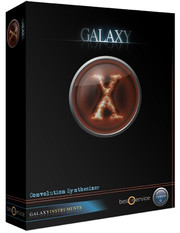
Best Service has announced the Galaxy X Convolution Synthesizer by Galaxy Instruments.
After three years of development Galaxy Instruments and Best Service proudly present GALAXY “X”, an exciting new virtual instrument with an extraordinary new kind of sound design: Effect Convolution. It all begins with the sources, which are sample sets especially and exclusively recorded and tweaked for use with FX Convolution: for X-KEYS hundreds of tonally playable instruments like piano overtones, a bowed fan, waterphone or mini-celesta, for X-FX thousands of effect sounds such as magic balls, whirling wood or circuit bent noises and for X-LOOPS exceptional loops such as 1-tone-drum, body percussion or rod spring piano.
But this is just food for the beast: the X-Engine.
With the X-Files of the X-Engine, a celeste mutates into a tuning orchestra, a bowed ventilator sinks into the resonances of a piano, a sitar smashes into a clatter of glass, a tonal dance loop arises from a kalimba.
X comes with over 1000 extraordinary ready to play key, FX and loop instruments and an extremely intuitive user interface, enabling you to create trillions of sounds easily.
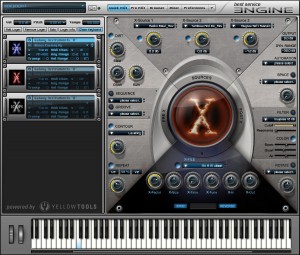
Galaxy X features
- Convolution Synthesizer.
- New sound synthesis for exciting new sounds.
- Integrated system for FX convolution in one virtual instrument.
- Complete production kit: X-Keys, X-FX and X-Loops.
- More than 1000 ready-to-play Instrument Layers.
- Easy creation of user sounds.
- 15GB of Source Sounds.
- More than 1000 multi-sampled Source Key Instruments.
- More than 5000 Source Loops.
- More than 2000 Source Effect Sounds.
- More than 1400 Convolution X-Files for completely altering the source sounds.
- Complex sound design with an extremely intuitive user interface.
- Easy dynamic use of convolution using the Mod Wheel.
- X-Eye for visualizing the amount of convolution.
- Musical and intuitive Pre-X and Post-X effects.
- Endless sound possibilities designed by you.
Galaxy X will be shipping January 2012 (release at NAMM show), priced MSRP 249 EUR / £219 GBP / $299 USD.
DarkWave Studio updated to v3.8.4

DarkWave Studio is a free modular virtual studio for the synthesis of electronic music. It has a built in pattern editor and sequencer. It allows you to load various machines such as virtual instruments and effects and connect them in a modular and straightforward fashion. DarkWave can load VST instruments and effects and it can also load machines using the DarkPlug API, which was custom made for DarkWave.
DarkWave natively supports both x86 (32-bit) and x64 (64-bit) versions of Windows with native binaries compiled for each platform. The x86 and x64 versions can each only load plugins for that platform, i.e. the x64 version only loads 64-bit VST and DarkPlug plugins.
Recent Changes
v3.8.4
- Fixed A Crash Loading Project With Missing PlugIns.
- Fixed Incorrect Storing Of VST PlugIn Unique ID.
- Added A Warning When Saving A Project That Was Written In An Older File Format To The Current Version Of The Program.
Visit: experimentalscene.com
Introducing the new virtual Klang Drum Machine

Now available from Supersynths, Klang Drum Machine is a new virtual drum instrument for Windows, featuring full enveloping, loop and groove editing, effects, pattern sequencing, and much more for the beat-making musician.
According to Supersynths, Klang Drum Machine is an eight-layer drum sequencing beast. Klang Drum Machine has eight layers, each with its own mixer, panner, MIDI channel selector, envelope controls, and loop editor. Each layer is MIDI CC learnable, so you can assign them to pads, keys, and so forth. As Supersynth notes, the pattern sequencer allows you to either create up to 64 patterns that can play in any order you wish, or you can stack them to create multi-timbral patterns. With Klang Drum Machine, you can load and save patterns and banks of patterns.
As for effects, Klang comes complete with reverb, delay, and a compressor — all tempo synced for great tempo effects. The virtual instrument also comes with a simple unison drone oscillator, which you can use to create rumbling drones, sc-ifi sounds, and anything in between.
The Klang core library (326 MB compressed / 750 MB uncompressed) features a wide variety of clangs, hits, strikes, and more. Many new dry samples are also included, covering bass drums, snares, toms, cymbals, side sticks, and more; in addition to the more unique samples available, there are plenty of “bread and butter” samples to allow you to create any kind of percussion tracks you wish.
Klang Drum Machine features at a glance:
- 750 MB sample library
- 8 Layers with envelope, mixing, and panning
- Multiple tempo-synced effects
- MIDI channel learnable and selectable
- Full-featured pattern sequencer
- Low footprint for instant results
- Use as many instances as you want
Until January 1, 2012, Klang Drum Machine for Windows will be available at the introductory price of $40. For a limited time, Klang Drum Machine will include the Cloudplayer and one expansion. You can learn more about Supersynths’ Klang Drum Machine virtual instrument at supersynths.com.
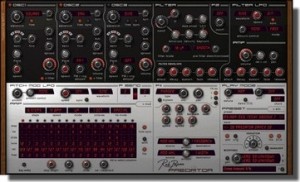
Rob Papen updates Predator virtual analog synth to version 1.6.2
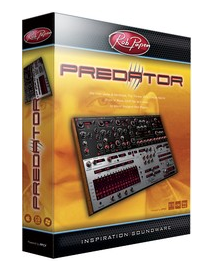
Here’s what is new:
- New oscillator modulation types: PM, Sign, Max, Min, S&H Mix.
- New filter types: 12dB & 24dB LP/HP/BP and Notch (type 2), Comb – filter and two new formant filters.
- Filter 2 with all filter types added included Q control.
- Filter 2 panning moved into filter section (was advance panel).
- Tempo sync Free Envelope 1&2.
- New fx added: stereo tape delay, tape flanger and analogue phaser.
- Alternative GUI color (more light grey color).
- Optimized DC offset respond.
- Back panel offers global tuning and tuning scales (.tun files).
- Midi program change and midi bank select can be turned off.
- New classic synth music by SYNTH.NL: 30 Synth NL bank.
- New session presets with Gizeh (trance banks): 30 Gizeh Trance 2, 30 Gizeh Trance 3.
- New presets inside these banks: 02 Predator dance 02, 03 Classic synth 03 and 04, 04 HipHop RnB 02, 05 Trance and PsyTrance 03, 12 DubStep 02, 11 all SFX 02, 20 all basses 04.
DATAMASKIN

