
New 500 patches strong free Reason Refill
Tweakazound is an instrument Refill which has been made with Propellerhead Reason synths and effects. Overall 500 patches that are ready for you to use in your music. Reason can sound awesome if you know how to use it, which is probably not anything new for most of you.

You can preview Tweakazound ReFill below. It’s available for download at the Reflection X site.
This Refill is a donationware.
More vintage sounds from KORG
Korg has released a free soundpack for the Korg SV-1, Korg SV-1 Sound Pack 2.
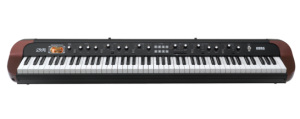
Here’s what they have to say about it:
This second Sound Pack features a collection of sounds that were inspired by user feedback. Some of these vintage sounds include darker tine pianos, an acoustic piano with more sustain as well as a wider variety of organ sounds. Of special note, for the first time there are split sounds, including left hand basses – a nice surprise hidden in the ROM; until now! This completely free Sound Pack provides you with even more user friendly and classic sounds, only adding to the tonal possibilities that are available at your fingertips with the Korg SV-1.
See the Korg site for details and to download.
YMO synth jam
A slowed-down ambient-ish cover of Rydeen (ライディーン) by Yellow Magic Orchestra, written by Yukihiro Takahashi. Played on a Roland Juno-6 with a Korg Microkorg providing the ‘percussion
Next iOS ships with MIDI
The next version of iOS – the operating system for the iPhone, iPad and iPod touch – will have an unexpected surprise for musicians: real MIDI support.

Apple’s iOS 4.2 update, due in November, includes some interesting new features that didn’t make Steve Job’s official announcement.
According to a report in AppleInsider, beta testers have found that iOS 4.2 adds support for the CoreMIDI framework to the operating system’s application program interfaces.
CoreMIDI could be huge for iOS music apps, because it provides standardized MIDI support. It is a built-in system that supports MIDI devices and how they communicate with other applications.
MIDI support means that the iPad could be a touchscreen control surface for any MIDI device; developers will be able to create multi-touch sequencers that control MIDI hardware; and you should be able to plug your MIDI keyboard into an iPhone, iPod touch or iPad and play your iOS software synths.
CoreMIDI on iOS 4.2
CoreMIDI support should help make MIDI more plug-and-play on iOS devices.
Here’s what Apple has to say about CoreMIDI:
In Mac OS X, Apple provides a new set of system services, so that applications and MIDI hardware can communicate in a single unified way, using a single API.
MIDI services, which are low level, provide high-performance access to MIDI hardware devices. There is a driver model in the MIDI world that “talks” directly to IOKit, so your application has a direct path from the MIDI services API to the hardware.
Using this driver model, third-party manufacturers can create driver plugins that talk to IOKit. Those can then be loaded and managed by a server, which applications talk to through the Core MIDI framework.
The CoreMIDI framework provides the client-side API that applications use to interface to MIDI devices.
The primary goal of MIDI services in Mac OS X is to have interoperability between applications and hardware, so that everyone is working to the same standard. Other goals include providing MIDI I/O with highly accurate timing, as required by professional applications. This means from a musical point of view being able to get a MIDI event into and out of the computer within one millisecond, i.e., to keep latency under one millisecond, and also to keep jitter –– i.e., the variations in I/O –– under 200 microseconds.
Another goal is to provide a single system-wide configuration, i.e., knowing what devices are present, and being able to assign names to those devices, manufacturer names, and what MIDI channels they’re receiving on and so on.
The MIDI services are designed as an extensible system. Toward that end, a device can have any number of properties attached to it. And a device manufacturer can publish their particular properties of their device.
Developers should be able to code apps with MIDI support, rather than having to support individual interfaces. CoreMIDI could also open up using the Apple iPad Camera Connection Kit for connecting existing USB MIDI devices.
Developers are already starting to support MIDI hardware on iOS, with devices like the Line 6 MIDI Mobilizer interface, This trend is likely to explode, though, with CoreMIDI support.
It’s not clear yet how “baked” MIDI support will be in iOS 4.2. If you’re an iOS developer or if you’re testing the iOS 4.2 beta, let us know if you’ve done any MIDI testing yet.
iPhone, iPad & iPod touch Getting MIDI Support
With this news, iOS 4.2 just got a lot more interesting for musicians.
Introducing Allen Morgan II S2.0 Producer Presets
Five-movement opus programmed onto a tiny 8-MHz, 8-KB microchip
I have blogged a “bit” on this guy before, but here’s some more details:
Tristan Perich, a New York composer of experimental music, wanted to see how small he could make big philharmonic pieces. His new release, 1-Bit Symphony, is a 40-minute, five-movement opus programmed onto a tiny 8-MHz, 8-KB microchip in super-efficient assembly language. The dinky chip containing this program (source code included in the liner notes) is installed in a CD jewel case and wired to a watch battery, volume knob, and headphone jack. Order the assembly at bangonacan.org, hit the On button, and the music flows through your earbuds.
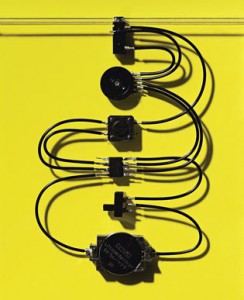
“I wanted to pare things down as much as possible and remove all of those extra layers,” Perich says. “Ultimately, the lowest you can go is 1 bit.” He couldn’t get quite that small; but still, at under 8 KB, the richness of his composition, which sounds like a grand polyphonic score performed in pulsing Nintendo bleeps and bloops, is surprising. And so is its conclusion: The final movement of 1-Bit Symphony is programmed never to end—the last tone simply goes on forever, or at least until the 3-volt watch battery runs out.
Passion for touch interfaces
Apart from nice ambient tunes this is a really nice demo. Usine is one of music creation’s most surprising secrets: it’s powerful sound software that incorporates creative touch interfaces as a core design principle. And in the video above, it’s running on a standard PC two-touch display from Packard Bell. Nay-Seven is one of the founders of the Usine community, all while lecturing internationally, and has been pushing the Usine software to its limits.
Some recent works, patches and workspaces , made with Usine from http://www.sensomusic.com/usine/
using a multi touch screen , working on graphics and music
Speaktron
Speakatron uses your webcam to identify when your mouth is open and plays a sound if it is. It uses the shape of your mouth and its position on the screen to help control the sound.
Speakatron was selected as a best hack of Music Hack Day London. It’s available as a download from Bereza’s site.
Learn the secrets of white noise
How to make a white noise build up in Ableton
More stuff on Reason 5
Here are two newly discovered tutorials I found the other day, enjoy
Beat Construction Volume 1 is the beginning of a new form of micro training for Propellerhead Reason 5 users producers and beatmakers all over the globe. In these beatconstruction series videos, you get to watch your favorite music instructor at work doing what he does best. HIP HOP PRODUCTION! We all love the talking, feedback and encouragement, but sometimes some just want to get right to the heart of the lessons. The Reason for this arrangement is very beneficial for both parties for as a professional producer without any restrictions can get more involved and produce high quality production tracks without breaking the flow of the must needed creativity that is necessary to produce professional quality results.
Along with this arrangement, the Propellerhead Reason 5 project files are included in each session so as to get hands on involvement in the very exact material that was used and produced by your instructor. This allows you to utilize the very exact mix, mastered sounds, samples and instruments used to create this production material. BTW: Do what you please with the Reason files, they are “Royalty Free”, so go ahead take advantage before the prices go up, because I promise you it will. So hurry and get your copy of Beatconstruction Series video tutorials for Propellerhead Reason files today!
DATAMASKIN

