
Die Krupps and Nitzer Ebb join forces on tour
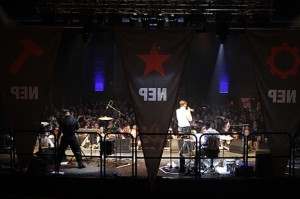
We have all heard Die Krupps’ and Nitzer Ebb’s collaboration “Machineries of Joy” from 1989. Now, 22 years later the two legendary bands join forces on a nine-date “Join in the Rhythm of Machines” tour in April and May. They will play Paris, Dortmund, Antwerpen, Gothenburg, Stockholm, Malmö, Berlin, Bratislava and Budapest.
A special EP is being recorded as we speak, to be sold exclusively at the concerts. There will also be surprises on stage.
Steiner Synthasystem VCO type A
This is a faithful re-release of the Steiner Synthasystem VCO type A. As always, Nyle was an integral part of this re-release. This VCO only differs from the original in that it incorporates the ability to tune it to a 1 Volt/Oct scale. Thank you Nyle.
More info at the web site: http://www.xmission.com/~dingebre/Syn…
Shared by dingebre
Buchla 223e Demo
Quick demo using the 223e arpeggiator to drive the 250e (strobe mode). I have sixteen keys assigned in the arpeggiator. One per stage in the 250e. I am turning on and off the first two stages using the first two keys. The 223e is running in falling mode. It can also run in rising mode, triangle (pendulum), random, or “spiral.” The 250e is not required, but it is a convenient way of setting the pitches.
Shared by boobtube356
iPad wireless control software for StudioLive
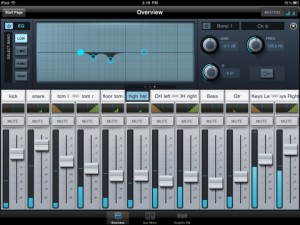
PreSonus has released a dedicated wireless control software for its StudioLive-series digital mixing consoles: SL Remote software for the Apple iPad. SL Remote, is now available free from the iPad App store. SL remote provides direct wireless control over PreSonus Virtual StudioLive software for Mac and Windows, which in turn controls the StudioLive mixer. At last, you can have wireless remote control of any PreSonus StudioLive-series digital mixer’s channels, auxes, effects, subs, Fat Channel processors, and more. Not only can these functions be controlled from anywhere in a venue by the front-of-house sound person, but custom aux mixes can be simultaneously adjusted by any performer with an iPad.
“While there are iPad apps for digital mixers costing tens of thousands of dollars, SL Remote is the only iPad solution for affordably priced mixers,” notes PreSonus CEO Jim Mack. “It’s a free app and is part of the free Virtual StudioLive computer-control system that also ships with both our 24- and 16-channel digital mixers.”
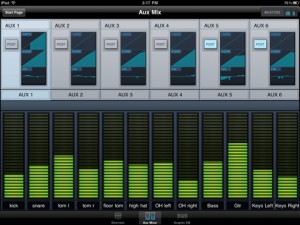
A StudioLive firmware update is required in order to use SL Remote. Registered StudioLive owners can download this update at www.presonus.com/technical-s….
The Prewsonus SL Remote is a now available at the App Store at http://itunes.apple.com/us/a…
Still looking for the classic Yamaha DX7 ?
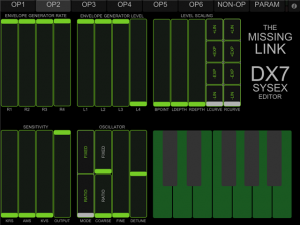
This iPad DX7 patch editor for TouchOSC, via armatronix, is designed to simplify and speed up programming the ‘notoriously difficult’ Yamaha DX7, TX7, and TX816 FM synths, via MIDI SYSEX.
It’s a free download (.touchosc file).
Introducing the”Drift Box”
“Drift Box” is a compact monophonic synthesizer.
That’s product of REON co.,Ltd in osaka japan.
Snyderphonics is up to something
Snyderphonics – the company behind the Manta controller – is working on a new multi-purpose device, the MantaMate.
Here’s what Snyderphonics has to say about the MantaMate:
I am working hard on the MantaMate, a device that will allow Manta users to perform without a computer, and to directly control analog synthesizers.
It will also be a powerful general-purpose converter between USB devices, MIDI devices, OSC over ethernet, and control voltage (supporting several voltage standards from Eurorack to Buchla to Moog to Serge to Korg).
It even has a built-in digital synthesizer, so that it’s possible to perform with only the Manta and a MantaMate.
There’s no set release date, but it sounds exciting, stay tuned
The Manta:
The first Snyderphonics product is the Manta, a touch-sensitive interface for controlling music or video. Each sensor in the hexagonal array knows exactly how much surface area your finger is covering, and this data can be routed to any audio or video parameter you choose.
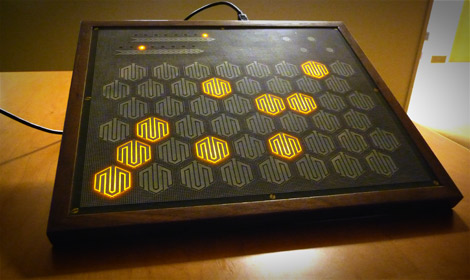 |
For instance, you could assign each sensor to a note in a musical scale, and route the surface-area data from each sensor to control the volume of that particular note. Play a chord, and you can control the volume of the different notes of the chord independently with your fingers. Alternatively, you could set each sensor to correspond to a video file, and fade between videos dynamically with your fingers.
The Manta also outputs centroid data to turn the Manta into a large X-Y multitouch surface, for applications that don’t require discrimination between discrete sensors. For instance, you could have the Y axis be pitch, the X axis be timbre, and the size of the point of contact (determined by whether you have your finger or your whole hand on the surface) be the volume of the note, and have a very hands-on performance synthesizer.
How much money does musicians earn by selling online??
Quite an interesting article on how much money you can gain by selling your music via the Internet. I published a similar story some time back so you can view this as an update

Abstract below:
You may have gotten the impression that I don’t like the Internet. Some people certainly have. Some are convinced that the reason for it is my ignorance of how it works.
The truth is I am deeply disillusioned about how it turned out and I’ll take this opportunity to tell you why.
The Internet should have been a godsend to musicians and creators of replicable works in general, for two reasons:
- The two biggest problems an independent creator faces are distribution and promotion, which in the past meant the need to deal with publishers (and all associated creative and financial trade-offs). The Internet has enabled even the smallest business to reach a potentially global consumer base.
- Creative works such as books, movies and music are pretty much the only products (others include software and news) that can be delivered on-line and as such seem custom-fitted to e-commerce.
Looking at the two points above, we see that the Internet should have opened wide new vistas for the creative sector and enabled thousands of independent creators to flourish without the need to court big business. So why didn’t it pan out that way?
Or did it? Some would say it did. However, looking at matters realistically, the amounts earned from creative output delivered through the Net verge on the laughable.
It so happens that I write this from a position of someone who makes money from making music available through the Internet, so let’s take a look at some numbers. Just how much can we make from this new method of distributing our work that should have been our paradise?
he numbers on how much music you need to sell, in various formats, in order to make as much as you would working a minimum-wage job (in the US).
The numbers aren’t pretty:
- In the case of Amazon and iTunes single-track downloads, 1,813 units must be sold monthly; 21,750 units a year.
- For CD Baby full album downloads, the numbers are: 155 units a month; 1,859 units a year
- For eMusic single-track downloads: 3,392 downloads a month; 40,941 a year.
- With Rhapsody streams, you’ll need 127,473 streams a month; 1,529,670 a year.
- Finally, Last.fm rates mean you’ll need 7,733,333 plays monthly; 92,800,000 plays a year.
These numbers assume that you’re not in a band. If you’re in a four-piece band, the numbers are higher:
- Amazon and iTunes, single-track downloads: 7,250 a month; 87,000 a year.
- CD Baby full-album downloads: 619 a month; 7,433 a year.
- eMusic single-track downloads: 13,567 a month; 162,807 a year.
- Rhapsody streams: 509,890 a month; 6,118,681 a year.
- Last.fm plays: 30,933,333 a month; 371,200,000 a year.
Wiszniewski’s numbers suggest that musicians’s shouldn’t expect music sales to be a large part of their income and not expect Internet radio to be part of it at all.
A little peak at iBlofeld
http://www.youtube.com/watch?v=MvpIXuMKLkY
iControlMIDI.
Plug & Play iPad Editors for Vintage & Software synths.
iBlofeld for Waldorf Blofeld.
Site: http://www.icontrolmididesign.com
App Store: http://itunes.apple.com/app/iblofeld/…
Swan Lake UVB Style
You’ll either get what’s going on here or you’ll just think, “???”. Exciting stuff to me, perhaps to some of you as well.
I’m using the Elektron Octatrack to recreate the sound of the UVB-76 Swan Lake broadcasts. A combination of the Octatrack’s filter distortion, SSR, BRR, and Lo-Fi Dist are animated with LFOs to approximate the broadcast. The distorted harmonics that appear are as disturbing as those in the original. Expect this UVB-76 project to happen mid-2011.
Shared by Allerian1
DATAMASKIN

