
Quantized Chords from the Tip Top Z8000
Full track with WAV audio here:
http://soundcloud.com/ritchiedrums/sad-sunday
~The 4 horiontal steps from the Z8000 sequencer are going through Synthesizers.com Quantizers to 4x Q106 VCOs, then a Mattson Mixer & filter to create chords. The 16 step vertical Z8000 steps are receiving a rotated & skipped clock from the 4MS multiplier & going to a COTK quantier to 2 BlackJack VCOs, then to the STG Mankato filter. The Blacet Binary Zone is sending divided clock to my MFOS rotary sequencer which is sending CV to the MOTM e340 generating clouds to the EHX memory boy delay
Alma redemptoris mater
This is Alma redemptoris mater, composed by Orlande de Lassus (1532 – 1594) and performed by Richard Galbraith on a modular analog synthesizer (by Synthesizers.com), with a Grove Audio PM Resonator. Visualization is Magnetosphere.
Better audio quality here: http://soundcloud.com/spinach-pizza/alma-redemptoris-mater-orlande
Pugix in Pen Park
Richard Brewster does electro-busking with his synthesizer in Pen Park. Alas, no one was there.
Duo Steel Tongue – Sample Library for Kontakt
Here’s what they have to say about it:
Over the last decade a number of adventurous instrument makers have used steel pans, propane tanks and custom alloy “shells” to create a new breed of melodic percussion: steel tongue drums.
Borrowing design concepts from traditional wood models, steel versions feature “tongues” of varying lengths cut into the top of the drum in a circular pattern. The drum is placed in the percussionist’s lap and is struck with fingertips for a soft sound, finger pads for a slapped sound, and thumbs for a harder tonal “knock”. Overtones of adjacent tongues ring sympathetically with the note that is being struck to create complexity of sound.
As part of Nine Volt Audio’s Duo line of products, we’ve recorded TWO steel tongue drums. The larger 1Tone is a nine-note model that originates from Israel and is tuned to the “Hitzaz” scale (sometimes written as “Hijaz”) in the key of D. It has a resonant and “ringy” quality that creates a beautiful droning background to performances. In addition to finger articulations, this drum has also been recorded with brushes.
The Garrahand is a small yet tunable model from Argentina. Despite it having only seven tongues, each was individually tuned through the sampling process to make the drum playable in a chromatic fashion. This drum has a buoyant and mellow sound with fewer overtones than the 1Tone.
With over 3100 samples and patches that are both natural and modern, Duo puts the evocative and expressive sound of steel tongue drums at your fingertips.
We encourage you to support the instrument makers and check out the acoustic versions of these instruments at www.garrahand.com & www.1tonedrums.com
Innovative music learning software for Mac
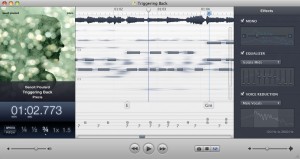
SuperMegaUltraGroovy has released version 2.1 of Capo, an innovative music learning software for Mac.
In this release, Capo has gained the ability to export MIDI transcription data, the waveform representation of audio has returned, and playback commands can now be controlled via learned keystrokes or external MIDI hardware.
Changes in Capo v2.1.1
- The waveform display has now been re-integrated into the UI, and now serves as the primary loop interaction area (i.e. Where you will do your clicking to set/modify loop points.)
- You can now export MIDI files from Capo (File > Export Note Entries…), for use in other applications such as Guitar Pro, Sibelius, Logic, etc.
- Playback commands may now be re-mapped using either keyboard or MIDI devices.
- Using Control > Go To Time…, you can now type in a point in time to jump to.
- Dropping, and clicking on chord markers now plays the chord.
- The note you are hovering over in the spectrogram is now displayed at the left-hand side of the spectrogram view, along with the existing C1, C2, … markers.
- Spectrograms, waveforms, and chromagrams are now all cached after they’re successfully calculated. Now slower systems don’t have to suffer (and eat battery) each time a song is loaded.
- An improved spectrogram processing front-end now uses a limiter to pull up quieter sections of audio, and keeps loud sections as they are. This results in a “hotter” spectrogram overall, but provides better balance to widely dynamic classical pieces.
- When working with audio files at rates beyond 44.1kHz, the MIDI playback no longer sounds out of tune.
- Capo’s chord detection now correctly reflects the combination of tuning changes and capo settings.
- Added missing standard tunings for 5-String Bass, and Banjo.
- The spectrogram now takes into account both channels of stereo audio equally.
- Dragging loops now snaps precisely to marker locations.
Capo 2.1 is available now as a free update to all 2.0 customers, and is still a $19 USD upgrade for 1.x users. Capo can be purchased for $49 USD.
More information: SuperMegaUltraGroovy / Capo
Release of the GRM Tools VERSION 3
GRM Tools proudly announces that they have partnered with DontCrac[k] to announce the awaited release of the GRM Tools VERSION 3 bundles…
Not only the famous “CLASSIC” and “SPECTRAL TRANSFORM” bundles have been totally re-writen from scratch and are now available in the RTAS – AU – VST and Standalone formats for Mac & PC but the folks at GRM Tools have designed an incredible set of new plug-ins called “EVOLUTION“. The GRM Tools “EVOLUTION” bundle is perhaps the most original and unexpected piece of audio software made in the past decade. EVOLUTION allows powerful and unexpected spectral and harmonic audio transformations such as morphing, evolving textures, original “VOCODER” type effects, time shifted filters, sliding timbers, noising, etc. EVOLUTION can also be used as very subtle audio treatment effects in delicate processing situations.
Describing what “EVOLUTION” really does is pretty tough ! We therefore suggest you download the free demo (no iLok or authorization required) and experiment for yourself EVOLUTION might simply change the way Sound Designers, Engineers, Musicians or Composers will process audio in the future !!! GRM Tools therefore opened an official GRM Tools forum board at DontCrac[k] for users to post their comments, bug reports and experiences using these new “unconventional” audio tools.
From Friday, March 25 to Sunday, April 17, 2011, EVOLUTION can be purchased as part of the GRM Tools Complete Collection at introductory price of only $489 (MSRP $1150). GRM Tools are actually sold and distributed exclusively by DontCrack.com via Instant Download.
Dynamo has been updated

Sinevibes has updated Dynamo to version 1.1.0.
The new version brings the following enhancements:
- New envelope matrix with actual envelope shapes instead of dots.
- XY pad replaced by individual envelope smoothness and effect intensity sliders.
- Command-click or command-drag to set all pattern step levels to the same value.
Dynamo is an AudioUnit effect plug-in that adds complex rhythmic motion to any audio.
At its core is an advanced step sequencer which works as a gate for the incoming signal. The sequencer offers up to 32 steps each with individual level and envelope shape, allowing you to construct modulation patterns of any complexity.
Price: USD 39.00
Visit: Sinevibes
New stuff from In Strict Confidence
“Set Me Free”, taken from the current In Strict Confidence album “La Parade Monstrueuse”, is now being released as a 14-track EP-CD. The CD includes the videoclip of “Silver Bullets”, an 8:30 minutes extended version of the title-track, a piano interpretation, remixes of other artists of various songs. More details as they get release.
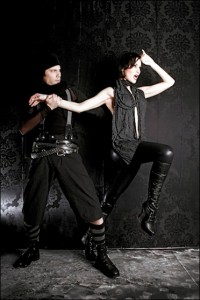
Formed in 1989/1990, they were known as Seal of Secrecy until 1992. They started out as a quartet, but stripped down to a duo (Dennis Ostermann and Joerg Schelte) in 1992, releasing two demos tapes on the way to their debut release “Cryogenix” on Zoth Ommog in 1996, shortly followed by the EP “Collapse”.
The band left the label after releasing the follow-up effort “Face The Fear” in 1998, releasing their third album “Love Kills!” on the very short lived Bloodline label two years later.
Granular Synthesis with Alchemy
Dan Worrall has done it again and created a great tutorial on granular synthesis with Alchemy. It covers all aspects of the granular engine as well as explaining in detail how the position and stretch knobs can be used to create all kinds of effects. All Alchemy videos are now available for everyone to watch, even if you don’t own Alchemy yet.
VST Spectrum worx – Little endian
http://www.youtube.com/watch?v=wTfyubr0QMg
VST Spectrum worx – Little endian
SpectrumWorx is a modular effect processor that works exclusively in the frequency domain. Two things make SpectrumWorx vastly different from other effects processors: its ability to manipulate the frequency domain and its modularity.
Working in the frequency domain lets us reach the very heart of the sound. Every single frequency is available for examination and modification. When we say “modular”, we mean modules – individual small, simple (and not so simple!) self-contained boxes (effects), which we can combine, arrange and re-arrange in so many ways – and of course, every arrangement gives us a new and totally different sound. With over fifty modules, there is a nearly infinite number of combinations available. Once the modules are set up – the game isn’t over. Every module has a number of its own controls which can easily be twisted and turned until the last drop of sonic power is squeezed from the input sample. When at last sonic perfection has been achieved, users can save their masterwork as a SpectrumWorx preset file for future use and even share it with friends.
Features:
* Over fifty modules (pitch shifter, classic vocoder, wah-wah, robotizer, wobbler, autotune, reverser, etc.).
* Sophisticated engine optimized for low CPU usage.
* Flexible Preset browser.
* Over 100 presets.
* Highly configurable LFOs.
* External audio support.
* Presets in XML format.
* Detailed User’s Guide.
DATAMASKIN

