
Yamaha CS01II plays BIG MUFF by Depeche Mode
Download this track at: http://snd.sc/iyLd2s
In this video:
The Yamaha CS01II is the first real synthesizer I ever owned. I got it when I was about 14 years old, back in 1985 or so. I noticed that I could get reasonable approximations of most of the sounds from Depeche Mode’s “Speak & Spell” album with it, but at the time I didn’t have the means to make decent multi-track cover versions, even after I got a 4-track.
Recently I was studying the Depeche Mode 5.1 surround mixes, and realized that I could clearly hear all the distinct parts of alot of the songs, so I decided to throw together some renditions using just my trusty old Yamaha CS01II as the sole sound source (including the drums), just to see how close I could get to the originals using very limited means.
The actual musical arrangement is about 100% accurate. The sounds themselves are of course only approximations, and most of them don’t have the same level of timbral detail as the ARP originals. I sequenced the whole thing in Cubase via a Kenton Pro Solo going into the custom CV/Gate inputs on my CS01II, recording each monophonic line in one at a time. Cubase provided the reverb and EQ, otherwise it’s all CS01II. I’ve deliberately been quite pure about this process- other than the reverb/delay/EQ, there’s no manipulation of the sounds going on here. This is, for me, mostly a technical exercise, so it wouldn’t make much sense to process the sounds very much, as that would only take it further away from the native sound of the CS01II.
I don’t really consider these to be “covers” as such- if I were covering these tunes, I’d do something creative with them as opposed to just mimicing them as closely as possible. I don’t have any desire to “cover” these songs in that sense. At any rate, this project has been a good exercise in close listening and mixing for me, so I see that as the main reward for my efforts.
THE BEAT THANG is here!
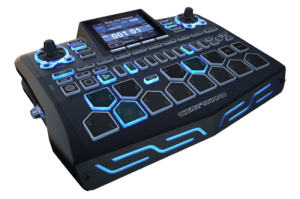
Renowned for the history-making sound design of Zoom’s SB-246 StreetboxxTM, the Beat Kangz have established an independent music technology start up that is proud to continue the time-honored tradition of American innovation and entrepreneurship. Flexible, functional, and user-friendly, THE BEAT THANG integrates pre-loaded sounds, sampling, and waveform editing in a portable, stylish and yes, even customizable, beat machine. The Kangz have stuffed over 3000 sounds and hundreds of production-ready beats, patterns and loops into THE BEAT THANG.
THE BEAT THANG truly moves beat making deep into the stratosphere with real bass, live strings, striking synths, Latin and African percussion, crunchy electric guitar, and startling sound effects. Each sound can be edited, tuned and manipulated using the 3.5 inch color video LCD screen, and fully functioning Digital EFX (EQ, Compression, Reverb, Delay, Filter, Chopped, Screwed, Reverse Record, tons more).
As if that weren’t enough, THE BEAT THANG offers onboard SAMPLING and resampling with easy key grouping, pad layering, and multi edit of all parameters in a kit or patch. 256 MB Ram (Standard) TWO High Speed SD card slots holding up to 32 gigs, MIDI Sequencer, USB in and out allow you to add your sound library, samples and midi files to create your own customized mobile sound experience. Oh, and those sounds you are packing have NO LOAD TIMES. Meaning no more waiting for minutes on end for your inspiration. Just keep it moving.
And speaking of moving, yes, the Beat Thang is a mobile player. The rechargeable lithium ion battery (like the one in your laptop) gives you hours of portable playing time. The Thang moves effortlessly from the studio, to the stage, to the streets with tons of features for recording, live performance and DJing. It’s light enough to carry in one hand. Loaded with functionality and flexibility, THE BEAT THANG boasts and rightfully so. A stunning combination of features, quality and style make it unlike any product in the music technology universe today.
Features:
One octave pad layout with 8 banks so you can bang out beats or play the keys.
16 tracks so you can create patterns that can be performed and remixed on the fly.
16 layers of velocity sensitivity for emotive performance.
High Quality Sampler & waveform editing. Onboard sampler & resampler.
Edit sample start and end times. Process samples using features like normalize, reverse and resample.
Easy to use Realtime Sequencer. Create patterns in real time using quantize, swing, individual bar lengths, tap tempo then string them together in SONG mode.
Mixer with built in FX Change track, pad and pan levels.
Add 24bit reverb, delay, flange, phaser, pitch shift, old record and many more.
Add BANG with onboard mastering.
Export your songs as .wav files or save them to your Beat Kangz Playa Thang equipped iPhone or iPod Touch.
Rechargeable internal battery.
Pitch and Mod wheel.
2 high speed SD card slots.
256 MB Ram Stock.
Connects seamless with Beat Thang Software.
Rugged all metal chassis!
Pre-ordering is through Beat Kangz. You can also check out The Beat Thang Virtual 2.0. Currently running as a limited time special price of $97 USD you get the Beat Thang in software. The hardware and software versions have multiple sound libraries called expansion packs available now as well. For more info go to http://www.beatkangz.com/
Richard Atkinson takes a look at the New England Digital Synclavier II
The first version of the Synclavier appeared in 1979 but was soon replaced by the Synclavier II with a new “partial timbre” sound editing feature (it tweaks the harmonics), built-in FM and additive synthesis, sampling, 64 voice polyphony, 32MB of waveform RAM (expandable to 768), 32 outputs, music-notation printing, multitrack sequencing, and digital hard-disk recording. In 1984 a third model was introduced and became the most infamous version of the line-up. The new features included a full sized and weighted keyboard with velocity and aftertouch which replaced the previous model’s plastic keyboard, and 128 voices polyphony. An optional DSP effects package including time compression/expansion was available for the Synclav as well. There was also a standard onboard arpeggiator and a robust sequencer with up to 200 tracks and its sampler had the ability to record and output at up to 100 khz!
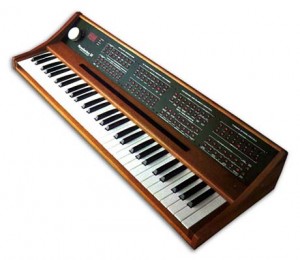
The typical Synclavier system consists of a durable 76-note keyboard peppered with 132 illuminated buttons and a single control knob, connected to a rack-mounted CPU running NED’s own 16-bit ABLE operating system plus the nostalgic mid-eighties looking mono-chromatic computer monitor/keyboard. Patches, sound files, sequences and samples are stored to 5.25″ diskette, hard disk or in some models, magneto-optical drives.
It should be noted that there are all sorts of ‘sub-revisions’ of the hardware component of the Synclav II, and these make each version capable/incapable of doing certain things. Some lower-end versions are not capable of using the ‘Timbre-frame’ timbral scanning programming method. Others are not capable of handling a MIDI retrofit. And all of these have different ‘top versions’ of the OS that they can handle, making the purchase of a used Synclav system a dicey affair. You can’t always be 100% sure of which variation you’re buying without some extreme care being paid to which hardware it has and what versions of the OS it’s capable of running. You could therefore be buying anything from a high-end sampling/sequencing workstation unit to a rather complex 12-op FM/additive synth, and several possibilities in between.
From its specs alone it can be seen that the Synclavier is a masterpiece digital sampler / synthesizer workstation which was the first of its kind, and way ahead of its time. They command prices well into the thousands ($25,000 to $200,000) and are only used by those who can afford such. New Synclavier systems (including new hardware, software, and Mac OS X emulations of the Synclavier operating system) service, and support are currently available through DEMAS, the company created after the fall of New England Digital in 1992.
Synclaviers have been used by The Cure, New Order, George Duke, Pat Metheny, Sting, Stevie Wonder, Paul Simon, Foreigner, Michael Jackson, Pink Floyd, Kraftwerk, Depeche Mode, Genesis, Kim Wilde, The Cars, Soft Cell, Geoff Downes, Frank Zappa, and film composer Alan Silvestri.
Realtime sound visualisation made with custom software “Partitura”
Partitura is a custom software to generate realtime graphics aimed at visualising sound. The term “Partitura” (score) implies a connection with music, and this metaphor is the main focus of the project. Partitura aims to create a new system for translating sound into visual forms. Inspired by the studies of artists such as Kandinsky, Paul Klee, Oscar Fischinger and Norman McLaren, the images generated by Partitura are based on a precise and coherent system of relationships between various types of geometries. The main characteristic of this system is its horizontal linear structure, like that of a musical score. It is along this linear environment that the different classes of abstract elements are created and evolve over time according to the sound. Partitura creates endless ever-evolving abstract landscapes that can respond to musical structures, audio analysis and manual gestural inputs. It is an instrument that visualises sound with both the freedom of spontaneous personal interpretation/improvisation and at the same time maintaining the automations and triggers of mathematical precision.
Partitura defines a coherent language of its own for the creation of new contemporary abstractions. It is within this system that Partitura creates worlds that expand from a single dot to multiple galaxies, from minimalism to complexity, from rigid to elastic, from solid to liquid, from angular to smoothness, from tentative to boldness, from calm to agitation, from slow to fast, from desaturated to saturation, from dark to lightness, from predictable to unpredictability. Literally ‘everything’ and its opposite… just like a musical flow.
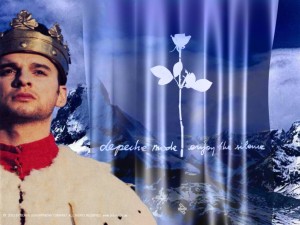
The making of Depeche Mode’s “Enjoy The Silence”
Here’s a great video from the Mute festival talking about the story behind one of my all time faorite DM tracks. Flood, the legendary producer of many classic albums, describes how the song Enjoy The Silence by Depeche Mode was created in the studio.
In this video:
I’m sorry about the bad sound and video quality – at the close position I was standing, the speakers were actually behind me, there was a lot of rumble from the hall below, and those big windows created a heavy backlight. It doesn’t make the speech less interesting, though…
This was recorded May 14th 2011 in the Roundhouse, London at the Mute Short Circuit Festival.
Documentary on the technoproducer behind acts like Plastikman – Richie Hawtin
Here’s a new 70 minute documentary about Richie Hawtin. In it you’ll learn all about the Canadian techno producer behind Plastikman, F.U.S.E, and key Detroit electronic music figure with ‘testimonials’ from people such as Daniel Miller (yes, we know, Side-Line looks like being sponsored by Mute these days) etc. The film is the first of the “Slices: Pioneers Of Electronic Music” series originally released on DVD.
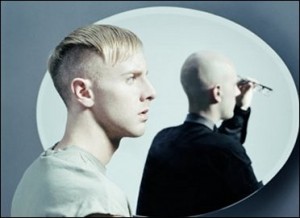
Born in Banbury, Oxfordshire in the UK, Richie Hawtin began his DJ career in Detroit and now resides in Berlin.
SoundPrism Pro Expression Trailer
Here’s a new trailer for Soundprism Pro, an advanced MIDI Controller for iOS
What is SoundPrism Pro?
* a professional composition tool and midi controller
* an interactive generator for harmonic sound textures and epic cinema tracks
* a completely new way to control existing VSTis, synthesizers and sound modules
* an intuitive way to visualize and internalize musical relationships
* an innovative way to interact musically with geometric pitch space visualizations
* a way to define awesome pitch layouts by using the new PitchClassShifter
What can I do with it?
* compose film soundtracks
* find new chord progressions for your pop and rock songs
* create loops with advanced tonality
* compose epic sound textures for your next video game
* provide your media presentations with self made music
In this video:
http://soundprism.com/pro/
SoundPrism Pro 1.4 now supports Accelerometer Input.
Back to the 80’s for some computer action
The Apple II became one of the most recognizable and successful computers during the 1980s and early 1990s. It was aggressively marketed through volume discounts and manufacturing arrangements to educational institutions which made it the first computer in widespread use in American secondary schools. The effort to develop educational and business software for the Apple II, including the 1979 release of the popular VisiCalc spreadsheet, made the computer especially popular with business users and families. Here’s a capture in 1982 demonstrating a sound card for the Apple II that makes “three distinct tones” which were in fact square waves.
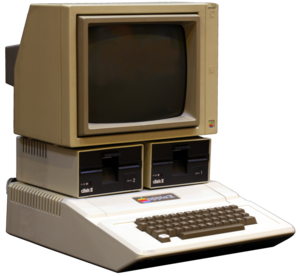
In this video:
If i remember correctly you could peek & poke machine code values to change the duty cycle of the waveform, but mostly you just bleeped away in square.
The clip is from the ABC Children’s Education show “Computers in Action” which was showing kids the amazing things computers could do at the time. I think the segment after mine was about traffic lights.
Controlling a dubstep wobble on your iPad
An experiment using an iPad and the Konkreet Performer app to control dubstep wobble / LFO sounds and drum effects in Traktor 2. Konkreet uses multi-touch technology to the full. Instead of traditional faders and knobs, use multi-touch and gestures to manipulate PERFORMER’s beautiful shapes to dynamically control your computer’s software instruments in real-time.
In the studio, it allows the artist to approach their sound-design routine from a new, inspiring angle: to reconnect to their software instruments and Digital Audio Workstations by using Performer’s revolutionary interface and arriving at sounds and progressions impossible with traditional controllers.
More info:
Download the Traktor 2 and OSCulator template files for free at http://digitaldjtools.net/news/traktor-mapping-for-konkreet-performer-wobbula…
Sell your music via Facebook – here’s how
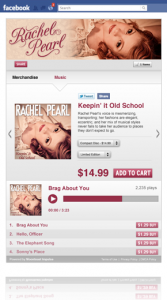
Moontoast Impulse is a new music app for Facebook that let’s fans listen, share, and buy without leaving the site. The entire song transaction occurs within Facebook.
The app lives on an artist’s Facebook page; it has a customizable interface. Fans can share individual songs and post them on their wall for their friends to see.
On the back-end, the Moontoast Impulse app lets artists look at top plays, top downloads, and top sales, as well as, who brought what and when.
If you’re managing multiple accounts, you can easily toggle between stores.
“We believe social commerce – selling through social sites like Facebook – represents a huge opportunity for artists to take commercial control of their music,” Moontoast CEO Blair Heavey told Hypebot. “We designed Moontoast Impulse to help musicians leverage the power of these communities.”
Similar technology was used by Big Machine Label Group to boost the online sales of artists like Taylor Swift, Rascal Flatts, and Reba.
The app has no sign-up or subscription costs, but Moontoast, the creator of the app, does take 15% revenue share on all sales through Moontoast Impulse.
In the near future, they will be offering sales of physical merch, an e-mail mailing list builder, and a free download for an e-mail capture widget.
For now, the app is only for use on Facebook, but in the future Moontoast plans to build apps and widgets that can be used everywhere.
DATAMASKIN

