
Reaktor: Quick demo of “Xylo” sample instrument
Background information:
Quick demo of “Xylo” which is a sampler instrument I’ve built in Reaktor over the last two evenings. It was inspired by watching a video by Clark Nova (http://vimeo.com/3059674) and the bug in Kontakt that meant I couldn’t reproduce it.
Xylo has 8 voices where each voice plays a loop, back and forth, across a shared sample. Each loop starts at the same point but has a different length, playback speed, and granular settings.
It’s designed to have a very long release time so that the loops carry on playing and bouncing off each other in a (hopefully) satisfying way.
Live improvization on the Fenix synth
Synton was a manufacturer and distributor of high-end electronic music equipment in the Netherlands. They were one of the principal importers of music equipment from E-Mu, Ensoniq, and Fairlight in Europe. Felix Visser, the founder of Synton began the company in 1973 after purchasing an EMS Synthi AKS and setting out to produce similar equipment with more of the functionality that he was looking for in an analog synth. Eventually, the company developed Synton Syntovox vocoders as well as the System 2000 and System 3000 modular synthesizers that were sold to Karlheinz Stockhausen and distributed in the United States by Bob Moog’s Big Briar Inc. In 1983, Felix Visser, product specialist Marc Paping, and designer Bert Vermeulen created the Synton Syrinx, a monophonic analog synthesizer that contained unique features such as a metal touchplate for manipulating sound as well as a formant filter.
Because none of the commercial analog synthesizers on the market had the same features as the synthesizer he wanted, Marc Paping and Bert Vermeulen reunited in 1997 to create the Synton Fenix, an analog modular synthesizer featuring 31 differing modules. The Synton Fenix featured an esoteric range of features and was the culmination of the designs that Paping and Vermeulen had liked in the vintage analog synthesizers that they had owned, played, and developed in the past. After creating an initial 25 handbuilt units and distributing these to close friends and fans of the Synton company, the team decided to handbuild another 50 units due to high demand from word of mouth. In total, only 75 units were created and the team stopped production of the Fenix in 2000. Musicians have cited the Synton Fenix as their favorite piece of musical equipment due to the combination of unique modules and distinctive sounds the synthesizer was able to create.
Teaser from the upcoming new Erasure album – listen here
Erasure – When I Start To (Break It All Down) by Mute UK
Erasure are soon ready to ship their new studio album “Tomorrow’s World”, released in early October.

But before it’s time for the album to land in stores there’s a new teaser out from the British synth pop duo with the single “When I Start To (Break It All Down)” coming in the end of September. The title track remixed by the duo including Steve Smart / West Funk and the multi-faceted songwriter, producer and mixaer Kris Menace (aka Christophe Hoeffel), as well as their own material also is known for his work with Felix Da Housecat. Kris is also known for the production and remix work for a host of other artists such as Moby, Air, Röyksopp, and Depeche Mode.
Watch the exclusive new video from Moby
Moby has released the music video for his latest single, “Lie Down in Darkness,” featuring an old Russian cosmonaut looking back on his time in outer space, in an exclusive Wired premiere. The music video, directed by Luke Seomore and Joseph Bull (Institute for Eyes) was shot in London last month.
“We really liked the idea of an old astronaut in a modern city contrasted with the astronaut in his youth travelling to space,” he added.
The team worked hard to research the video, drawing inspiration from Yuri Gagarin biography Starman. They were particularly interested in the partners of cosmonauts and astronauts. “They have an interesting dichotomy: On one hand they are really proud that their other half is going into space, but there is also this great fear,” said Seomore. “This idea is explored within the music video. Similarly the astronauts have a great sense of pride but at the same time isolation, because so few people have had the same experience.”
Seomore and Bull went to great pains to find an actor with a strong enough face. “There were loads of actors who looked like dads out of butter adverts,” said Seomore. “Keith [Chanter] walked in and he felt like someone important. The funny thing is that he was actually very posh English. He’d be in the car talking in long monologues saying things like [in a plummy English voice], ‘It’s a funny old game, acting.’”
The team shot the video around London over two days in locations including South Bank and a swimming pool in Walthamstow that opened in 1968 and has all of the original fittings, giving it “a Soviet feel.”
They managed to source a real space helmet, which had to be modified to ensure that it no longer formed a vacuum around the wearer’s head. Without the air supply that would be used in space, it would otherwise have had a suffocating effect on the actor. They also sourced primitive ’60s computers and shot using uncoated lenses to give it a retro feel.
The edit was simple, but the post-production was relatively complicated because the team was keen to replicate the effects of ’60s space footage. “We wanted it to look like the footage from the original space flights where they had primitive video cameras that distorted the image to look like really grainy CCTV,” said Seomore.
Moby took a hands-on role when it came to post-production, offering quite a bit of feedback to the directing duo. “We were pretty harmonious most of the time,” said Seomore, “although he was keen to emphasize the contrast of how the ‘old’ footage was graded versus the ‘modern’ footage, whereas we wanted to keep it a bit ambiguous.”
Via WM
Updates for the circuit modeled emulation of the legendary SID chip
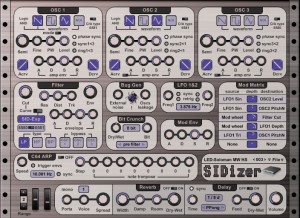
HyperSynth has released an update of SIDizer, a circuit modeled emulation of the legendary SID chip.
SIDizer is a state-of-art emulation of legendary SID chip in a form of a modern software synthesizer. Using circuit modeling technology nearly all unique features of two versions (6581-8580) of SID chip among their famous flaws are accurately modeled.
Changes in SIDizer v1.2
- Added new modulation source: LFO S/H.
- Added Loop point option for wavetable sequencer.
- Fixed crash while changing filter types.
- Fixed issue with preset manager lock feature that was produced in v1.1.
SIDizer for Windows (VST) is available to purchase for $49 USD.
Main features:
-3 oscillators offering 8 waveforms: Saw, Triangle, Square, Pitched noise, “AND” combinations of them
-Oscillators special features: ring, sync, phase sync, Sqr PW, level
-Wavetable sequencer (8 tracks)
-Selectable 6581-8580 D/A distortion
-3 Amp envelopes ADSR
-12 dB (LP & HP), 6 dB BP SID modeled Filter
-Best matched Exponential-fitted curves for 6581-8580 filter frequencies
-Simulating 6581 half wave filter distortion
-1 Filter envelope + key track for filter freq
-2 LFOs each with 4 simultaneous outputs offering sync and retriggering option
-1 Mod envelope
-Versatile Modulation matrix
-Bug-generator module for reproducing famous bugs: oscillator leakage, ex-input noise
-Bit Cruncher with pre and post filter route option
-Advanced 8 step C64 like arpeggiator
-Master: Pitch and Mod wheel, Porta, Spread, Reverb, Delay
-Easy to use GUI
-Factory soundbank created by Torben Hansen (aka Metal of Vibrants)
Amsterdam Dance Event 2011 – Electronic Music Festival
Time again on the 19th – 22nd of October, 2011
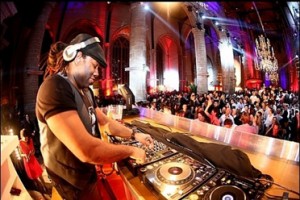
The Amsterdam Dance Event (ADE) is the leading electronic music conference and the world’s biggest club festival for electronic music. The event offers a unique blend of daytime conferences, including interactive workshops, technical demonstrations and in-depth round-table discussions, alongside a nighttime music festival which takes place in 44 venues around the city. The annual event attracts 2,500 business professionals and 112,000 festival visitors from all around the globe.
Ostinato for 8 iPods – by DigiEnsemble Berlin
“Ostinato for 8 iPods” – Classical Music with smartphones – DigiEnsemble: flutes and violins made of smartphones! The DigiEnsemble Berlin is in uncharted waters. It plays classical music with smartphones. Now, they come out with comprehensive material showing how to make joint music with smartphones and tablet-PCs. With its own composition „Ostinato for 8 iPods” the DigiEnsemble Berlin releases an own piece of music especially composed for mobile gadget. Oriented to classical music it meets the opportunities of a smartphone that turn it into an instrument.
„Ostinato for 8 iPods” is appropriate to eight players with iPods, iPhones or iPads. With a little practice it sounds like a polyphonic instrumental piece. Commented by words of its composer the sheet music for “Ostinato for 8 iPods” is published for free usage. The piece especially addresses those who have never learned an instrument or only rarely use it. The way it is designed opens the possibilities of making digi-music to everyone – even to beginners. In its newly produced video the DigiEnsemble gives a foretaste of its prowess. From close camera perspective the art of playing can be seen in detail. The digi-musicians show how they play their instruments individually. Moreover the DigiEnsemble gives answers to questions not only musicians are concerned with: How does it work? What is special about making digi-music? What are digi-instruments good for? The DigiEnsemble Berlin makes smartphones sound like music instruments. Eight partly classical educated musicians got together trying out how to turn iPods, iPhones and iPads into instruments. Everybody is invited to share this experience and turn school break, coffee klatch or regulars´ table into a smartphone orchestra rehearsal.
How does yours sound?
—
The DigiEnsemble is an experimental study group founded and led by Matthias Krebs that follows a systematic approach to playing on mobile devices (iphone, ipad & co). Regular meetings are held for group practice as well as discussion and refinement of the approach.
If you would like to join us for the ensemble or would like to have more first hand information, please contact us at [info(at)digiensemble.de]
* http://digiensemble.de (german)
* http://youtube.com/digiensemble
* http://facebook.com/digiensemble
* http://twitter.com/digiensemble
* http://flickr.com/photos/digiensemble/
* http://soundcloud.com/digiensemble
Sneak preview – REASON 6 BETA
This guy has uploaded a video showing off his first impressions working on the upcoming release of Reason:
Here’s what they have to say about Reason 6:
Version 6 adds audio recording and editing into Reason, along with Propellerhead’s acclaimed mixing console with masterfully modeled EQ and dynamics on every channel, multiple parallel racks, all the effects you know and love plus new ones to fall in love with, and much more of what you’ve always wanted in Reason.
Propellerhead says Reason 6 will be available Sept 30th
Fancy Lady Circuit-bent Delay
Background information:
Here’s a circuit bent delay, built from a karaoke machine. There are four feedback modes: soft, hard, static wave, and dump repeat. The speed can vary from a fraction of a second to over ten seconds, with awesome grain added as the delay increases. A hold and pulse button are also provided. Runs off batteries and has built-in speakers. Makes noise without anything running through it as well.
Crystal forest – by Bruno and his analogs
VELVET VOYAGE – “Kristallwald” (Crystal Forest) – Performed by Bruno Ender Lee, August 13. 2011
The Crystal-Sequence and some FX are pre-recorded, from the 2004-CD “Traummaschine”, with Arturia Modular Moog V. The Live-Part: Moog Little Phatty Stage II, Synthesizers.com Studio-88, ARP Odyssey, MacBeth M5N, Roland Juno-60, Roland JP-8000, Analogue Solutions Vostok, Korg MS-2000, Moog Etherwave Theremin
DATAMASKIN

