
Live modular performance – Muon Dependency
Would love to spend some time in this dude’s studio 
A live performance. A 137 space modular synthesizer, Waldorf MicroWaveXT, Dave Smith Prophet 08, Nord Lead 2X, Yamaha TX816, DX7II, and Oberheim Matrix 6.
All synthesizers are controlled either with Numerology 3 Pro or from the modular synth on-board sequencers. Recorded in Cubase 4 from Steinberg.
I played a single line at various times on the DX7II. Everything else is fully automated including a pseudo-random sequence generated by a Catgirl Synth Suboscillator/Harmonic Sequencer module by Ken Stone.
The baseline is the Prophet 08 controlled by a midi output from the synthesizers.com Q172 midi output of a Q960 8 step sequencer pattern.
Background info on the Numerology 3 Pro:
Numerology 3 is a music sequencing and audio plugin environment which uses an innovative approach to electronic music composition based on modular step sequencing. With version 3 Numerology now comes in two flavors: a Standard Edition for anyone that wants an economical step sequencing addition to their studio, and a Pro version with advanced features for users looking to make Numerology a cornerstone of their compositional workflow. Another major addition is an AudioUnit version of Numerology that allows users of supported hosts to add advanced step sequencing to their DAW-based workflow. The Numerology AU is the first Audio Unit plugin to offer sample-accurate MIDI scheduling and built-in latency control.
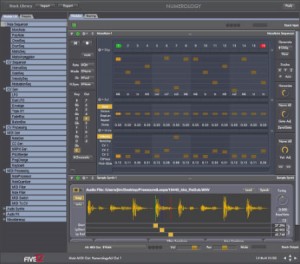
Other highlights of Numerology 3 include new generative sequencing options, a completely revised user interface, a preset playlist, a humanize function, Audio and MIDI recording for every part, and several new and updated modules. These features expand and complement the capabilities provided by Numerology’s extensive list of sequencing and signal processing modules. With version 3, Numerology’s library of modules now numbers more than 50, not including hosted Audio Units.
The Generate and Evolve features in Numerology 3 allow users to explore new compositional territory by using generative algorithms both to create new patters, and to make transformations to existing patterns. The Generate feature includes 18 algorithms for generating new patterns, and is setup to allow users to easily control the musical context in which the pattern is generated. Evolve goes a step further by allowing users to program specific algorithmic changes to a sequence. These changes can be triggered directly, or setup to automatically repeat for regularized pattern modulation.
Features specific to the Pro version of Numerology include multi-output support for hosted AudioUnits, monophonic audio routing support, OSC support, custom scale quantization, and several new modules specifically oriented for building advanced sequencer setups. Included in that set are gate generator and clock offset modules, a CV To Audio module for driving an analog synthesizer directly from Numerology (with a DC-capable audio interface), and a pair of operator modules supporting a total of 61 functions.
Both the Pro and SE versions of Numerology 3 come with much improved synthesis options for the built-in sample-based SampleSynth and DrumKit modules. These modules now include a multi-mode filter, 2 AHDSR envelopes, a beat-synchronized LFO and a modulation matrix. Complementing these additions are a new set of built-in audio effects, including tempo-synchronized delays, multi-mode filtering, and a ring modulator.
Two new features in Numerology 3 greatly expand user options for storing and sharing presets and patterns, the Stack Library and Module Presets. The Stack Library is a new centralized location for storing part-oriented sequencing and synthesis setups. The Numerology 3 download comes with a library of stacks that include a variety of demo tracks, examples and core sequencing templates. In addition, the new module preset function in Numerology 3 allows users to easily store and load settings for any module. This feature is particularly handy for keeping track of sequencer patterns as well as building preset libraries for the SampleSynth and DrumKit modules.
OSX Lion fix for Ableton Live

There’s a new beta of Live supporting Mac OSX Lion.
Apartment Music
Apartment Music #11 was the second in a series curated by Hal McGee (Gainesville, FL) which featured live streaming video, plus two performers from remote locations. Otolathe broadcasting from Tampa, FL was one of these remote performers, and the other was Otto von Rhinau and Friends from Strasbourg, France. The show also featured Andrew Weathers & Hal McGee, Adam Scott Neal, Andrew Chadwick, Christopher Nadeau, Keahota Hota, Lumen Kishkumen, and Nicholas Rejack.
Reaktor: Massive Automaton Morning
Featuring Massive:
I’ve been enjoying playing with the Reaktor ensemble Massive lately, thanks in no small part to bkallmer’s tutorials on bluewatervst.com. In this sketch I’m using a beat written with the Gogood snapshot ran thru Audio Damage’s Automaton effects device – one of my favorites!
Wet Dream War Machine – cave electro :-)
Noise Comedy in a Cave. Head Mounted Spring Reverb Cajon with electronics. September 2009, Hyogo, Japan.
Cakewalk: Z3TA+ 2 Sound Examples – Sequences and Arps
Sound examples of Sequences and Arps from Z3TA+ 2’s new sound library.
The legendary waveshaping sound of Z3TA+ (zay’-ta) is back – and better than ever. New filters, modulatable waveshapers, flexible effects, expressive control and a gorgeous new interface make Z3TA+ 2 one seriously powerful synth. It’s not often that a soft synth can be called a classic, but in the case of Z3TA+ it’s definitely appropriate. Used on countless tracks over the past decade, Z3TA+’s distinctive sound has been a staple of electronic artists the world over.
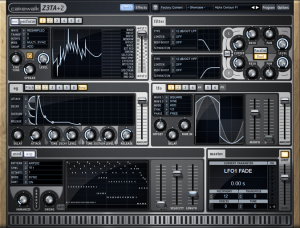
Z3TA+ 2 has a completely redesigned user interface that inspires performance and makes sound design clear and comfortable while preserving that signature sound that has made it a favorite of top producers and musicians around the world.
Showcasing the WMD Gamma Wave Source
The WMD Gamma Wave Source is a dual digital wavetable VCO that can create millions of timbres using onboard digital “effects”.
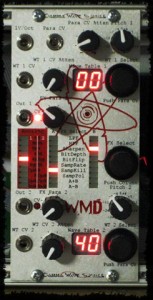
The Controls
1V/Oct – Pitch input, used with standard 1 Volt per Octave keyboards and MIDI-CV converters. 0-5 volt input.
Pitch 1 & 2 – Controls the relative pitch per channel.
WT 1 & 2 Select – Select the desired wave table from the chart. 256 are available, each producing a different sound. Click for the table chart.
Out 1 & 2- Oscilator section output, each puts out +-2.5V/ 5Vpp signal.
The Effects Section
The GWS has four effects pipelines. Two for each oscilator. The Routing table selects how the oscillators interact with the effects pipelines.
FX Select Knob – Pushing this knob in will select the column that the knob is adjusting. Turning it will adjust the LEDs in the select column and will alter the Routing or Effects selection.
FX Para 1 & 2 – These knobs control the FX parameter for the oscillator section. Each effect has a specific parameter that is controlled by this knob. Adujust to taste.
Para CV & Attenuation Knob – This is a CV input for modulating and controlling the effects on the oscillator. Press the WaveTable Select knob to activate CV control per oscillator section. The LED will light when CV control is active. The FX Para knob will adjust the center or edges of the CV control depending on the selected effect.
Effects Table – These are the available effects, they are all created mathematically using 8 bit processing. The result is generally lo-fi and edgy, but smooth fat sounds are also possible.
In this video:
Here’s a little Kraftwerk-like jam showcasing the WMD Gamma Wave Source wavetable oscillator module.
Our TR-909 Rim Out is clocking the Kilpatrick K4815 Pattern Generator and one side of a Livewire Dual Bissell Generator as a simple Attack/Decay envelope generator.
The pitch CV of the K4815 is running to the other side of the Dual-Bissel, using it to generate portamento. This is much more fun than your typical portamento as you have control of up and down glide rates.
The new Critter and Guitari Pocket Piano GR is being played using its new mono glide mode, which sounds really nice!
For filters on the Gamma we’re using a Division 6 Filtaire, modulated by the Livewire Vulcan’s sinewave, and a Metasonix R-54. We’re also using a Metasonix r-51 as our VCA and the Flight Of Harmony ‘Sound of Shadows’ karaoke delay.
EGDR808 – new emulated drum machine
ElliottGarage presents EGDR808, a drum machine that emulates the vintage hardware from the 80′s. Its realistic and clear interface recalls the analog machine from the past, for all the vintage fanatics. You can play with the rythm presets included or you can create your own pattern.
Features:
– Interface like the real drum machine from the 80′s
– 16 steps sequencer
– 12 programmable rythm patterns and 4 fills patterns
– Auto fill in every 2, 4, 8, 12 or 16 pattern
– Save the pattern you’ve created and play your songs
Modular Sequenced with Ribbon Controller
http://youtu.be/IFYlz-Onto0
Background information:
Using a hybrid 5U modular synthesizer, this recording is a live performance with a Walking Stick 500mm ribbon controller solo. The synth is running multiple sequencers, oscillators, filters, and envelopes, in order to play all of the parts at once. A dotcom Q119 sequencer is used for three lines of sequence, and it is triggered by a STG Trigger Store. Nothing is multi-tracked.
Bandecho – tape delay – sustain/feedback
Bandecho is a plugin modelled after vintage tape echoes like Roland Space Echo and Watkins Copicat, but with several extra features making it one of the best sounding echo machines available. We believe that the sounds you can get from this beauty are far more versatile than any tape echo on the market
Bluenoise Plugins tell us that their new Bandecho is a plug-in modelled after vintage tape echoes like Roland Space Echo and Watkins Copicat, but with several extra features making it one of the best sounding echo machines available. They believe that the sounds you can get from this beauty are far more versatile than any tape echo on the marked. Here’s what they have to say about it in their own words…
If you are looking for everything from vintage tape echo to extreme textured delay lines, look no further!
Tape echo rack
Bandecho actually consists of eight echoes and not one as you might think. The first is the stereo tape echo that is the heart in the plugin and what drives all the other functions. This echo can be up to 5 seconds long and can be synced to your host BPM for easy beat making. The readouts automatically change from milliseconds to beat when set syncing to host. You can change from regular quarter notes to dotted and triples. The two sliders adjust the time and in stereo mode you can set a different echo time for left and right. This is something you can’t do in a real tape echo! It also has some very interesting filters that can make the echo oscillate new tones and a LFO that can modulate different sources like the mentioned cutoff filters and panning.
Drive rack
In our opinion an echo needs a distortion part to sound great and this drive is something special. Because it has a cutoff and a resonance it can self oscillate and create tones inside the distortion. Basically you can send the whole signal through the oscillating distortion to make it sound warm or to give it more bite! This is very usefull if you want to create a vintage sounding echo.
Effect track
The effect rack consists of several unique effects perfect for making the echo shine…or should we say crackle. The first part is the Old Tape which makes the tape slow down and speed up like a bad tapehead. The next part is the Granilizer which really gives the tape a dirty sound. It crouches the echoes down to small fragments. At the bottom there is a Chorus and that does what you expect. On the righthand side is the Comb Filter which is the second echo stage in Bandecho. By adding a super short delay we can make each echo taps sound like tiny reverbs of their own. It kind of gives the feeling of sending the echo signal into a resonating small room.
Multiecho rack
The multiecho rack consists of the six last echoes in the chain. The first two are taken from the input signal making it two extra basic echoes. The third and the fourth are taken after the distortion part and will echo the distorted signal. The last two echoes are taken after the combfilter and will therefore have all the different processes included when echoed. These six echos are some of the unique about the plugin and the main reason why this echo can do insanely wide and complex delay lines.
Output rack
The last rack is the output rack where you where you can set the plugin up to be a send effect or an insert effect. It also shows the outputs for all the different delays.
Usage
Bandecho is built to be very easy to use. The workflow is logical and though it has many advanced features we believe that the user will quickly be familiar with the different possibilities within the plugin. It comes with 100 presets included from the very basic slapback echoes to advanced modelled delays. We give you a great starting point and you should easily find the sound you are looking for.
Pricing and Availability:
€35 | $50 | £31
More information:
DATAMASKIN

