
A new version of GarageBand has seen the light of day
Apart from the launch of the new iPad, Apple has also released GarageBand 1.2, a significant update that adds MIDI note editing – a feature that’s been on most users’ wish list from the start.
Previously, the only way you could fix a mis-timed recording was to use GarageBand’s quantise features, but note-by-note editing is now confirmed.
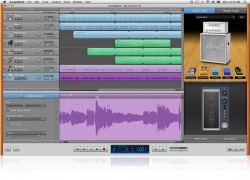
This isn’t the only new feature, we also have a new Touch Instrument in the shape of Smart Strings, while Jam Sesssion enables you to play with up to three other GarageBand for iOS users wirelessly.
Here are the highlights:
- GarageBand 1.2 introduces Jam Session, a feature that lets groups of people wirelessly connect their iOS devices to play instruments and record live music together. Jam Session automatically synchronizes the tempo, key and chords of your Touch Instruments. After jamming, everyone’s tracks are automatically collected on your iOS device for you to edit and mix.
- GarageBand also introduces Smart Strings, a new Touch Instrument that allows you to ‘play’ a string orchestra with one finger.
- The new Note Editor is probably the most welcome addition. It allows you to fine tune a Touch Instrument recording instead of replaying it from scratch.
- Integration with iCloud keeps your GarageBand songs up to date across your iOS devices, and you can share your finished songs directly to Facebook, YouTube and SoundCloud.
GarageBand 1.2 will be released today for $4.99. Updates are available for free to existing customers.
Vintage Synthesizers I PPG wave 2.2
A voyage into the heart of the PPG wave 2.2 Wavetable Synthesizer from the year 1982.
Polyphony – 8 voices | ssm filter chip module based.
It has been used by Trevor Horn, Gary Numan, Art Of Noise, Frankie Goes To Hollywood, Depeche Mode, Propaganda, Saga and many more!
Exploration by Marko Ettlich
Every sound you hear in this song was made from human voices
Here are the details:
Every sound you hear in this song was made from human voices.
I wandered around with a little microphone at GDC San Francisco 2011 to record vocal sounds from anyone who was willing to make them. I wanted to make a song out of these noises. In fact, I wanted to make a complete song, using nothing but these vocal recordings.
This is that song.
People grunted, groaned, moaned, screeched, screamed, and sang into my little microphone and I used this source material to produce Voices of Devs.
Absolutely everything you hear in this track was made by manipulating these recordings using various sound design techniques. Every drum, lead, chord and effect was, at one point in time, a recording of somebody making noises with their mouth at GDC San Francisco 2011. No other samples, synths, instruments or recordings were used in this track. Whatsoever.
You can read more about how this was achieved right here: http://bit.ly/GDC-Song
Visit these places to purchase:
http://mickgordon.bandcamp.com/
Remember to subscribe!
Follow me on Twitter: http://twitter.com/Mick_Gordon
Like me on Facebook: http://facebook.com/MickGordonMusic
Visit my site: http://mick-gordon.com
Software used: Adobe Audition 3.1, FL Studio 10, Melodyne, Reaktor, Kontakt, PaulStretch, and stacks of plugins.
The Voices:
Jeff Ball, Sean Beeson, Alex Brandon, Nathaniel Chambers, Ben “Crossbones” Cooper, Charles Deenen, Brian DiDomencio, Morla Gorrondona, Joe Griffith, Lance Hayes, Kole Hicks, Jimmy Hinson, Thomas Kohl, Sam Hulick, Jake Kaufman, Kieran Lord, Kunal Majmudar, John Mazzei, Hazel Mckendrick, Ben Minto, Keith Moore, Lennie Moore, Jayson Napolitano, James Nixon, Dan Reynolds, Pontus Rufelt, Michael Schiciano, Paul Sivertsen, Jeremy Taylor, Hillary Thomas, Joe Thwaits, Steve Tushar, Mike Worth.
Create Digital Music’s MeeBlip SE gets easier to use and MIDI-controllable
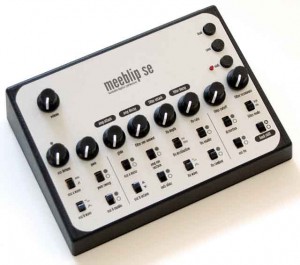
Create Digital Music are building and shipping MeeBlip SE. A spokesperson said, “Whatever the ‘SE’ stands for – seconda edizione, or a meaning of your own choosing – the MeeBlip SE is the original MeeBlip, but better. Building on the first version of our open source synthesizer, we’ve worked with feedback from users to make the MeeBlip more usable and more sonically versatile.”
New in this version:
- A more intuitive, playable control layout. The changes are subtle, but after lots of conversations with users, we worked to make each knob and switch the choice we liked best. (Of course, you can still modify those choices via our open source firmware, if you like.)
- Patch storage. Sure, it was a bit more “pure” never being able to store patches, but this is a digital synth, after all. Now, you can save and recall up to 16 patches right on the MeeBlip, using dedicated front panel load and save buttons. It’s especially nice for live performance.
- Variable pulse width. Instead of a fixed square wave, you can now use the dedicated PWM knob to adjust the timbre of the first oscillator. There’s also a “pwm sweep” switch for enabling an automated PWM envelope, of which we’ve grown rather fond. Hello, thick synth leads.
- Anti-aliasing. You can now use more pristine anti-aliased waveforms, or turn this off for other timbral effects. It gives you another option for coloring the MeeBlip’s sound.
- Control everything with MIDI. It’s simple: if there’s a sound parameter in the MeeBlip, there’s a switch or knob to play with it. And now, the reverse is true, too: if you see a switch or knob, you can control it via MIDI. At last, you can use a tracker or sequencer to program detailed MeeBlip sounds.
Pricing and Availability:
MeeBlip SE Quick Build Synthesizer: $139.95 until March 31st ($149.95 after that)
MeeBlip SE Build Everything Kit; $119.95 until March 31st ($129.95 after that)
MeeBlip micro Kit: $39.95
More information:
Basslyne – new bass plugin VST for electronic music
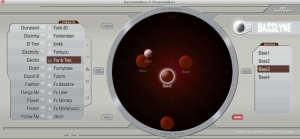
DaSample has released Basslyne, a new Bass plugin VST instrument for Windows and Mac OS X dedicated to electronic music.
Now you can easily create and shape your sound. Instant access to different presets is quick and easy. The ability to use multiple oscillators allows Basslyne to produce powerful electronic and virtual analog-bass instruments.
Features:
- Powerfully simple interface.
- Stack Module synthesis.
- Easy To Use.
- Sophisticated EQ Overdrive.
- Advanced Automation.
- User friendly interface.
- Integrated, full-featured FX Racks.
- Expandable sound architecture.
- FM Oscillators.
Price: €39.
Richie Hawtin 2012 NAMM Report
Richie Hawtin is a regular attendee of the NAMM trade event — which takes place in January in Anaheim, California. Its a rare opportunity to look behind the curtain of what makes the technology industry operate — which fuels the work of Richie Hawtin. Here Richie tours the event to provide this exclusive video report for his followers
NAMM Members represent every aspect of musical instrument manufacturing and retailing.
Edit by Barbara Klein
Camera by Jonni Rutkowski
Video introduction to the new “CLAUDE CONTROLLER”
Here are the background details from the inventor himself:
This is my latest (and greatest) invention. It is a very sophisticated MIDI controller, allowing the player to articulate many parts of the sound – filters, envelopes.effects etc simultaneously using your left hand and feet. The right hand plays a keyboard with my patented ‘Vibe Bar’ for imparting vibrato & pitch bend.
I think it’s going to be the future of the synthesiser controller!
It consists of 36 wheels and 2 joysticks…….with a pedalboard – 2 peddles and 4 switches..very playable, very cool.
The MIDI circuit is Livid Instruments MIDI Brain.
I like to think of a synthesiser more like an acoustic instrument – rather than an instrument containing 1000 different sounds, you have 1 sound with 1000 articulate-able variations.
Review of Focusrite VRM Box
Russ from Pro Tools Expert unboxes and then reviews the Focusrite VRM virtual monitor system.
“The high-quality USB headphone interface with a difference. VRM stands for Virtual Reference Monitoring. It emulates the experience of mixing in real rooms, with real speakers using headphones. With three rooms and 15 speaker models you get multiple perspectives on your mix. No more burning CDs to listen to your latest creation in the living room! ”
Arturia Spark Vintage Drum Machines
SPARK Vintage Drum Machines brings 30 legendary drum machines to the musician.
Intuitive and powerful, this software is much more than your typical sample player. By mixing high quality samples and virtual analog synthesis (based on TAE®), Spark Vintage Drum Machines manages to capture the unique soul of these instruments.
More details : http://www.arturia.com/sparkvdm
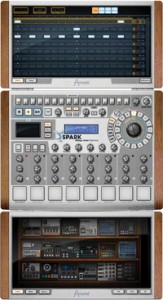
MAIN FEATURES:
- 30 legendary drum machines including: Roland TR-808, TR-707, TR-909, CR-78, Korg KPR-77, Mini Pops 7, LinnDrum, Yamaha RX5, Maestro Rhythm King MKII, Simmons SDS V,…
- Easy workflow: one interface to learn, thirty drum machines to play
- Made for live performance: XY Pad, Beat Looper, Slicer, Real-time automation on all parameters
- 14 high quality effects : Multiband Compressor, Reverb, Bit crusher, Multiband EQ, Chorus, Delay, Distortion, Phaser, Plate reverb, Destroyer, Flanger, Space pan, Limiter, Sub generator
- Spark’s Step Sequencer makes track creation a breeze
- Perfect integration: 16 independant audio outputs, midi I/O
- Unparalleled sound quality based on virtual analog synthesis (TAE®) and high resolution sampling
- 64 patterns pre-programmed for each drum machine
Saturn – new distortion and saturation effect
FabFilter has introduced its latest audio processing plugin Saturn, a distortion and saturation effect. In this tutorial, Dan Worrall explains the basics of FabFilter Saturn. He starts with a simple single-band saturation example explaining the available algorithms and most important controls of the plug-in. Finally, he explains some more complex setups, using multiple bands and making use of the extensive modulation section.
FabFilter Saturn is a high quality multi-band distortion and saturation plug-in. From subtle, clean and warm tube or tape saturation to the wildest multi-band guitar amp effects: FabFilter Saturn delivers!
Saturn will be available March 8th, 2012.
More information: FabFilter
DATAMASKIN

