
The Moog Sub Phatty Part 2- The Filter
Here is a demonstration of the sound and functionality of the Moog Sub Phatty’s filter section.
“Previous to the shooting of these demo videos, I set all of the “under the hood” functionality to settings that would cause the synthesizer to act most like a vintage synthesizer. In the process of shooting, the synthesizer was turned on and off a number of times. A couple of times, I found that certain obvious settings had been reset (like the LFO pitch tracking feature, which kept coming on). When it didn’t affect the subject I was shooting, I didn’t reset them to my tastes. It appears that I should have, because it now seems likely that this video was shot with the filter in 18 dB or12dB per octave mode, despite the fact that I had set it to 24dB per octave before starting the series of shoots. Keep that in mind! (sadly, I no longer possess the unit, so I can’t reshoot!)”
MachFive 3 IRCAM granular synthesis
MOTU’s Matt LaPoint demonstrates MachFive 3’s IRCAM-based granular synthesis engine by applying simple, yet effective, granular techniques to the main Star Wars theme.
The new Waldorf Rocket desktop synth

Waldorf has announced a new desktop synth – the Rocket.
No one expected this Rocket launch, which is in clear violation of several UN resolutions and basic laws of physics. Unlike conventional missiles, this one comes in a square shape and will be sold world-wide in complete ignorance of German governments exports restrictions.
It’s incredible sound is a powerful weapon of mass destruction, and never before has this been achieved with such an enormous fun factor. It features an analog multimode VCF with lowpass, bandpass, and highpass, resonance up to self oscillation and beyond, a powerful monophonic oscillator section with Ultra High Density Sawtooth and unison for chord play.
Furthermore equipped with a powerful Arpeggiator and a destructive Booster circuit, this Rocket is technologically way ahead of all current defense systems.
Rocket is an ideal fun sound design machine, which in combination with its extremely attractive price, will appeal to any sound designer and musician interested in quality sounds. It works as a stand-alone instrument or in any imaginable music production environment. But its most important feature is of course its sound: a real Waldorf synthesizer, powerful, direct and with a lot of love for the details.
And of course, this Rocket is 100% Made in Germany – With Love!
Specs
- Analog multimode-filter (VCF) with Low Pass / Band Pass / High Pass
- VCF-input
- Highly flexible oscillator-section with pulse width modulation and hard sync
- Up to 8 oscillators in unison for chords or Ultra High Density Sawtooth
- Low Frequency Oscillator (LFO) for modulation
- Envelopes for VCA, VCF and Sync
- Booster circuit to generate aggressive sounds
- Arpeggiator with different rhythmic patterns
- Glide
- USB powered
- MIDI in and out
- Extensive control panel with high-end pots and switches
- Control via MIDI and USB
- MIDI clock sync
- Line output
- Loud headphone output
- Launch key for easy pre listening
The Moog Sub Phatty Part 1- Oscillators
First part in a new series of explorations of the Moog Sub Phatty, details below:
Here is a demonstration of the sound and functionality of the Moog Sub Phatty.
Hey, click here to add Automatic Gainsay on Facebook! http://on.fb.me/zA21Xl
The Moog Sub Phatty theme is comprised of Sub Phatty sounds, with the exception of the drums, which were programmed using an Ensoniq ASR-10. There are no effects used of any kind.
See if you can spot the two glaring quality control failures which evince my commitment to getting videos out quickly to all of you. 
Demo of Elektron Analog Four and a Roland TR-707
This demo is of the Elektron Analog Four, a four voice analog synthesizer/sequencer and the Roland TR-707 drum machine. The Elektron is doing all the tones here and of course, the 707 is playing the drums. In terms of effects, there is a slight bit of analog delay and chorus on the 707’s snare. Otherwise, all effects used are the ones built into the Elektron (it’s reverb and delay were used on this project). The mixer is an Alto AMX-220. The master of that was then sent to an Electra EQ, then finally to my soundcard. No post-processing, compression, etc was used.
Jordan Passmore says: I am having lots of fun with the Analog Four. It excels very well as modulated and filtered textures. It sounds very different than other analog synths I have owned in the past and the sequencer is (of course) fantastic. All tones here were programmed by me.
Industrial pioneers SPK are back with a field report from Frisco
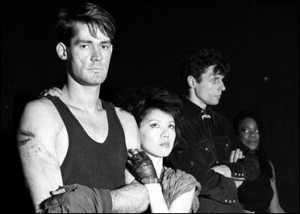
Out now is “Field Report San Francisco”, the first of a series of previously unreleased soundboard recordings by the industrial pioneers of SPK. “Field Report S.F.” was recorded at the Odd Fellows Hall on May 16th 1981 and was the first ever SPK show in the USA. The CD features big part of the concert plus a previously unreleased studio-recording from 1982. Get it here on Amazon DE.
The second release that also hits the shop shelves is “Case Study London” which holds previously unreleased soundboard recordings from 1982 / 1983 + 2 exclusive studio tracks. You can get that one here on Amazon DE.
Here’s what Brian Lustmord says about the “Case Study London” CD: “The release is interesting for me personally as it includes a show where I was at the mixing desk (London, Heaven 1982) and another from when I was more actively involved in SPK as a member, performing material I had contributed too (London, Brixton April 1982). The Brixton show is of particular interest from a historical perspective as it’s one of only 2 SPK shows where all (except one) of the tracks performed have never been recorded in the studio. This is a mostly undocumented period in SPK history between the raw sound of ‘Leichenschrei’ and what became the “Metal Dance” direction that I really disliked and had no involvement in.”
SPK were an Australian industrial music and noise music group formed in 1978. They were fronted by Graeme Revell on keyboards and percussion. In 1980 the group travelled to the United Kingdom where their debut album, “Information Overload Unit”, was released on Side Effects. In 1983 Sinan Leong joined on lead vocals. The group disbanded in 1988.
Version 8 of the Reason Refill ‘Salad Bar’ is out from Soundcells
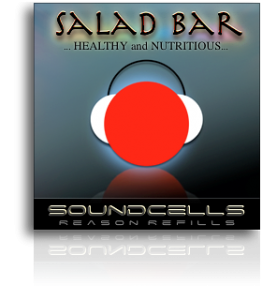
Soundcells tells us that Version 8 of their evergrowing ReFill project, Salad Bar, is stuffed with 30 new combinator patches coming from the Soundcells ReFills “PolysixRE” and “Antidote Signature”, plus 15 new Salad Bar exclusives. They say that Salad Bar´s patches will cover all kinds of music styles showing you the very best Soundcells has to offer.
A spokesperson told us, “With its almost 380 combinators in total, this ReFill simply is a “must-have” for every producer´s collection.”
Salad Bar v8 Contents:
• 252 combinator patches coming from all Soundcells ReFills.
• 125 Salad Bar exclusive combinator patches.
• 359 well balanced patches for Thor, Malstroem, Subtractor, NNXT, Antidote, Polysix and ReDrum.
• 60 rex loops.
• The modules folder contains the basic synth and NNXT patches which were used for the combinator sounds.
• 8 tracks in RNS format – inspiring with highl ‘tutorialesque’ value.
Pricing and Availability:
14,90 EUR
Rotor – a Rotary Speaker Rack Extension for Reason
http://shop.propellerheads.se/product…
Introducing Rotor, a rotary speaker Rack Extension from Propellerhead. Meticulously modeled on the Leslie 122, Rotor brings the sound of the classic rotary speaker design to Reason—perfect for adding a vintage flavor to organs, guitars, vocals and keys.
The Leslie speaker is a specially constructed amplifier/loudspeaker used to create special audio effects using the Doppler effect by rotating the speakers or a sound-directing duct. Named after its inventor, Donald Leslie, it is particularly associated with the Hammond organ but is used with a variety of instruments as well as vocals. The Hammond/Leslie combination has become an element in many genres of music. The Leslie Speaker and the Hammond Organ brands are currently owned by Suzuki Musical Instrument Corporation.
A rotary speaker simulator also known as a Leslie speaker simulator, is a device that attempts to recreate the sound of a Leslie speaker used extensively to amplify and modulate the raw organ tones produced by (though not exclusively) the tonewheel organs made by the Hammond Organ Company, and invented by Don Leslie.
While many analog devices have been touted as rotary speaker simulators, including but not limited to the Mini-Deja Vibe, Mojo Vibe, Rotosphere, Rotovibe, and Uni-Vibe, it was often only capable of simulating vibrato and at most chorus, despite the fact that a rotary speaker can also accomplish flanging, phase shifting, and even tremolo. This is because, instead of actually mimicking the way the sound wave is manipulated by the baffles of a Leslie Speaker cabinet (i.e. rotary speaker cabinet) and bounced around the cabinet, all the analog devices actually do is manipulate the signals themselves. Thus, the result is one that, though pleasant and interesting, is by no means similar to the sound produced by a Leslie.
Richie Hawtin with Traktor DJ for iOS
TRAKTOR DJ in action. Richie Hawtin prepares tracks on the beach, then tears up the club – all on his first day with TRAKTOR DJ. More at: http://www.native-instruments.com/tra…
TRAKTOR DJ is available at the iTunes App Store for $19.99 / 17,99 €
TRAKTOR DJ brings the leading pro DJ software to iOS with an intuitive app for instant, high-impact DJ sets. Create mixes in seconds — put your hands directly on beautiful waveforms and manipulate them using gestures you already know.
Auto tempo detection makes track syncing effortless while iTunes integration turns your library into a virtual crate to dig through — TRAKTOR PRO’s acclaimed sync engine keeps tracks locked together so mixes hit hard. TRAKTOR DJ also syncs effortlessly toTRAKTOR PRO 2, allowing you to share essential track data — beat grids, BPM counts, and cue points.
Track heard: Hobo – Incise (coming soon on Minus)
FM open up the brand new NI Traktor DJ iPad app and take a look at it in action. We get some first impressions and check out the features and usability of the touch-screen iOS DJ app.
KingKORG – Demo “Mellowness”
Akihiro Horikoshi
http://xsjazz.com
http://soundcloud.com/xsjazz
—
This video is a demo of the recently-announced KingKORG Synthesizer.
Composer/Producer Mr. Akihiro Horikoshi plays “Mellowness”, one of the demo songs included in the KingKORG Synthesizer. The drum tracks are provided by the KROME Music Workstation, and the backing track was sequenced using the second of KingKORG’s two timbres. Because this was performed in real-time while manipulating the two timbres, Mr. Horikoshi plays a different phrase from the demo.
KingKORG :
http://www.korg.com/KingKORG
DATAMASKIN

