
Jam with 2 Moogs, a Mopho (sequenced) and the Roland V-Synth
Synth jam held on March 9th, 2013 by REWO (René van der Wouden). Recorded in one go.
chris randall – ripspace
Some evening fun with the new Richard Divine soundpack for the Elektron Analog Four. As you can see, Chris also used a MeeBlip, a small modular, and the Maschine. All sequencing done on the Maschine and Analog Four.
KORG MS20 Beat Distortio & Filter Overdrive
KORG MS20 SN#141344 with original IC35 Filter Chip is extremely sensible at input distortion; it can produce really wild sounds when both VCOs are driven high in the Mixer (especially with a lot of Peak on both HPF and LPF). On this video, the MIAMI Drum Machine is severely distorted with Electro Harmonix MetalMuff. Just for fun, just for shaking neighborhood. 
KORG MS-20 with IC35 under Doepfer Dark Time Step Sequencer Control; with a little effort, is it possible to set VCOs under exponential control from sequencer; the difference between Doepfer Gate and KORG Trig can be overriden – in a very rough way – narrowing at maximum the Doepfer Gate Pulse Width. On this video, some experiments with CV/Gate control on Pitch, on Cutoff, on re-triggering of envelope.
Ohrwert – Rundfunk (Live Session w/ OT+A4+DRM1)
Live session of “Rundfunk” with Elektron Octatrack + Analog Four and Vermona DRM1 MKIII. Original track: https://soundcloud.com/ohrwert/ohrwer…
iPod mopho mix – Pushing the boundaries
Sequencing a DSI Mopho using a iPod Touch 4G running the Little Midi app w/Midi Mobilizer. The audio from the Mopho is routed back to the iPod via a iRig and filtered through Magellan Jr’s FX (delay/reverb) via Audiobus and then recorded in Audioshare. This pretty much pushes the iPod to its lmits as far as processing is concerned but it works.
Wob-Wob Fader
This short demonstration shows my little invention: CV-source dedicated for Dub-Step drops. Unlike regular fader, this one has its maximal value on the middle position. Schematics available. It’s very simple and it’s free for non-commercial use.
You can get schematic here: http://ic.pics.livejournal.com/rpocc/…
R2 and R3 can be replaced with 4.7k to increase the sweep width.
http://rpocc.ru/
”Via Marconi” – ’80s Italo with Memorymoog
The Memorymoog was the last official synth, made back in 1982, to come from Moog before they eventually went bankrupt and out of business. As a result, it was never fully completed; as MIDI technology was just coming out, the Memorymoog never did get to fully implement MIDI capability. There were two versions of this synth: the Memorymoog and the Memorymoog Plus (the version can be determined via the Autotune feature). The Plus model added a basic MIDI implementation, a Sequencer, and it also had more stable oscillator control, making the Plus model more valuable to collectors than the standard model.
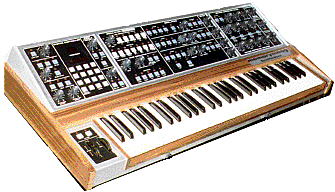
Due to the seemingly incomplete MIDI implementation as well as a less than perfect user-interface/operating system, some popular upgrades and retrofits have been produced and these days it is very common to find Memorymoogs with these retrofits. The most valuable upgrade is the Lintronics Advanced Memorymoog (LAMM), originally designed for the standard model, but also available for the Plus model. It provides a redesigned operating system, advanced MIDI functions and improved hardware components. Kenton Electronics produces MIDI retrofits for both the standard and Plus Memorymoog models (Kenton and Lintronics can even install these upgrades for you, considering the delicate nature and value of the Memorymoog). These upgrades can substantially increase the stability, MIDI functionality and value of the Memorymoog.
Background video description:
From my (eventually) upcoming Italo Dance / ’80s Synth Pop album. This song is entirely made with a Memorymoog (all parts except the Simmons drums, of course).
Time machine: Moog Minimoog Model D Analog Synthesizer Overview
The Minimoog was designed in response to the use of synthesizers in rock and pop music. Large modular synthesizers were expensive, cumbersome, and delicate, and not ideal for live performance; the Minimoog was designed to include the most important parts of a modular synthesizer in a compact package, without the need for patch cords. It later surpassed this original purpose, however, and became a distinctive and popular instrument in its own right. It remains in demand today, nearly four decades after its introduction, for its intuitive design and powerful bass and lead sounds.
The Minimoog is monophonic (only one note can be played at a time) and its three-oscillator design gave it its famous fat sound. Four prototypes were made over the years before a final design was decided upon to release as a commercial product. The Minimoog Model D adapted some of the circuitry (such as the filter section) from earlier modular instruments, but designed other circuitry (such as the oscillators and contour generators) from scratch. To produce a sound, the musician would first choose a sound shape to be generated from the VCO(s) and/or the type of Noise (White or Pink).
IAMX – “I Come With Knives” – (Official Video)
Here’s a brand new video from IAMX, details below:
Official album release: March 22nd 2013
Album Pre-order: http://www.boutiqueiamx.eu
IAMX on tour: http://www.iamx.eu/tourdates.html
Video directed, shot and edited by Michel Briegel in Joshua Tree
Produced by Orphic
Make-Up and hair: Kelly Shew
Thanks to Ray Hinton from http://www.lumitech.net
Music written and produced by Chris Corner
Machinista – Molecules And Carbon
The official video of the track “Molecules And Carbon”. Machinista is the creation of John Lindqwister (Cat Rapes Dog, #366: A life lived, Basswood Dollies etc.) on vocals and lyrics together with Richard Flow (Vision Talk, Haze For Sale etc.).
John Lindqwister:
(Cat Rapes Dog, #366: A life lived, Basswood Dollies etc.) – Vocals, Lyrics
Richard Flow:
(Vision Talk, Haze For Sale etc.) – Music
www.machinistamusic.com
www.facebook.com/machinistamusic
DATAMASKIN

