
Time machine: YAMAHA SK-10 String Machine 1979
Synthesizer Demo of the analog synthesizer/string machine YAMAHA SK-10.
The SK-10 was introduced 1979 by Yamaha, Japan. It is the smallest instrument of the Yamaha SK-series.
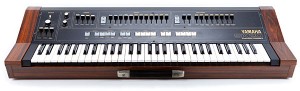
Yamaha’s SK-series are combo-keyboards with synthesizer, organ, brass and string sections. The SK-10 was the first of the SK-series, released in 1979 – the SK-20, 30 and 50D followed in 1980, and the SK-15 in 1981, possibly as a replacement for the SK-10. The SK-10 is the only one in the series that does not incorporate a synth section, but has organ, brass and string sections that can all be played together for more interesting combinations. Very sturdy casing, 4-octave and fully polyphonic the features also include a leslie simulator, vibrato, attack and sustain rocker switches, a slider for ‘brilliance’ and a one-octave transpose switch. Not exactly feature-laden, but a lovely string synth sound. Interestingly, they are often referred to as ‘analog’, but in fact do have a digital section. Its organ has one of the early implementations of Yamaha’s FM technology in a very limited form, concurrent with the GS-1/2 development platforms which eventually led to the DX series.
The ORGAN SECTION is available in all the SK series synthesizers. It offers a full range of stop levers from 1′ to 16′, percussion levers with adjustable decay, and controls for overall sustain, brilliance and decay. This gives you quite a lot to work with in the way of synthesis. The organ’s sound is FM based and it sounds very B3 like. You can add a Vibrato and a noisy but good Tremolo to it. Its sound is all about the 70’s era rock organ, especially with the Ensemble chorus effect in use. It also has a Leslie-speaker output around back.
The PRESET STRINGS section isn’t very sophisticated and offers very limited editing capabilities. It is the string section though, that is worth aquiring this keyboard for.
All the different sections of the SK synths can be layered and stacked via the slider bars. You use the slider bars as a mixer to set the individual volume for each section. All sections have their own separate audio outs (though a mix out is also available). A great thing for live performances is the split keyboard mode. That way you can have, for example, a very nice, punchy bass sound from the synth section and a lead sound coming from the organ or solo sections. Although it has no patch memory, there are push buttons for instantaneous selection of organ, poly-synth and string preset sounds; there are three presets in each section. It also, has no arpeggiator or sequencer, and lacks MIDI. But it’s cheap, easy to use, has a nice sound, full 61-note keyboard, and classic wooden panels.
Apogee Quartet Overview w/ Miles Walker
Producer and engineer Miles Walker talks us through the features of the Apogee Quartet. A 4 in and 6 out audio interface that connects exclusively to Apple computers and iOS devices.
For more on the Apogee Quartet go to their blog: http://www.uniquesquared.com/blog/pro…
Cyntia AYANOさんからのメッセージ
Cute girl with big synth 
Background description (Googlish from Japanese):
Movie of the article is a comment on the Korg website Featured Artist Interview, Girls HR / HM band that was published in the SOUNDBYTES, keyboardist’s AYANO of Cyntia.
KingKORG製品ページはこちら。
http://www.korg.co.jp/Product/Synthes…
Teaser video: Pet Shop Boys – Electric – The New Album – June 2013
Electric – The New Album from Pet Shop Boys
Released June 2013
http://www.petshopboys.co.uk
deadmau5 & Imogen Heap – Telemiscommunications
Background video details:
Buy “Telemiscommunications” at iTunes: http://smarturl.it/TELEMISIT
deadmau5 & Imogen Heap – Telemiscommunications (Official Video) from Ultra Music
http://ultramusic.com
http://deadmau5.com
http://imogenheap.com
Credits:
Video Creative Direction — Imogen Heap and Colin Gordon
Project Coordinator — Colin Gordon
Editor — Alexander Goodman
Choreographer — Gabriel Ciulli
Competition Website — Andy Carne
Animators — Eoghan Kidney, Jake Zhang, Alex Aguilar-Rudametkin, Eric Spivey, Marc Fleps, Kat Michaelides, Sitji Chou, Mayra Hernández Ríos, Ewen Farr, Eric Funk, Rory Waudby-Tolley, Dru Henderson, Oana Nechifor, Paloma Dawkins, Djoh Djoh (Joe DeMarie), Alexandre Siqueira, Stella Salumaa, Chris Butcher, Ty Coyle
Subscribe to Ultra Music – http://www.youtube.com/subscription_c…
Subscribe to UltraTV – http://www.youtube.com/subscription_c…
Ultra Music is an American independent electronic music record label based in New York City.
Techno demo of Elektron Analog Four, NI Maschine MK2, Arturia Minibrute
Here is a demo Jordan Passmore recorded of the Elektron Analog Four, Native Instruments Maschine MK2, and Arturia Minibrute. The A4 is doing the bassline and main melody, the Minibrute is doing the filtered clicks and Maschine is doing the drums. The Minibrute is being ran through a phaser, analog delay, analog chorus, then finally through the A4. The A4 is only affecting the gating (VCA trig) of the passed thru audio.
Here it is the new video from OMD – Metroland
From the upcoming OMD album English Electric out April 8th.
Preorder your physical copy from http://omd.firebrandstore.com/
Preorder on iTunes from http://smarturl.it/iTunesEE
E-MU SYSTEMS DRUMULATOR Vintage Drum Machine 1983
Created in the wake of the Emulator sampler-synths, E-mu unleashed the Drumulator sample-based drum-machines. The Drumulator was E-mu’s attempt at creating a rhythm machine like the Linn LM-1 that was better and cheaper. What they made wound up becoming a huge hit for E-mu. The Drumulator had eight drum sounds on a ROM microchip which were gritty, lo-fi 12-bit samples of basic drum sounds…but they were some classic sounds! The Drumulator II added sampling so you could bring in your own sounds. Samples could be truncated, looped, etc.
The Drumulator was primarily a drum machine, however, and offered sequencing that could be accomplished in real-time for a live feel. Or it could be meticulously programmed via step entry and edit modes. Up to 36 sequenced patterns can be stored, chained and mixed to create up to 8 songs. Your sequences and sample data can be stored to floppy diskettes. The Drumulator can be connected to an old computer (like an Apple II) for better visual sequencing and editing too. The Drumulator II went on to become the even better SP-12 drum machine.
Dave Smith Instruments Mono Evolver Keyboard drone
The DSI Evolver in action, details below:
Single patch drone on the DSI Mono Evolver keyboard, one shot recording, no editing.
VCA is held open with max VCA level with tweaking and editing of various parameters during recording. More details below..
Making extensive use of the modulation routings of all 4 LFOs, FM and RM of the digital oscillators and one of the sequencers switching the wave shape of one of the digital oscillators. Strange pitching effects courtesy of S&H modulation of the delay time on 2 of the delay lines built into the MEK. Nastiness courtesy of the tuned feedback circuit.
All running through Sonnox Oxford reverb for a bit of atmosphere, shame I didn’t have a Roland Space Echo.
Film is edited segments of Voyage to the Planet of Prehistoric Women courtesy of http://archive.org/details/Voyagetoth…
This one goes out to Atomic Shadow. – http://www.atomicshadow.com/
Exoplanet – Alien Soundscapes & Sound Effects
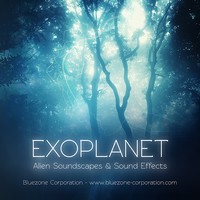
Bluezone Corporation has announced the release of Exoplanet – Alien Soundscapes & Sound Effects, a cinematic/ambient sound library.
This downloadable sample pack offers a huge choice of extraordinary Sci Fi nature sounds, forest ambiences, textured animal gurgle and growl sound effects and includes reworked hardware synthesizer pad sounds.
For original compositions as well as soundtracks, this pack of 124 professional atmospheric / FX sounds is the reference sound library you’ll turn to again and again for all types of music compositions.
The sample library costs 16.95 EUR.
DATAMASKIN

