
First video of the Madrona Labs Soundplane
The first public demonstration of the new Soundplane instrument from Madrona Labs! At the Decibel Festival in Seattle, September 2011. Thanks to all the participants and Decibel Festival! Find out more at http://madronalabs.com .
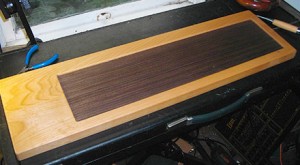
“Madrona Soundplane A, a force-sensitive surface for intimate controlof electronic music. What is intimate control? Instruments like the violin and hand drums give the player a very responsive connection to sound through their physical construction. In a state of creative flow, we stop thinking about these instruments as separate devices and speak directly through them. In a very real sense they become part of us.
On a typical MIDI keyboard, most of the information from each finger gesture is thrown away, and the rest is boiled down into a single 7-bit velocity value. The Soundplane A transmits x, y and pressure data at about 1000 samples per second, letting the synthesist move beyond the ADSR model for control and articulate each note individually, as on an acoustic instrument. An array of very responsive capacitive sensors detects a range of forces from an extremely light touch to a hard slap. A DSP calibrates the sensors dynamically and sends the data via USB.
The playing surface is a material custom developed for us, a flexible sheet of hardwood veneer bonded to a plastic backing for strength. The case is milled out of alder, a sustainably harvested Northwest hardwood. We have sourced all of the construction locally and will test and assemble by hand here. The entire instrument is about 28 inches wide by 8 inches deep by 1 inch thick. We think it will look great next to a monome.“
Check out the new electronic instrument – StringStation
Comprehensive look into a new musical instrument called the StringStation. The Stringstation is a custom 40-string music instrument designed to allow strings to advance future music in Surround Sound.
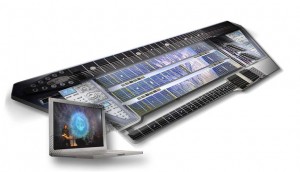
Here’s how they describe it:
StringStation incorporates the growing science of Digital Sound Modeling- allowing the entire expressive dynamics of human touch on strings to be the catalyst for any sound imaginable…It also introduces an intricate and truly amazing 3D resonance factor that reveals an atmospheric, dimensional soundfield never known before. Fingertips on strings instantly have a detailed nuance and dynamics allowing extreme expressiveness in music and sound creation- The StringStations 40-strings are programmed in distinct groups (bass, melody, rhythm, orchestration…) that when captured together with its innovative surround pickup matrix, pulls pure 3D tone resolution that delivers an ultra wide, exceptionally dimensional panorama. It captures in vivid 3D, a ‘fractal lattice of interpolations’. The powerful sonic force of its natural string tones layered with any sound imaginable via digital sound modeling and computer control are the beginning of an extreme level of surround music innovation…
First plugin especially developed for creating rich motion sounds
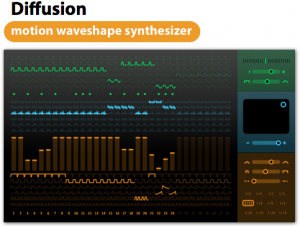
Sinevibes has announced Diffusion, a synthesizer instrument plug-in for Mac.
Sinevibes is extremely excited to announce Diffusion, its very first instrument plugin which has been especially developed for creating rich motion sounds. Diffusion’s unique synthesizer engine combines additive oscillators and waveshaping models with an advanced matrix sequencer that allows for over 400 different parameter combinations per step. All this being accessible via an intuitive interface makes Diffusion an extremely capable tool for producing animated synths and basses which have incredible density and character while being clean and warm at the same time.
“To create synth and bass parts required for today’s electronic music styles, producers often need to layer multiple plugins and do a lot of post-processing.” – says Artemiy Pavlov, founder and chief developer at Sinevibes. “With Diffusion alone, they can now create very complex motion instruments with a lot of liveliness and character, enjoying an extremely fun-to-use interface while at it.”
Diffusion features
- Dual monophonic oscillator with 6 additive waveforms and 6 waveshape transformation models.
- Flexible tempo-synchronized sequencer with up to 32 steps, each with individual setting for note switch, waveform, waveshape model, envelope type and modulation depth.
- High-contrast user interface with randomization features.
- Useful collection of preset patches and templates.
Diffusion for Mac (AU) is available to purchase for $59 USD. It requires Mac OS 10.5 or later, and a 32 or 64 bit AudioUnit instrument host application that supports Cocoa user interface technology.
Review: BeatMaker 2 for iOS
BeatMaker 2 is an elaborate studio with loads of effects and hundreds of samples. I ignore both of those facts completely as I go on a wild tear to put it through its paces. Included are tips on Hokusai and all kinds of sample chopping fun.
“Build your own virtual home-studio, create multiple instruments and connect them to a full-range of audio effects. Compose, record, arrange and transform your ideas into complete songs, ready to be shared with others. Import your own sounds or use the sound library provided: more than 170 high-quality instrument and drum presets from synthesizers to realistic orchestral sounds. You can even import songs from your iPod library! Connect your MIDI accessories for an external control of BeatMaker’s instruments, effects and mixer, ideal for home-studio productions and live performances. BeatMaker 2 is an universal application, with specifically designed interfaces for the iPad and iPhone platforms. Works on all iPhone, iPod and iPad models starting with third generation devices (iPhone3GS, iPod3G 32GB, iPad 1 & 2).”
Karlax – wireless controller to re-establish the artist’s body
Karlax is the first wireless controller to re-establish the artist’s body at the heart of the Digital Arts performance. This instrument’s revolutionary ergonomic design uses the artist’s own natural movements for an unlimited freedom in the creation and artistic expression.
Ampex ATR-102 Mastering Tape Recorder Plug-In Trailer for UAD-2
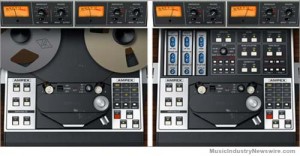
Introducing the Ampex ATR-102 Mastering Tape Recorder plug-in for UAD-2. In this short video, you’ll see (and hear) side-by-side hardware to plug-in comparisons, as well as testimonials from artists and engineers on one of the most beloved two-track tape machines ever made.
Background info:
For more than three decades, the two-channel Ampex ATR-102 Tape Recorder has turned music recordings into records. The perfect complement to the workhorse Studer® A800 Multichannel Tape Recorder Plug-In, the officially sanctioned ATR-102 plug-in provides the final, cohesive analog polish and punch for any in-the-box mastering session, without the ongoing maintenance and calibration of a physical tape machine.
Impeccably developed over a nine-month period in the renowned UAD engineering tradition — and incorporating presets from noted ATR-102 users Chuck Ainlay, Richard Dodd, Buddy Miller, and Mike Poole — the ATR-102 Mastering Tape Recorder Plug-In faithfully replicates the unique dynamics, frequency response, and saturation characteristics of the original hardware. Scrutinized and fully authenticated by Ampex Corporation, the sound of the ATR-102 plug-in for UAD-2 is virtually indistinguishable from its analog cousin.
“With the Ampex ATR-102, we’ve taken the time to provide all the popular tape formulas and hands-on calibration options of the original hardware,” said Matt Ward, President of Universal Audio. “With a mastering tape deck as iconic as the ATR-102, we wanted to make sure that its sound remained fully intact in the virtual world.”
“To bring the complexity of a such an iconic tape recorder as the ATR-102 to the digital world is no small feat,” said Gordon Strickland, Chairman and CEO of Ampex Corporation. “Universal Audio is the only company we could trust to faithfully and accurately model our Ampex legacy products, as they too have a legacy that spans back half a century with their analog products.”
Available for purchase via UA’s Online Store, the Ampex ATR-102 Tape Recorder Plug-In sells for $349.00.
The Ampex ATR-102 Tape Recorder Plug-In is available as part of the new UAD Software v6.0 release. In addition to the Ampex ATR-102 plug-in, v6.0 includes the release of the Brainworx® bx_digital V2 EQ and SPL® Vitalizer MK2-T direct developer plug-ins, as well as highly anticipated Pro Tools compatibility enhancements and Mac OS X Lion support.
ATR-102 Mastering Tape Recorder Plug-In features include:
Ampex-authenticated plug-in emulation of the ATR-102 Mastering Tape Recorder — the most popular professional 2-track machine ever made
Provides rich, cohesive tape sound, without the hassles of calibration, maintenance, tape degradation, etc.
Adjustable (L/R) Tape Delay, Wow, Flutter, and Crosstalk
Requires a UAD-2 DSP Accelerator Card available from authorized dealers worldwide
Models entire ATR-102 electronic path, including transformers, amplifiers, Input, Record. and Repro paths
Featuring multiple Tape Formulas and Calibration Levels for mix down
Independent L/R Input Gain (Record) and Output (Reproduce) Level
IPS Speed/Emphasis Curve chooses between 3.75 NAB, 7.5 NAB, 7.5 CCIR, 15 NAB, 15 CCIR, 30 AES
Independent L/R record Bias, Record EQ, and Playback EQs, with Auto and Manual Cal capabilities.
More information on the ATR-102 Mastering Tape Recorder Plug-In:
www.uaudio.com/store/special-processing/ampex-atr-102.html .
Korg Introduces microARRANGER keyboard
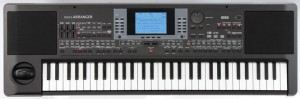
The microARRANGER is the latest addition to Korg’s line of ‘micro’ keyboard instruments. The microARRANGER can quickly turn a simple idea into a complete song featuring a full backing arrangement. The specifications and capabilities are based on Korg’s Pa50SD Professional Arranger.
Features & Highlights:
Compact composing/performing keyboard that acts as your musical arranger
61-key Natural Touch mini keyboard; Velocity sensing
Built-in stereo speaker system
4 Stereo Effect Processors with 89 effect programs.
304 Styles; each is a complete and interactive musical environment for capturing your inspirations
Each Style includes Intros, Endings, Fills, and four Variations, all are completely editable
Styles follow your chords, voice leading, and tempo settings – you are always in control!
660 Preset Sound Programs and 128 User Programs provide excellent Korg sounds
32 Drumkits; 64 User Drumkits;
SD/SDHC card slot for data storage, importing Styles, sharing data with a computer DAW, etc.
Here are all the details of the instrument in Korg’s own words…
Following the composer’s tempo selection, chord changes and voice leading, the microARRANGER can create a full backing arrangement in real time, based on the selected musical Style. Each of the over 300 Styles is a complete composing environment that includes intros, breaks, fills, endings and four variations for a realistic performance. Each Style also includes four preset instrument selections. The user is always free to change any element to his or her own liking. These same features allow the user to play a favorite song, with the microARRANGER creating a full backing arrangement on the fly.
The user’s compositions can be recorded in a variety of ways. The internal recorder features step, real-time and workstation modes, allowing both the accomplished player and the non-keyboardist the ability to create and save their own songs with a rich backing arrangement – anything from a simple drum and bass groove to a jazz quartet or a full R&B rhythm section. Full editing tools are included to polish any performance. Songs can be saved on a convenient SD/SDHC card.
The microARRANGER features high-quality Korg sound, with over 650 professionally-created sounds to choose from. Four studio-quality stereo effects processors add vitality and motion to the sound; 89 Effect Programs are available.
As the “micro” name implies, the microARRANGER is compact, lightweight, and extremely portable. The Natural Touch keyboard features 61 velocity sensitive mini-keys proportioned for comfortable playing. A stereo speaker system is built right in for sharing the microARRANGER’s sound, or headphones can be used for private practice.
Pricing and Availability:
Pricing and availability for the Korg microARRANGER will be announced shortly.
More information:
Messing around with an Analogue Systems “French Connection”
Given that it was an early electronic instrument, the Ondes Martenot was singularly playable, so it’s not surprising that composers such as Barry Gray (see the box on the penultimate page of this article) continued to experiment with it throughout the ’50s, ’60s and 70s. Even today, its unique method of control and expression attracts musicians keen to develop new sounds and playing styles. So when Johnny Greenwood of Radiohead asked Analogue Systems to develop a Martenot-style controller for his modular analogue synthesizers, the company was keen to oblige.
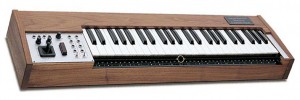
Named the French Connection, Analogue Systems’ design adopts the control mechanisms of the classic Martenot, but leaves the sound generation out, and packages everything in a neat unit designed to sit in front of any of the company’s RS Integrator modular synths or, for that matter, similar modulars produced by other manufacturers. The keyboard itself is four octaves wide, and in front of this you’ll find the wire controller with the small ring through which you insert your index finger. The wire (which is actually a fine nylon cord) is stretched above a fingerboard in which you’ll find small circular depressions that represent the white notes on the keyboard; and protruding metal studs that mark the positions of the black notes.
To the left of the keyboard and the wire controller, there’s a control panel reminiscent of those that you’ll find on other Analogue Systems products. To the far left of this, there’s a sprung X/Y joystick that returns to the central position when released. Above the joystick itself you’ll find two knobs that determine the output range for each axis, with a maximum maximum (if you see what I mean) of approximately 10V. There are four joystick outputs, two each for the ‘X’ axis and for the Y axis. These, like all other Analogue Systems devices, use 3.5mm sockets. To the right of the joystick you’ll find the large, sprung wooden button that also harks back to the original Martenot. If left untouched, this sits in its uppermost position, and generates an output CV of 0V. As you depress it, the CV rises progressively to a maximum of approximately 10V. Again, a knob located above the button itself controls the actual range of operation.
There are just two further controls on the French Connection, and these are the switches located immediately to the left of the keyboard. The first of these determines whether the pitch CV is controlled by the keyboard or by the wire controller. The other determines whether the keyboard produces a conventional trigger and gate, or whether the button produces an amplitude CV. There are eight physical outputs for these – three pitch CV outputs, three button CV outputs, a trigger output, and a gate output. And that’s all there is to it. Add an IEC mains input and an illuminated on/off switch to the right-hand side of the unit, and mount everything in a gorgeous, polished wooden case, and you have a French Connection.
In this video:
I had the oppurtunity to mess around with an Analogue Systems “French Connection”, an imitation of an early electronic instrument called the Ondes Martenot. This controller is CV’d up to an MFB Kraftzwerg. Just a demonstration of some of it’s capabilites. I’ll make a more musical video soon.
How to get started with analogue synthesizers, modular systems, stepsequencers and more
“The Testsalon inside Rough Trade East in London is the showroom installed by Schneidersladen, Berlin with the latest news in electronic hardware devices. The Video gives you an overview on how to get started with analogue synthesizers, modular systems, stepsequencers, drummachines, or filters from independent manufacturers like Doepfer, Sherman, MFB, TomOberheim, Makenoise, Cwejman, SND, Vermona and many others. All is connected with each other via Midi or cv gate and you can make some music easily .. if you are around. “
Introducing the SampleRobot 4 Sampling Suite

Skylife has announced SampleRobot 4 Sampling Suite, a collection of applications designed to automate sampling tasks.
SampleRobot 4 Sampling Suite contains the following products:
- SampleRobot 4
- WaveRobot 4
- Camel Audio Alchemy Player 1.2
- Awave Studio 10.4, and
- more than 1 GB of premium samples in Soundfont 2 file format.
Description:
With the Sampling Suite you can easily do automatic sampling of acoustic and electronic instruments. Remote control your MIDI gear and sample all sounds automatically. Integrated WaveRobot software lets you find loop points for whole multi-samples with different velocity layers during recording.
Import older sampler formats like Ensoniq, Kurzweil, Roland and Yamaha or even use original AKAI S1000 series CDs with Awave Studio and export them with SampleRobot to various software sampler formats. Or send new multi-samples back to your old hardware. You can convert about 290 audio file formats.
Alchemy Player is a powerful sampling synthesizer that offers a broad range of high end effects and sample playback features. With the newly created Alchemy Export Bridge you can export samples from SampleRobot directly to Alchemy and Alchemy Player. Play and shape instruments and samples instantly within your favorite DAW both on Mac and PC.
SampleRobot 4 Sampling Suite comes with new export options like “Export all Projects at once” and “Export to Waldorf Blofeld”. SampleRobot and WaveRobot are optimized for Windows 7 and offer better Win7 performance than previous versions.
Features:
- Turn acoustic and electronic instruments, voices and noises into virtual instruments fast
- Fully automated sampling
- Intuitive project assistant
- Sophisticated auto-loop processing and editing
- Alchemy Export Bridge
- Sampling of virtual instruments
- Direct sample playback on Mac and PC, edit effects, modulation and envelopes
- Convert about 290 audio and multi-sample formats
- Import formats like AKAI S1000, MPC, Kurzweil K2xxx, Roland S, Ensoniq and MIDI Sample Dump
- Extract samples from sampling CDs
- Audio batch processing, auto-loop for all, resampling, normalizing, gaining, fading
- Export samples directly to Steinberg HALion 4, Logic Pro EXS24, NI Kontakt 4, Reason NN-XT, Waldorf Blofeld, Soundfont2 and many others
- Import and export for Yamaha Tyros 2+3, Motif XS+XF
- Full MIDI remote control, incl. program and bank changes, multi-velocity layering
- Release-Sample editing
- Optimum loop handling incl. forward-backward loop with 2 independent crossfades and auto-gain functionality
- Sample and export whole synthesizer sound bank in one go (equipment copier)
- Premium multi-samples from classic synthesizers included
SampleRobot 4 Sampling Suite is expected to be available in August 2011, priced at US $399.
DATAMASKIN

