
Jupiter-8, Roland Juno-60, Juno-106, Poly 6 – Analog synth song
Gear used is jupiter-8, juno-106, juno-60, Poly 6, td-30 V-drums. Recorded and mixed in Sonar X1. EFX from Sonar.
Jupiter-8, Juno-60, TR-707 – 1980s style
Background information:
An ’80s synth / dark improvisation in my style utilizing mostly early ’80s Roland synths. I’m using a few “live” performance techniques like acting on the synth volumes and filters in real time. The verses are a bit “straight” but the choruses have a good chord progression and sound nice (if a bit melancholic) with the huge, magic, silky string sound of the JP-8, and the electric bass following on the high notes, wait for them 😉
Equipment:
Roland Jupiter-8 = octave arpeggio synth bass, strings, pad, lead
Roland Juno-60 = pad
Roland TR-707 = drums, arpeggio sync
Fender Jazz = electric bass
Fender Stratocaster = electric guitar
Roland M-10DX = submixing, reverbs, echoes
Cakewalk Sonar X1 PE = recording, effects, compression
Roland Jupiter 6 + Roland Gaia “Super Midi”
Background info below:
In this video I have Midied out of the Jupiter 6 into the Gaia which allows me to play the Gaia through the Jupiter 6. The Jupiter 6 is set on an arpeggio string patch in which I have added some portamento. The Gaia is set on a Sawtooth Synth patch. The two synths sound very good together!
Roland MKS-80 (Jupter 8 in box) come to life by Lemur control
YouTube Published on Jul 14, 2012 by Puzzlegob
“Testing out my MKS-80 Lemur Template
(drums from DSI Tempest & Moogerfoogers)
available to download here:
http://liine.net/en/community/user-library/view/260/”

Wikipedia: “The Roland MKS-80 Super Jupiter is an 8-voice polyphonic analog synthesizer that was manufactured by Roland between 1984 and 1987. It is the only of MKS series of synthesizers to have fully analog voltage controlled oscillators. Contrary to popular belief, the voice architecture is more closely related to the Jupiter-6 synthesizer than the Jupiter-8, the service manual states that “The module board of MKS-80 features the following in addition to that of JP-6, its brother module. ) HPF_ )Low boost circuit in the 2nd VCA. )DC supply current boost circuit.” The unit is fully capable of producing most of the Jupiter-8’s signature sounds, in addition to many sounds unique to the MKS-80. In 1985 out came another revision of MKS-80, known as “Rev 5″, that had no ties with any previous Jupiter’s hardware, as it used a new generation of both Roland VCO’s, VCA’s and filter. The Rev 5 filter was also used in JX-8P, JX-10 and MKS-70 synthesizers.”
Analog – new soundset for the Saurus software synthesizer.
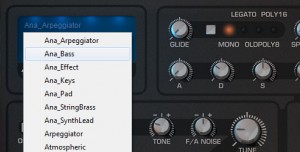
Tone2 has announced Analog, a new soundset for the Saurus software synthesizer.
Taking you on a journey through an analog world, the Analog soundset digs deeper into Saurus’ offerings with a strong emphasis on authentic vintage sounds.
A collection of 200 classic synth sounds including emulations of the Moog, Oberheim, Jupiter, Arp Solina, Clavinet and many others that suit almost every style of Electronic music. Let Analog take you back to a time when these machines were at the center of every studio and now be the source for your creative productions
Enjoy its warm strings, expressive brass, dirty leads, squelchy basses, screaming synths, vibrant pads and just let it inspire you.
Analog for Saurus is available to purchase for 39 EUR.
Roland Jupiter 50 In Depth Look
Sonic State gives us a good run through of the Jupiter 50:
Roland UK visited us with a Jupiter 50 so we could explore exactly what you get with the little brother of their flagship Jupiter 80. We looked at the synthesis capabilities, the Supernatural voices, performance capabilities and how it works in a DAW setup.
Roland Jupiter-50 review
Check our exclusive video to see the first, full, in-depth review of the new Roland Jupiter-50. Dan ‘JD73’ Goldman shows off the Jupiter-50’s sounds and digs deep into the synth engine, before revealing his final verdict on the performance keyboard.
Rolands pitch:
With its unprecedented fusion of synthesis and acoustic instruments, the new-generation Roland JUPITER has changed the way we play, react to, and feel a keyboard. By combining the supreme expression of the JUPITER-80 with the travel friendliness of the JUNO series, the new JUPITER-50 brings SuperNATURAL sound and pro performance to every stage and studio.
- – Stunning SuperNATURAL sounds powered by our most advanced sound engine
- – Travel-friendly design; 76-note weighted keyboard
- – Fast, friendly user interface with intuitive color-coded buttons and sliders
- – Registration function for saving and selecting sounds instantly
- – Pro-quality multi-effects and reverb
- – Expressive performance controllers, including D-BEAM, pitch/mod lever, and control input jacks
- – USB Song Player/Recorder
- – USB audio/MIDI functionality; bundled with SONAR LE and JUPITER-50 Control Surface plug-in for SONAR
Roland Jupiter 8 “Wicked”
The Jupiter-8 is an eight-voice polyphonic analog subtractive synthesizer introduced by Roland Corporation in early 1981.
The Jupiter-8, or JP-8, was Roland’s flagship synthesizer for the first half of the 1980s. Although it lacked the soon-to-be standard of MIDI control, later model Jupiter-8s did include Roland’s proprietary DCB interface, and all of them sported advanced features such as “Four on Four” and the ability to split the keyboard into two zones, with a separate patch active on each zone.
JP80 + JP8 + JP6 + Ion “3 Jupiters”
Here we have a Jupiter 80, Jupiter 8, Jupiter 6 and Alesis Ion. The Ion is being used for the Arpeggiator. The patch on the Ion is called “Infrastructure”. The patch on the Jupiter 80 is called “Big Mouth Pad” which is the first patch of the new 2.0 version.
Closer looka at the “Roland Jupiter 6” – Fat Analog Synth
The Jupiter 6 is an incredible analog synth. All of the Jupiters have a sound that was unlike any other synthesizer and the Jup 6 is no exception. This sound is due in part to classic analog Roland technology in its filters, modulation capabilities and a thick cluster of 12 analog oscillators at 2 per voice. Easy and intuitive programming via front panel sliders, knobs and buttons for all your tweaking needs.
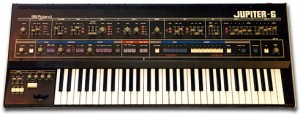
The Jup 6 is a scaled down version of the Jup 8 in terms of programming and polyphony. However the Jup 6 has some major improvements of its own such as newly added MIDI control and better tuning stability! While the Jup 6 does have MIDI, the implementation is very rudimentary and hard to control. The Jup 6 was one of the very first (along with the Sequential Prophet 600) synths to use the then new MIDI protocol, and the implementation on the Jup 6 is far from complete.
Synthcom Systems, Inc. offers the Europa firmware upgrade for the Jupiter 6 which gives it an up-to-date and comprehensive MIDI implementation. All parameters are controllable via Continuous Controller or SysEx. Europa also features an extensive arpeggiator which will sync to MIDI clock with programmable clock divisors and rhythms, and has about 50 more playback variations than the JP-6’s original Up, Down, Up/Down, and Down/Up. A Europacized Jupiter 6 is a thoroughly modern synth with a classic sound.
DATAMASKIN

