
Space music: The Aristocratic Mouse
A 1960s Space-Age/Lounge style song with Yamaha YPT-400, Moog Memorymoog, Synthesizers.com modular and Fender Stratocaster.
Close to Mooger
My friend Tara Busch uploaded this Moog fest preparation video clip
Animoog versus the real thing
Here’s a good bass check up from one who I believe knows what he’s talking about when it comes to comparing real Moogs to softies:
Animoog Taurus bass impression, compared with “Taurus” presets from the Moog Little Phatty, and Arturia Minimoog V. $1 vs. $1300 vs. $200.
First thing I worked on with the Moog Animoog iPad app, was programming a passable Taurus-type bass sound(two saws, octave apart, detuned slightly). There is mojo coming from both the Little Phatty and Arturia Minimoog that I couldn’t capture, but I feel like this’ll do a pretty good job in a pinch.
To program the sound, this is what I found:
1. Build off of a static saw Timbre. “StaticFatSaw1” is good. Putting a “Sine” wave, or “OctaveSaw” in the Timbre slot next to it gives some good variation moving around on the X/Y pad.
2. The key for me to getting the vibe in the right ballpark was forcing the synth into mono operation, and using the “Detune” control to separate the saw into two separate octaves. This can be accomplished in two ways I’ve found:
-(preferable) “Unison” set to “4”, “Detune” set to approximately “8”, and ONLY use the Left audio output from the iPad(I used the “tip” side only of a stereo 1/8″ TRS to dual mono 1/4″ TS cable, coming out of the headphone jack)
– “Unison” set to “2”, and “Detune” very slightly under “10”. This’ll sound alright coming out of the iPad speaker, but is less flexible, and would be difficult to perform with.
3. all Orbit, Path, Delay settings to “0”
4. approx. fiter settings: Drive “10”, Env. “0”, Freq “5.3”, Res. “1” – maxing out the filter “Drive” seemed to be a key to getting the right amount of “spit” in the sound with the filter wide open.
5. approx. Thick settings: Crush “0”, Drive “2.5”
6. I zeroed out all Mods, except for one, that makes the poly-pressure open up the filter freq:
– Source off, amount “0”
– Control poly-pressure, amount “+33”
– Destination: filter-freq
7. Setting the KB scale to “Chromatic” with “Mono” and “Legato” makes the on screen keyboard act as I would expect. “Cor” at “10”, “Glide” around 45%.
All three Synths recorded straight into Steinberg MR816csx. Levels adjusted slightly, no additional post processing.
Moog goes back to its roots with the Ladder
The Ladder, a new rack-mountable hardware processor that’s based on Bob Moog’s original ladder filter design.
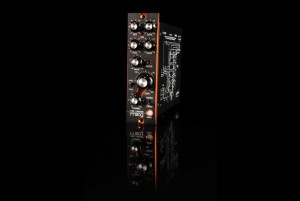
Promising to deliver “all the punch, fullness and analogue euphoria of the original Moog Filter,” this also offers features designed to make it useful in today’s studios, details of which can be found in the press release below.
The Ladder will be available in December priced at $769.
Moog The Ladder press release
Moog Music, a North Carolina-based electronic musical instrument manufacturer, today announced the release of The Ladder, a Professional 500 Series Dynamic Ladder Filter based on Bob Moog’s original ladder filter design. The Ladder is Moog Music’s first 500 series module for the Pro Audio market and is designed to add depth, flexibility and classic Moog vibe to sound sources.
“There have been a lot of firsts for Moog this year.” said Mike Adams, President/CEO of Moog Music Inc. “The release of Animoog, the first professional synthesizer for the iPad has introduced us to whole new segment of customers. Now The Ladder will reacquaint Moog with the Pro Audio community that embraced Moog Modular Synthesizers in the 1960’s. We are very happy to see the market embracing this exciting format and we look to developing other modules.”
The Ladder packs all the punch, fullness and analog euphoria of the original Moog Filter, but adds key component and feature upgrades required for professional studio use. From classic Moog filtering and vibe to modern sweetening and wild, exciting behavior; The Ladder is a powerful, articulate sound sculpting tool.
The Ladder features include:
Low Pass and High Pass: The Ladder has inherited the smoothest all-analog filter section possible. Choose between LP and HP at the flick of a switch.
Cutoff: Simply adjust this knob to determine where The Ladder begins to sculpt the sound.
Attack and Release: These variable controls allow you to perfectly dial in the timing behavior of The Ladder’s envelope section. Use them to open and close the envelope as fast as lightning, or slow as molasses.
Amount: Use in Positive or Negative mode for mild to extreme sound shaping and manipulation. The amount determines how much signal is sent to the envelope section of The Ladder. From slight timbral excitement and voicing to extreme compression-like behavior and even reversed filtering is achievable.
Resonance: Controls the amount of harmonic bump at the cutoff frequency. This is the voice of The Ladder. Create sweet, dynamic or extreme speech like behavior and beyond. Accentuate specific frequencies to excite a sound or create completely new and unique ones.
NOTE: The Ladder’s Resonance control can push the unit into self-oscillation. This can be used for effect if desired.
2Pole/4Pole: Select how aggressive the filter slope is. 2 pole is equal to 12db per octave, which is smooth and sweet, while 4 pole is 24db per octave, which is hard, aggressive and most similar to a Classic Moog filter.
Bypass: Totally transparent relay bypass for routing and A/B comparison
Availability and pricing: The Ladder will be available at Moog Dealers worldwide in December 2011 for MSRP US$769.00.
nnoiz Papp testing animoog
nnoiz Papp testing animoog with TUNESIA´s UPRISING playback
Animoog does not need any further introductions by now, but in case you’ve missed it – here’s some highlights:
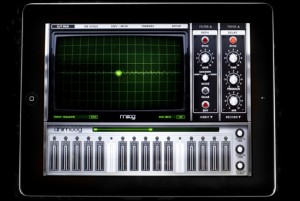
Animoog, powered by Moog’s new Anisotropic Synth Engine (ASE), is the first professional polyphonic synthesizer designed for the iPad. ASE allows you to dynamically move through an X/Y space of unique timbres to create a constantly evolving and expressive soundscape. Animoog captures the vast sonic vocabulary of Moog synthesizers and applies it to the modern touch surface paradigm, enabling you to quickly sculpt incredibly fluid and dynamic sounds that live, breathe, and evolve as you play them. Visually captivating and sonically immersive, Animoog brings iPad based music production to the next level. Whether you are new to synthesis or a professional, Animoog’s unique user interface gives you the power to easily create a visually vibrant and sonically rich universe. It is the ultimate tool for total creative expression! Animoog’s diverse library of timbres is derived from analog waveforms captured from classic Moog oscillators, both vintage and modern, and run through a boutique’s worth of high-end outboard and analog signal processors. These include modular synth panels, Moogerfooger pedals and more.
· Anisotropic Synth Engine (ASE) – An exciting new Moog technology that allows the user to move dynamically through an X/Y space of unique timbres to create an expressive and constantly evolving soundscape.
· Timbre page – Assemble unique sounds in the X/Y space from timbres of a wide variety of vintage and modern Moog synthesizers and pedals Note: this is NOT simple sample playback.
· Polyphonic Modulation – Simply slide your fingers to control multiple modulation parameters in Animoog right from the keys.
· Polyphonic Pitch Shifting – Easily manipulate the exact pitch of each note in a chord by rotating or sliding your fingers.
· Delay Module – A classic analog style ping pong delay.
· Thick Module – From bit crushing to unison voice detuning and drive, this module adds depth, edge and character to Animoog’s already massive sound palette.
· Moog Filter – The classic four-pole Moog ladder filter with High Pass, Low Pass and Band Pass modes.
· Record Module – Record your performance and overdub new layers, or play along live. Transfer recordings between Animoog and any other apps which support AudioCopy/AudioPaste
· Path Module – Direct ASE through Animoog’s X/Y space to create new expressive and shifting sounds that will blow your mind!
· Orbit Module – Control the rate of orbit in the X/Y space around the path you created for subtle to insane voice manipulation.
· Flexible Modulation Matrix – Amp,Filter and Mod Envelopes, LFO with infinitely variable wave shapes and sync, and four super flexible and assignable modulation slots.
· MIDI in/out – Use your LittlePhatty or any other MIDI controller to control Animoog.
Full review of Moog’s ANIMOOG by Mark Jenkins
ANIMOOG the first polyphonic synth software app by Moog reviewed in detail by Mark Jenkins, author of “Analog Synthesizers: Understanding, Performing, Buying – from the Legacy of Moog to Software Synthesis”.
Mark performs using Animoog and other iPad apps at the BIRMINGHAM THINK TANK SCIENCE MUSEUM PLANETARIUM (UK) on Saturday November 26th 2011, tickets on sale now, and on the EAST COAST USA in March 2012. www.markjenkins.co
Btw, here’s one more 
Moog released Animoog today as their first synthesizer on the iPad and I absolutely love it!
This video gives a brief overview of the Animoog’s features and also shows how expressive it is when played with an Eigenharp Pico over MIDI using poly-pressure.
The Eigenharp and Animoog seems like a match made in heaven since the Eigenharp is able to send three independent detailed per-note performance data streams and the Animoog is able to react to this on a per-note level. Also, the visualization of the sound on the Animoog is marvelous, it gives a great representation of what your sound is doing.
The iPad is hooked up to my MacBook Pro using USB MIDI from the Alesis iODock, the Eigenharp Pico is also hooked up to the laptop and sends MIDI from the EigenD application to the ‘dock’ MIDI port. This uses a small MIDI-only Eigenharp Pico setup that loads very quickly and provides 16 MIDI playing keys with poly-pressure and three independent data streams for each key (pressure, left/right, up/down), as well as two 3D controller keys that are somewhat similar to little joysticks and are sending each three independent streams of MIDI CC data also.
Moog’s iPad synth finally released – Animoog
A Tour of Animoog from Moog Music on Vimeo.

Moog’s highly anticipated Animmog has reached the stores and it sure looks like a real treat for synth fans. If you have downloaded it and tried make sure to leave your comments or send us your links to Youtube reviews that you have made.
“Animoog, powered by Moog’s new Anisotropic Synth Engine (ASE), is the first professional polyphonic synthesizer designed exclusively for the iPad. ASE allows you to move dynamically through an X/Y space of unique timbres to create a constantly evolving and expressive soundscape.
Animoog captures the vast sonic vocabulary of Moog synthesizers and applies it to the modern touch surface paradigm, enabling you to quickly sculpt incredibly fluid and dynamic sounds that live, breathe, and evolve as you play them.
Visually captivating and sonically immersive, Animoog brings iPad based music production to the next level. Whether you are new to synthesis or a professional, Animoog’s unique user interface gives you the power to easily create a visually vibrant and sonically rich universe. It is the ultimate tool for total creative expression!

Animoog’s diverse library of timbres is derived from analog waveforms captured from classic Moog oscillators, both vintage and modern, and run through a boutique’s worth of high-end outboard and analog signal processors. These include modular synth panels, Moogerfooger pedals and more.
Animoog is the newest innovation in creative tools from Moog Music, the legendary electronic musical instrument company founded by Bob Moog in Asheville, NC.
We want as many people as possible to experience Animoog. We have decided to make Animoog available for thirty days at the introductory price of $.99. Regular price $29.99.
Key Features:
• Anisotropic Synth Engine (ASE) – An exciting new Moog technology that allows the user to move dynamically through an X/Y space of unique timbres to create an expressive and constantly evolving soundscape.
• Timbre page – Assemble unique sounds in the X/Y space from timbres of a wide variety of vintage and modern Moog synthesizers and pedals. Note: this is NOT simple sample playback.
• Polyphonic Modulation – Simply slide your fingers to control multiple modulation parameters in Animoog right from the keys.
• Polyphonic Pitch Shifting – Easily manipulate the exact pitch of each note in a chord by rotating or sliding your fingers.
• Delay Module – A classic analog style ping pong delay.
• Thick Module – From bit crushing to unison voice detuning and drive, this module adds depth, edge and character to Animoog’s already massive sound palette.
• Moog Filter – The classic four-pole Moog ladder filter with High Pass, Low Pass and Band Pass modes.
• Record Module – Record your performance and overdub new layers, or play along live. Transfer recordings between Animoog and any other apps which support AudioCopy/AudioPaste
• Path Module – Direct ASE through Animoog’s X/Y space to create new expressive and shifting sounds that will blow your mind!
• Orbit Module – Control the rate of orbit in the X/Y space around the path you created for subtle to insane voice manipulation.
• Flexible Modulation Matrix – Amp, Filter and Mod Envelopes, LFO with infinitely variable wave shapes and sync, and four super flexible and assignable modulation slots.
• MIDI in/out – Use your Little Phatty or any other MIDI controller to control Animoog.”
Enjoy
Synth spotting: Above & Beyond – You got to go (Kebu remix)
Here’s what Kebu has to say about the tune:
This is a remix I made for a competition. If you like it, please follow this link and vote for it by pressing “spin” (requires registration):
http://www.beatportal.com/remix/detail/ab-you-got-to-go-k…
I didn’t plan to make any more videos before my upcoming album is ready, but I stumbled upon a competition to remix Above & Beyond’s “You got to go”. Since I’ve recently discovered Anjunabeats and their great trance compilation Worldwide 03, which I’ve been spinning almost every day now for two weeks, I just had to take the time to give it a shot!
I saved only the vocals (sung by Zoë Johnston) from the original track and remade all music using only analog synths. The analog synths and analog drum machines were controlled in realtime by a MIDI sequencer and mixed together with the vocal using an analog mixer and hardware effects.
Equipment used: Korg Mono/Poly, Polysix, Poly-61; Roland Juno-60, Alpha Juno, TR-808 (w. MIDI); Moog Source; Oberheim Matrix 6R; Vermona DRM1 Mk III; Electro Harmonix Small Stone; Boss BD-2 (H2O mod), DD-3; Lexicon MPX500; DBX 290; Emagic AMT8; M-Audio Midisport 8×8/s; Alesis iO26; Cubase SL 1.06; Allen & Heath GS1; Yamaha S30 (as MIDI keyboard); Doepfer MCV1; Kenton Pro 2.
Camera: Canon HF100
Hope you enjoy my t-shirt! 😉
Beatles experiment – Moog and Synthesizers.com
Beatles Moog vs. Synthesizers.com by RossT

Track details:
Beatles ‘Here Come the Sun’ Moog and Synthesizers.com experiment
“This is an attempt at emulating the Moog parts from The Beatles song Here Comes the Sun using a Synthesizers.com modular system. The Left channel is the original Moog track ( with some strings bleeding in). The Right channel is the Dotcom modular. The emulation turned out pretty good considering that I’m not using the same recording equipment Abbey Road had to offer at the time. One particular challenge was to emulate a certain vibrato effect heard at certain places. My guess is that the vibrato was not from the Moog itself, but I suspect from the Artificial Double Tracking tape effect which The Beatles employed often and George Harrison was a particular fan of.”
Beatles ‘Because’ Moog vs Synthesizers.com experiment
“Here I take a stab the the Moog sound from ‘Because’. First, the original is heard, followed by the original on the Left channel and the emulation on the Right channel, finally the emulation is played on it’s own.”
Beatles ‘Maxwell’s Silver Hammer’ Moog vs Synthesizer.com experiment
“My attempt at emulating Moog sounds from The Beatles song ‘Maxwell’s Silver Hammer’. First the original Moog sound is heard followed by the Synthesizer.com emulation. I’m relatively satisfied with the brass ensemble but the rest could have been better. There were just some tricky thing going on I could figure out about some sounds. My suspicion is that some of these sounds were played through guitar amplifiers, giving them certain resonant characteristics I couldn’t emulate on a modular synth alone.”
Minimoog model D and Minimoog Voyager
“Ghosts inside your house” from Astronauta Pinguim’s third album “Zeitgeist/propaganda”
Astronauta Pinguim (playing the Minimoog model D) and Carlos Romero (playing the Minimoog Voyager)!
DATAMASKIN

