
King-style 80s synth pop with Memorymoog, LinnDrum, and PPG Wave 2.3
A live improvisation of a typical mid-’80s style arrangement – a bit in vein of King’s “Love and Pride”. The Memorymoog has the lion share in this video, with its typical, quintessential synth brass. The LinnDrum is the standard drum machine of that era, and the PPG offers an elegant choir sound.
Hardware feature – PPG Wave 2.3:
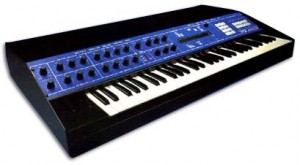
The German made PPG Wave 2 series of synthesizers are incredibly great sounding analog/digital hybrid vintage synths. They use digital samples of wavetables and feature analog VCA envelope and VCF filter sections for a classic and warm sound. The Wave 2.2 (pictured above) has oscillators that can generate over 2,000 different single-cycle 8-bit digital waveforms! Covered by knobs, the Wave still looks analog and this comprises the “Analog Control Panel”. More complex and new-wave editing of the wavetables and samples is covered by the “Digital Control Panel” where there are several key-pad buttons and an LCD screen. Another familiar treat to analog junkies is the inclusion of an 8-track sequencer which features automation of pitch, loudness, filter cutoff, waveforms and more. A cool feature – its onboard sequencer will also record any filtering and wave changes, in real-time!!
The more commonly encountered Wave 2.3 followed the 2.2 and had enhanced sample-playback capabilities. The sampler was pretty full-featured for its time and included upgraded 12-bit digital waveforms, Fourier analysis and linear playback of samples. The 2.3 model also featured 8-parts multitimbrality and MIDI implementation. The PPG Waves are know to create excellent pads, brass and bass sounds.
Steal that sound!

Hal Leonard Books has published Steal This Sound by Mitchell Sigman. Presented by Keyboard Magazine, the book is a collection of Sigman’s columns of the same name from Keyboard, detailing the greatest synth sounds from the greatest records, and how they can be achieved with modern gear.
Presented in chronological order as they appeared in the magazine from inception to the present, Steal This Sound includes more than sixty articles describing prominent synth sounds from Prince’s “When Doves Cry” and Nine Inch Nails “Closer” to MGMT’s “Time to Pretend” and Radiohead’s “Everything in It’s Right Place”.
Hal Leonard Books PR officer had this to say, “Steal This Sound is packed with invaluable tips and insights into re-creating these great synth sounds and provides a unique view into how synth technology has evolved over the years. Sigman explains how these sounds were created originally on synths by Moog, ARP, Sequential Circuits, Roland, and Korg, and gives step-by-step instructions to re-create the sounds using widely available modern plug-ins and software instruments from a host of manufacturers. Steal This Sound is a great read for music enthusiasts and an invaluable resource for keyboardists and programmers.”
About the Author:
Mitchell Sigman is a Los-Angeles based keyboardist, guitarist, and producer. His band Celebutante plays the LA area and has numerous TV track placements in shows such as The Jersey Shore, The Bold and the Beautiful, Burn Notice, Monk, and more. Sigman also won a BMI award in 2008 for his work on the Berlin track “Scream”, which is used as the theme song for the Lifetime drama Angela’s Eyes. Sigman has been a writer for Keyboard Magazine since 2004.
Pricing and Availability:
$19.99
More information:
Wheel Ring
Gear used:
Wiard AO Uncle
Toppobrillo Quantimator TWF
Make Noise René Brains PP Wogglebug QMMG Math
4ms Noise Swash RCD
Analogue systems RS 110
Doepfer A 117
A 134 cv from Moog MP 201
Featured hardware – RS 110:
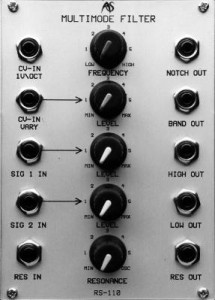
The RS110 consists of a two channel audio mixer followed by four, parallel, resonant filters with voltage controlled frequency and a unique “insert” point in the feedback path that generates and controls resonance.
Filter Modes
The RS110 offers four filter modes. These are 24dB/oct low-pass, 24dB/oct high-pass, 12dB/oct band-pass and 12dB/oct band reject (often called ‘notch’) filtering, with the cutoff frequencies (Fc) of the high-pass and low-pass outputs being the centre frequencies of the band-pass and notch outputs. Each of these filter characteristics is described in appendix 2.
There is no switch to select between the modes because all four are available simultaneously from the appropriate output sockets. However, the cut-off and resonance can not be defined individually for each, and the controls act upon each mode equally
Cutoff Frequency
You can control the cut-off frequency manually using the FREQUENCY control. In its fully anticlockwise position, Fc is approximately 30Hz. As you rotate the knob clockwise Fc will increase until, it its fully clockwise position, it exceeds 15kHz. These extreme positions are called ‘closed’ and ‘open’ respectively. You may also control Fc using one or both of the CV inputs:
If you apply a CV conforming to the 1V/oct standard, Fc will track the CV in exactly the same way as an RS90 VCO would if you applied the same CV to its CV-IN 1V/OCT socket. If the CV is supplied from a keyboard then, in common parlance, the filter is tracking the keyboard 100% and, with the resonance at maximum, you can ‘play’ the filter as if it were a conventional oscillator. You can also use this facility to make a notch or band-pass filter “track” the notes you are playing, and this can be used to create many special effects.
You may wish Fc to track incoming CVs differently, so the CV-IN VARY input is provided. This socket and its associated LEVEL control allow you to specify the filter’s sensitivity to CVs within the range ×V/oct to approximately 0.4V/oct. The former of these makes the filter invariant to incoming CVs, while the latter makes it over-sensitive compared to CV-IN.
You can determine Fc in the range 3Hz to 50kHz using combinations of the frequency control knob and the voltage control inputs.
Resonance
The filters have a common resonance, ‘Q’, that you can control using the RESONANCE knob. In its fully anticlockwise position, Q is approximately zero, and there is no emphasis of the signal at Fc. As you rotate the knob clockwise Q will increase, whereupon every mode of the RS110 will accentuate the harmonics that lie close to the cut-off frequency, Fc. Increasing Q further, the filters will exhibit ringing, and will severely colour any signals passed through them. Finally, if you continue to increase the resonance beyond a certain point, the filter will itself begin to oscillate, even in the absence of an input. Each mode will now produce a stable tone at the cutoff frequency determined by the various controls. This oscillation takes the form of (approximately) a sine wave, and it is produced by all four of the conventional audio outputs. The exact nature of the wave varies slightly from mode to mode, and you can use these subtle differences to create tonal variation when using the RS110 as an oscillator.
Everything Moog – check out the store
Here is some footage of Moog Music’s new store in Asheville, North Carolina.
Here’s a new analog treat for your iPad

Fermion–much like a true classic hardware analog synthesizer–makes all synthesis parameters concurrently visible, available and tweak-able, for greater real-time performance control.
For playing hard core dance and techno, nothing beats the classic sound of a monophonic synth. Easily create and play sounds like a classic Moog or or a Roland TB-303.
Features
* Monophonic— plays one note at a time l]
* Oscillator Module
* Dual oscillators
* Square, Triangle, Sawtooth, Reverse Sawtooth waves
* Octave selector, supporting 5 octaves
* Glide between notes (Lag Processor)
* Oscillator fine tune (more than one full octave)
* Oscillator sync
* Low Pass Filter Module
* Modulation module
* Tremelo/Wave
* Vibrato/Pitch
* Filter
* Envelope Generator module
* Supports ADSR (Attack, Decay, Sustain, Release)
* Volume
* Filter (amount of low pass filter)
* Arpeggio
Fermion is a based on the open source project Mobilsynth by Allen Porter. Developers are encouraged to visit the website and contribute. For more information about the Mobilsynth, visit http://code.google.com/p/mobilesynth/”
What is Moog up to?
Marc Doty ipad from Moog Music on Vimeo.
People are going to go crazy for this. I’m going crazy for it and I’m the guy who hates this!”
-Analog synth enthusiast Marc Doty.
Moog: Two Opto Freq’s 69
Background info:
Moog Freqbox 1 VCO out to Freqbox 2 in
Freqbox 2 VCO out to Freqbox 1 in
FB out’s to 2x Analogue Systems RS 100
to Make Noise Optomix
Freqbox CV in from Renè via Toppobrillo Quantimator
Freqbox env in ,fm in and wave in from Moog MP 201 ( Midi sync)
clocked by Logic via 4ms RCD
trigger for Optomix from Renè ( XY ) and Kenton clock out
mixed by CP251to
ADSR from Sherman filterbank 2
Drum Logic Ultrabeat
3 tracks
MOOG SOUND LAB: Phantogram “16 Years”
MOOG SOUND LAB: Phantogram “16 Years” from Moog Music on Vimeo.
Moog Indigo
“Blue has always been my favorite color.
Here is a montage of some blue footage cut to a soundtrack that was made using only sounds from the Bob Moog Tribute library for Omnisphere. “
Tara Busch goes Moog

My friend Tara has decided to donate to the Bob Moog foundation via her latest release.
The Bob Moog Foundation announced today that synthesizer and vocal sensation Tara Busch has donated a three song EP to support its mission of “igniting the innovator inside us all”. The ethereal electronica EP, “Rocket Wife,” created specifically for and donated to the Bob Moog Foundation, is available for download at Bandcamp. In conjunction with the release of the EP, Busch and the Foundation have issued a remix contest using the 17 stem tracks from the title track of the EP.
The Bob Moog Foundation (BMF) will announce three winners on November 10, 2011. The winners will have their remix posted on the BMF Bandcamp site where it will be available for sale, with proceeds benefitting the Foundation. The grand prize winner will receive a framed limited-edition archival image of Bob Moog, a selection of BMF merchandise, and the opportunity to collaborate virtually with Busch on a track where she will supply vocals and synth soundscapes. Two other winners will receive runner-up prizes.
Tara Busch is an American producer/musician/remixer and score composer. She is influenced by the rich, complex harmonies of Brian Wilson, BBC Radiophonic Workshop diva Dellia Derbyshire, and the innovations and futurist attitudes of electronic music pioneer Bob Moog. She is known for her richly textured, vocally orchestral electronica, and her psychedelic, ethereal remixes.
Busch reflects, “This is a homage not only to Bob Moog and his legacy, but to the effect the synthesizer had on my music, creativity, and life. What Bob did, most famously with the Minimoog, was to make the groundbreaking world of synthesis available to everybody, not just for the privileged few.
Though grateful for my voice and writing ability, I think having a more embracing attitude towards merging the creative and scientific worlds when I was a child would have been beneficial; not just for my music, but also for my development in general. I think Dr. Bob’s SoundSchool will help kids to develop open, bright, embracing and creative minds.
I’m excited and inspired by their quest to educate children and adults alike about ‘the intersection of science & music’ and hopefully this EP will help introduce more people to the Bob Moog Foundation. One hundred percent of the profits from the EP and the remix stems will be donated to the Bob Moog Foundation.”
Sunday, August 21, 2011 marked the sixth anniversary of Bob Moog’s passing and the fifth anniversary of the BMF’s formal launch. In celebration of that milestone, the foundation is making daily announcements of new projects, branding and fundraising opportunities. Monday, August 22 saw the launch of the Moogstress blog, written by Michelle Moog-Koussa. On Tuesday, the BMF announced their new logo, which features the innovative spirit of “Dr. Bob” and an offer for a limited edition poster designed with materials from Bob Moog’s archives. Later in the week the BMF will release a new merchandise line, Dr. Bob’s Archive Series, featuring artwork found in Bob Moog’s extensive archives. The BMF directs the preservation and interpretation of the archives for future generations of journalists, educators, innovators and fans.
The Bob Moog Foundation ignites the creative and innovative spirit in us all through exposure to interactive educational experiences rooted in the pioneering legacy of Dr. Bob Moog. Our work includes:
* Dr. Bob’s Sound School (formerly MoogLab) teaching children and adults science through music in a hands-on environment.
* Dr. Bob’s Archive Preservation Initiative. The BMF directs the preservation and interpretation of Bob Moog’s extensive and historic archives for future generation.
* The Moogseum, a future interactive facility where music, science, history and innovation will converge. The creation of the Moogseum is pending adequate funding.
Find the album at: bobmoogfoundation.bandcamp.com/album/the-rocket-wife-ep-by-tara-busch . The stem tracks are available for download at: bobmoogfoundation.bandcamp.com/album/rocket-wife-remix-contest .
The remix contest begins today and ends at midnight on October 15, 2011. All submissions should be uploaded to the “Rocket Wife” group on SoundCloud via this link: soundcloud.com/groups/rocket-wife-remix-contest-tara-busch-and-the-bob-moog-foundation .
Learn more about the foundation at: www.moogfoundation.org .
DATAMASKIN

