
SKnote releases Grasso plug-in
Grasso is a complete saturation and dynamics unit that provides subtle to strong level-independent processing but it is not a compressor, no thresholds, and it is not an envelope shaper, no triggering.
Grasso includes some special features like level-independent dynamics, tube-saturation stage, dynamic and level-independent pre-drive filtering, spank control and a modeled power-supply and SKnote says that it is very useful to add color and dynamic control to mixes and single tracks, from subtle to extreme.
Main features:
- tube-modeling
- level-independent dynamics
- level-independent dynamic filtering (on attack and decay)
- detailed control on tube circuits with several options
- “spank” feature (post-drive dynamic response)
- modeled “weak” power supply (more harmonics or “sagging”)
- special post drive expander for great dynamics
Pricing and Availability:
$29.99
More information:
Tek’it Audio has announced the Arp-EG Classic – new MIDI arpeggiator plug-in
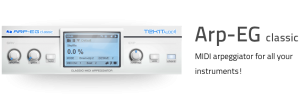
Tek’it Audio has announced the release of Arp-EG Classic, a MIDI arpeggiator plug-in. Using Arp-EG classic all the VST instruments you like and even your hardware synths (using your DAW MIDI out) can now play arpeggio sequence.
Use the six playback modes and the four octave range, speed up or slow down your arpeggio sync on the beat of your DAW. Control the groove using the shuffle and gate function, control the expression with the transpose function, give to each note his one velocity, play polyphonic chord or notes sequence. Assign all the parameters to your MIDI controller easily and randomly generate your arp with a single click.
A demo version of “Arp-EG classic” is available to download. The full version is available to purchase as a VST plug-in for Windows for €12 / $16.
Sinevibes’s Sequential updated to 1.3.0 – Working in realtime
http://youtu.be/wsOf7JyaI80
See how quickly you can modify a drum loop using Sequential’s effect matrix. More about Sequential AudioUnit plugin: http://www.sinevibes.com/sequential/
Sinevibes has announced a major update for Sequential, an AudioUnit plugin for creating rhythmic effect patterns. They tell us that new features make it an even more capable and fun tool for re-processing beat loops, creating complex motion textures, and spicing up tracks with unique transitions, breaks and glitches.
Sequential 1.3.0 brings the following improvements:
- New effects: phase modulation sine oscillator, glitch triangle oscillator and shot noise generator.
- Re-calibrated input envelope follower parameters for faster reaction time and smoother shape.
- Alternating color shades in effect matrix.
- New preset patches.
Pricing and Availability:
Sequential 1.3.0 is immediately available for $29 as a 32/64-bit AudioUnit plugin for OS X. The update is free to all existing users. New customers can also purchase it as part of the Sinevibes Complete AudioUnit pack with a 50% discount.
More information:
u-he demos Reason Rack Extensions
The well know soft synth developer u-He, was one of the first companies to sign up to provide “plug-ins” to the new Reason Rack Extension program, here’s a demo where they show how.
Propellerhead’s new Reason Rack Extensions are currently the talk of the music technology town, and u-he is one of several developers that has already signed up to create them.
We caught up with u-he’s Urs Heckman as he showed us exactly how Rack Extensions look and feel when they’re running within Reason.
By the way here’s another video showing some of the new stuff from u-He:
MusikMesse: Introducing UNVEIL – De-Reverberation and Signal Focusing
More things are “unveiled” as we approach tomorrows MusikMesse, here’s one from Zynaptiq:
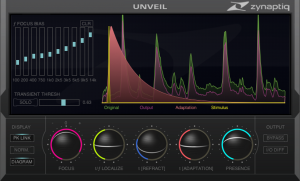
UNVEIL is a real-time, de-mixing based plug-in that allows attenuating or boosting reverb components within a mixed signal of any channel count, including mono sources, as well as modifying reverb characteristics. Additionally, UNVEIL allows you to bring the key features of a recording into focus, or move them to the background, by attenuating or boosting perceptionally less important signal components. Based on our proprietary, artificial intelligence based MAP (Mixed-Signal Audio Processing) technology, UNVEIL allows fixing previously unusable location audio and dialog, tightening up live music recordings, removing reverb and “mud” from musical signals, as well as creative sound design.
UNVEIL has many uses, some of which are:
- Audio engineers can attenuate reverb in recordings
- Film mixers and dialog editors can remove reverb from dialog and location sound
- Music producers can turn vintage drum-loops rich in reverb into dry recordings, and vice-versa
- Foley artists can remove ambience from sub-optimally captured sounds
- Mix and mastering engineers can bring key mix elements into focus by attenuating components commonly referred to as “mud”
Good Bye, Reverb
Removing reverb from recordings has always been difficult to impossible. Existing de-reverberation strategies either manipulate signal dynamics, require specific channel formats, are limited to certain signal types, or all of the above. Enter UNVEIL.
UNVEIL is not an expander or envelope shaper, is not a spectral thresholding processor, does not use phase cancellation techniques or inter-channel correlation analysis, and thus works with any channel count from mono to whichever surround formats your DAW supports, and without changing signal dynamics. To achieve this, it utilizes a model of the human auditory system to discern which parts of the signal are reverb, effectively “listening” to your signal much like a human would. These components are then separated from your signal for processing using our MAP technology. From there, reducing the amount of reverb in your recording is as easy as adjusting the value of one of our slick track-ball-esque sliders.
Hello, Reverb
Conversely, UNVEIL allows increasing the amount of reverb in a recording, too. You can turn a close-miked drum kit into a full-on room-heavy monster, move a sound back in the sound-stage or adapt the amount of reverb on different location recordings to match each other better. Additionally, UNVEIL gives you several parameters that allow manipulating reverb characteristics…like all of it’s features, within a mixed signal, in real-time and even using mono source material. No, that’s not magic, that’s advanced science.
UNVEIL The Detail
UNVEIL’s algorithm isn’t limited to processing reverb. Actually, it processes any signal components that the human auditory system considers as being of little significance, which includes the parts that many engineers refer to as “mud”. As a result, UNVEIL allows reducing the level of all the stuff that clouds your signal and masks the detail you work so hard to capture, bringing the key features into focus and, well, unveiling all the inherent detail. As a bonus, this also increases headroom, so you’ll even be able to increase perceived levels without having to slam the meters. And again, you can use the inverse function to add grit and a less up-front character to your recording.
One Small Step…
Except for the mathematics under the hood, everything about UNVEIL is simple and easy, results are always just one small step away. That being said, UNVEIL allows adjusting the process in a very wide range. No dumbed-down “easy-mode” in sight, just a perfectly stream-lined, no-nonsense GUI that looks as slick as UNVEIL sounds. And oooooh yes does it sound good. But don’t take our word for it, grab the demo for a test-drive!
Expresso – new free distortion effect plug-in for Windows
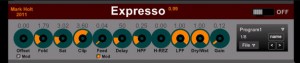
Mark Holt has released Expresso, a free distortion effect plug-in for Windows.
My first ever release of a VST effect. Made in Synthmaker v2.0, so, sorry, no Mac version.
Most of the modules are my own (rather simple) code rather than stock modules. I’ve been using it a lot and thought I should give something back to a community that’s given me a lot over the years.
The first knob is called offset and this adds DC offset to the input signal (the mod LED below changes the direction of offset). The next knob is labelled fold and adds some fold back distortion. The next knobs are sat (saturation), feed (feedback – the mod LED changes the signal slightly), delay (for the feedback), HPF (high pass filter), H-REZ (high pass resonance), LPF (low pass filter), clip (hard distortion), followed by a dry/wet control and finally gain (for output). The feedback path actually goes after the clip module and re-enters before the fold back distortion stage, so maybe a future update will change the knob order to reflect this (it’s like it is for chronological reasons). Beware that on settings where all settings are high that you will get proper high squealing feedback. I’ve kept that as a feature and the tone can be changed with the delay knob when it appears.
Get Your FREE Little Radiator plug-in and a chance to win the ULTIMATE prize!

This is what Soundtoys say about it….
Everyone needs a little warmth in their life. Little Radiator models the classic sound of the Altec 1566A mic preamp, and lets you spread some analog tube magic on your mixes. This was one of the main sounds from the classic Motown mixes, became a secret weapon of boutique producers, and is now a vital part of the sound of bands like the Black Keys. Why? Give it a listen and hear. Subtle warmth, or driving grit, all the things you need to shake the “clean” off of your computer recording. Now you’re getting that warm feeling.
Radiator. Coming April 2012
This upgrade from Little Radiator is based on the Altec 1567A (the 1566A’s big brother). It’s the next level in this classic sound with extra control and an extra SoundToys twist. Details coming soon.
A Bit of History
The unmistakable green-faced Altec gear, and in particular the 1566A and 1567A, played a big part in shaping the early “sound” of Motown between 1961 to 1964. Songs by greats like The Four Tops, The Marvelettes and The Supremes went through a 1567A mixer to the massive three track recorder. Ahhh, when life was simple. These mic preamps and mixers have a very colored warm sound and are very loud. The EQ is as simple as it gets, with one knob for bass, and another for treble. After Motown, and after much gear came and went, analog diehards began seeking out the 1566A and 1567A as inexpensive sources for real tube sound.
Go and grab it whilst it is free from SoundToys
Little Radiator™ gives you the warm sound of the classic Altec 1566A tube mic preamp, and it’s totally free (for a limited time).
And by sharing with your friends, you also get a chance to win the ultimate prize: PLUGGED FOR LIFE! Get all SoundToys plug-ins for as long as you live or we live!!!
(The top runners up will also get prizes like free SoundToys bundles, free upgrades to Radiator™, and cool SoundToys t-shirts.)
Step one – find a code. Got one already? Skip this and go register it below.
Don’t have a code yet? Check the audio forums, check FaceBook, check everywhere ’cause that code gets you the free plug-in and gets you your own sharing code. Then you can give yours to all your friends and they can get it for free, too. Plus, each person you sign up with your code, gets you closer to earning more free stuff. Free bundles, t-shirts and upgrades to Radiator (more details coming soon) and, of course the outrageous Plugged for Life prize that the most ambitious one with the most shares will have bestowed upon them.
Check out our Contest Page for complete details.
OldSkoolVerb 2.0 – new freeware algorithmic reverberation effect plugin
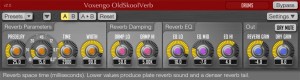
Voxengo has announced the release of OldSkoolVerb 2.0, a freeware algorithmic reverberation effect plugin for Windows and Mac.
OldSkoolVerb now supports most user interface features latest Voxengo plugins offer, including undo/redo history, preset manager, user interface coloration and others.
Most importantly, this updated version 2.0 features an improved reverb algorithm which became more robust, more stereo-balanced and more parametrically flexible.
OldSkoolVerb is available to download as a freeware effect plug-in for Windows and Mac (VST/AU).
Bleep’ – new free synth plugin
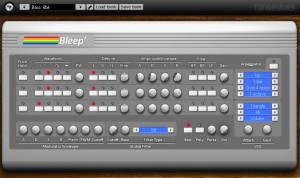
ToneBytes has announced Bleep’, a free synthesizer instrument for Windows.
Bleep’ — is a free VSTi synthesizer plug-in for Windows which inspired by the sound of MOS Technology SID. At the same time Bleep’ is not emulator of this chipset but only partially similar to its architecture.
Bleep’ features
- 3 oscillators with four waveforms: sawtooth, triangle, pulse (with PW) and noise.
- Each oscillator has own detuner, ADSR envelope and multimode LP/BP/HP filter.
- Multimode LFO synced with BPM.
- Modulator Envelope Generator.
- Pseudo arpeggiator.
- Overall multimode filter.
- Built-in preset manager with ability to patch name editing.
- VST automation and full MIDI Learning are supported.
Bleep’ is available to download as a freeware VST instrument plug-in for Windows PC.
Basslyne – new bass plugin VST for electronic music
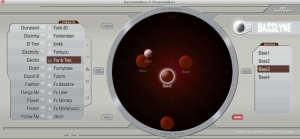
DaSample has released Basslyne, a new Bass plugin VST instrument for Windows and Mac OS X dedicated to electronic music.
Now you can easily create and shape your sound. Instant access to different presets is quick and easy. The ability to use multiple oscillators allows Basslyne to produce powerful electronic and virtual analog-bass instruments.
Features:
- Powerfully simple interface.
- Stack Module synthesis.
- Easy To Use.
- Sophisticated EQ Overdrive.
- Advanced Automation.
- User friendly interface.
- Integrated, full-featured FX Racks.
- Expandable sound architecture.
- FM Oscillators.
Price: €39.
DATAMASKIN

