
Short demo featuring the Akai VX 90
This is a small demo from the AKAI VX 90. Actually a basic one-osc VCO synth ( 6 voices ), but with some special features like the PWM over all waveforms, FM, Chorus FX, Unison Modus this unit shines with a very nice analog sound. All sounds from the VX 90, exept the snare, rim and the short toms ( Roland TR-808 ), the HH and the clap are the drumatic 3 plugin. The bassdrum and the simmons-toms are made with the AKAI VX 90.
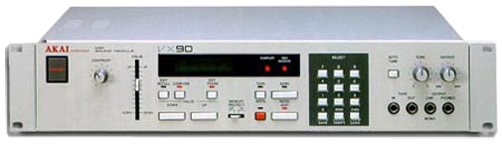
With an identical voice structure to the AX73, the VX90 is little more than a rack-mount version. It is a MIDI equipped six-voice analog synthesizer with advanced digital controls and functions. Like the AX73 it has an auto-tune function and a really nice VCF lowpass/hipass filter and envelope section. The VX90’s memory capacity holds up to 100 patches. It can be played polyphonically or in a stacked unison mode for that thick lead sound for your rave and techno anthems. A really cool feature of the VX90 is that you can plug the Akai S-612, S-900 and S-950 samplers in to it and run their samples through the VX90’s analog filter and envelope sections.
Jomox Xbase 999: Short Demonstration
Short demonstration of the Jomox Xbase 999 analog drum synthesizer. All sounds are generated by the Xbase 999. Kickdrum, Snaredrum, Low Tom, and High Tom are true analog. Hi Hats, Clap, Rim Shot, Crash, and Ride are digital and can have different 8 bit samples assigned to them.
ALESIS ION , DEMO NA CLASSIC KEYBOARDS
About the synth:
The Ion Analog Modeling Synthesizer is one fat-sounding digital synth! Using Alesis’ proprietary DSP Analog Modeling technology with a 500 MIPS processor (500 million instructions per second), every knob and button is tweakable in real-time giving you the feel and sound of a true analog oldie.
The Ion has 8-voice polyphony with 3 oscillators per voice, and is 4-part multi-timbral. It offers continuously variable wave shapes (sine waves can morph into square waves), plus osc-sync and FM synthesis. 16 filter types are included, along with two LFOs, Sample & Hold, and an Arpeggiator-all of which sync to MIDI clock. A powerful and intuitive modulation matrix is built in, as well as a 40-band vocoder that does not use up any polyphony. External stereo audio can be processed through the filters, effects, or the vocoder.
Though not a true analog like the Andromeda A6, the Ion is capable of creating a wide variety of sounds from warm thick analog pads all the way to gritty monophonic leads and basses, as well as some funky and realistic sound effects. The Ion also simulates the best of the classic analogs such as Oberheims, Roland Jupiters, Arps, Moogs, etc, largely due to its great filters – there is hardly any aliasing even on the highest tones. The Ion also comes equipped with not one but two modulation wheels, both assignable to mods in the mod matrix (LFOs only assignable to mod wheel 1). The Ion has an amazing range of tonal possibilities.
The chic design, layout, and large backlit screen make editing on the Ion a dream! The Modulation Matrix is easy to understand and can route any modulation parameter to almost every component of the Ion!! All parameter knobs (excluding master volume & menu knob) are 360 degree pots allowing you to twist all the day long! A 160×160 graphic display provides instant visual feedback as a parameter is edited. Along with having 512 patch settings (all user-rewritable), the Ion has 64 multi-timbral setups. All parameters including arpeggiator settings are stored with each preset.
The ION keyboard contains 49 velocity-sensitive keys, 4 analog outputs and 2 stereo analog inputs (all balanced and using 24-bit conversion), 4 individual insert effects, a stereo master multi-FX processor, and an internal universal power supply. Expression and sustain pedal ports as well as headphone jacks are also there. For those who want a versatile synth and can’t afford the A6, this is the synth for you – arguably one of the best ‘virtual-analog’ synths for awesome, analogue-like sounds.
FireBird 2 – the software synthesizer for Windows is now free
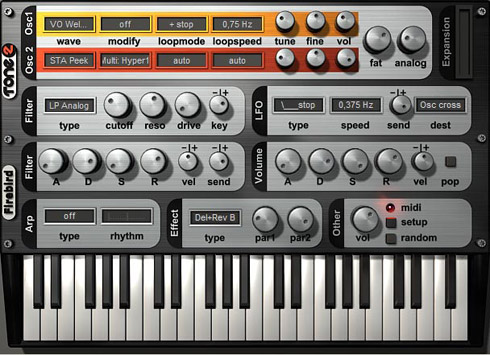
Tone2 Audiosoftware has released its FireBird 2 software synthesizer instrument for Windows as a free download.
Here’s what they have to say about the free soft synth:
After seven years of faithful service, the time has come to set the bird free. Firebird itself has become vintage and even though it’s no longer profitable to remain a commercial product, we feel that more people should deserve an opportunity to enjoy this sometimes heavily underestimated synthesizer.
Which is why we decided to release one last update and turn the product into freeware (previously $79). We want to say a big THANK YOU to all customers who supported the development of Firebird and other Tone2 products, by purchasing our software.
FireBird 2 for Windows is a free download here >>
Features
-
Very easy to program and easy to use
-
A unique sounding synthesis: Harmonic content morphing (HCM)
-
High sound quality: Warm, transparent
-
437 hand picked presets included, over 1000 sounds available
-
84 oscillator types containing 18,000 morphable waveforms
-
38 different filter types
-
True stereo mode, 4x unison mode, and up to 8 oscillators per voice
-
Can sound like other synthesis methods – additive, subtractive, AM, FM, phase distortion, supersaw, vocoder, sync
-
Can sound like natural instruments like piano, brass, organs…
-
23 spectral manipulations or “modifiers” can be applied to the oscillators
-
21 arpeggiator types
-
13 effect types
-
Skinable user interface
Yamaha AN1x – demo
Demo of Yamaha AN1x synthesizer. Sounds, sequences & video editing by WC Olo Garb.
The AN1x is a powerful retro-analog synth with a really cool new feature that lets you record real-time editing and filtering and be able to store it as part of the sound! A major contender in the new wave of analog-digital synths using DSP modeling of analog waveforms to recreate the coveted sounds of analog synths with modern digital specifications. It offers truly traditional yet modern methods of analog synthesizing, 10 notes of polyphony, 8 knobs for tweaking, and an arpeggiator with dozens of inspiring patterns!
Although the AN1x is not a follow-up to the CS1x (which has since been followed by the CS2x and the CS6x) it has borrowed many functions and technologies from the CS1x synth. First, it’s built in an almost identical case with the same layout of buttons and knobs as the CS1x. However the function of every knob and button has been greatly expanded. The AN1x also has 2 Scene memories for instant recall of any envelope and filter settings and the mod-wheel can be used to morph between the two scenes. On-board effects and a state-of-the-art arpeggiator section also are on-board for giving your sounds life and motion.
The AN1x adds a new Ribbon controller for increased real-time control. It also includes pulse width modulation, ring modulation and oscillator syncing. The AN1x may not be the next evolution of the CS1x but it is basically a more advanced synth capable of increased sound potential and quality. It has a better feeling keyboard than the CS1x as well assuming that the AN1x is for those looking for something more professional than the CS1x.
Time machine: PPG wave 2.2 + Waveterm A
Vintage synthesizer demo track
all sounds: PPG wave 2.2 synthesizer + Waveterm A
using some factory samples from the original Waveterm A sample library.
recording: multi-tracking without midi
fx: a bit reverb and delay
The PPG Waveterm A – or just PPG Waveterm – was PPG’s first entry into a full studio solution.
The PPG Waveterm A does NOT produce any sound itself meaning you will need a PPG Component like the PPG Wave 2.2, PPG Wave 2.3 or PPG EVU if you want to hear anything you do on it.
The PPG Waveterm made PPG owners able to produce their own wavetables and to save their own programs to floppy disk instead of tape using the Cassette interface.
It also made PPG owners able to create songs and to – most importantly to most – sample something and play it back using the PPG Wave 2.2.
The PPG Waveterm is based on an old german computer called Eltec Eurocom II based on the Motorola 6809 processor, and can be set up to run the ‘ordinary’ Eurocom II software (Flex 9).
You can also hook up a keyboard and a printer to it to have a ‘fully featured’ home computer – a very expensive one though.
The PPG Waveterm was not cheap – but it was a giant leap in music technology, and the quality of the samples you could produce using the PPG Waveterm was astonishing back then in all its 8 bit glory.
ARP Quartet Demo
The magic of the ARP Quartet lies in layering its four sounds (Brass, Organ, Piano, and Strings) together in interesting ways to create some huge analog sounds. Here are a couple short demos of the huge analog walls of sound that can be created by combining Brass & Strings, and Strings & Organ together.
More on the ARP:
The ARP Quartet is identical to the Italian made Siel Orchestra. In fact, it is the Orchestra! ARP bought, relabeled and sold it as the Quartet without changing it much. It’s a 4-part orchestral synthesizer with 4 sections: Brass, Strings, Organ and Piano. These 4 tone color families can be played individually or two can be simultaneously played. They are also individually tweakable. Selected presets will light up LEDs to show you which sliders and buttons can be used to modify the current section. The synth itself is very limited however, and there’s no external control, no pitch/mod wheel and few edit parameters. But it sounds very good and it is, after all, a classic analog synth.
The Brass section creates Trumpet and Trombone sounds with independent attack and sustain controls. The String section creates Cello and Violin sounds with independent attack and sustain controls. The Organ section is 2-voice and has a Celeste sound available as well. The Piano section offers two types, traditional or Honky Tonk.
MKS 80 Overview
Another video featuring the Super Jupiter
New free soundbank for the microKORG

Korg has released a new free soundbank for the microKorg synthesizer.
Here’s what they have to say about it:
These 128 custom sounds from Korg USA are truly a micro makeover, pushing the powerful microKORG analog modeling engine to deliver a fresh and wild collection of leads, basses, atmospheric textures, arpeggiations, motions synths, rhythmic grooves and much, much more to explore. Take your microKORG and your music to new levels with this exciting new sound set!
Download the new sound library right here >>
Checking out the KORG DS-8 Digital Synthesizer
Playing the Korg DS-8 without any additional effects or eq. All you hear is coming straight out of the Korg DS-8.
“The Korg DS-8 employs 4 operator FM synthesis from Yamaha – but on the DS-8 you have sliders to tweak a sounds a bit. A pity, that it’s not possible to save the sounds you have edited with the sliders. You have to edit the sounds in the normal edit mode.
On the DS-8 you have to deal with terminology from analog synths, not with “operators”. It also has an useful effect processor with great delay and modulation effects. The little brother of the DS-8, the Korg 707 does not have this effect processor, which is a big minus.
In the video I show you the kind of sounds, which are the best on the Korg DS-8 in my opinion – mostly beautiful, relaxing pads. A lot of other sounds are also possible, but many of them are quite ugly, so I let them out…. :-)”
DATAMASKIN

