
Moog Factory Tour: Testing and Calibration
This installment in our Moog Factory Tour series explores the testing and calibration process done to every Moog instrument before leaving the factory.
Checking out the Propellerhead PX7 FM Synthesizer in Reason 6.5
A nice review of the recently released PX7 FM synth for R6, details below:
More info: http://bit.ly/X3rh1F
Recently Propellerhead approached me about designing some sounds for a new FM synthesizer in Reason. As you may recall from some of my previous video tutorials, I showed you how to create an FM synth out of several Thors and a Combinator. The purpose was to demonstrate how to get some of the more modern, edgy FM sounds that we associate with dubstep and electro.
Although my method for creating FM sounds this way worked, Propellerhead have made this easier now with a new FM synthesizer engine, the PX7, now available as a Rack Extension for Reason 6.5. The PX7 is a true six-operator FM synth with some dazzling math behind it, resulting in a replica of the Yamaha DX7, the first commercially available FM synth from the early 1980s.
Just so you all know, the DX7 and I didn’t have a great relationship when we first met. I first encountered it in the labs at Berklee when I was studying music synthesis. It was a million miles away from what I wanted to achieve soundwise. I was very into the big, fat, warm analog sounds that I was hearing in all the drum’n’bass tunes I was into at the time. The DX7 was also difficult to program at first. It didn’t make sense to me and was really tedious. It had a very small display that required you to scroll through dozens upon dozens of parameters to create and edit a sound. More importantly to me at the time, it was seemingly not capable of producing the analog sounds I was into.
Years later, after a revival in software form, FM synthesis has found a very special place in my heart. I now find it to be very exciting as I am now very clear on what I can and can’t do with it. I have developed an appreciation for the highly detailed and exotic sounds that FM can produce. So I hope you all enjoy and appreciate the irony of this situation and my love/hate relationship with FM throughout the years. Most importantly, I hope that you enjoy the lesson in the PX7 and ultimately FM synthesis. – Chris Petti
Moog Factory Tour: Minimoog Voyager
Jim Debardi from Moog Music takes us on a tour of the Moog Factory to give us a history of the Minimoog synthesizer and to show us how they handcraft the Minimoog Voyager.
Alpha Plus – free advanced trance synthesizer
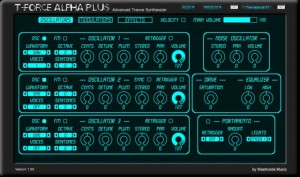
Alpha Plus is a free ‘advanced trance synthesizer’ for Windows.
It’s a three-oscillator subtractive/FM synth with built-in delay and reverb.
Details and audio demos for Alpha Plus below:
Features:
- Synthesis: Subtractive/FM.
- 3 Multiwave Oscillators with voice control (adjustable from 1 to 8 voices per osc), adjustable stereo width and panning, with Sine, Saw, Ramp (reversed Saw), Triangle, Pulse (square with PWM) waveforms and retrigger option for each oscillator (with “retrigger off” the oscillator is in free running mode, the oscillator starts with random phase positions everytime played a note, with “retrigger on” the oscillator’s phase starts from position 0 everytime played a note.
- 1 Noise Oscillator with adjustable stereo width and volume.
- 1 Resonance Four Pole State Variable Filter, switchable between Low Pass, High Pass, Bandpass and switchable 12/24 dB slope, Resonance can be driven up to self oscillation.
- 1 ADSR Filter Envelope.
- 1 ADSR Amp Envelope.
- 2 ADSR Mod Envelopes.
- 2 host syncable LFOs.
- Adjustable Drive function for Saturation/Distortion.
- two band Low Freq/High Freq Equalizer.
- Bitcrusher.
- Portamento.
- 32 step Envelope Controlled Trance Gate.
- Velocity control (on/off).
- Dual Delay, switchable between Stereo mode and Ping-pong mode (right and left channels have their own tempo settings).
- Stereo Reverb.
- integrated Sidechain FX, optional with internal bpm synced triggering or external triggering via MIDI In (triggered by MIDI Note On, on MIDI channel 2). Note: see the manual of Your DAW for informations how to route a second MIDI Track to a VST/VSTi, because some DAW’s have different ways of MIDI routing.
- all functions fully automatable.
Return of the Sigma
Utterly shameless synth noodling.
“I did this a few months back after digging my old Korg Sigma out of the spare room and dusting it off. I bought it secondhand in 1989, it was pretty old and beaten up already then, and it’s never been serviced and has sat completely unused for the past 6 years or so. At first it didn’t make any sound at all, but after leaving it on a while and wiggling all the pots a bit, it started to cough and splutter back to life. I really liked the noisy, slightly broken sound – the crackly filtered hiss makes it sound very woodwindy and reedy, like some weird alien durduk.”
The Sigma is a marvelously expressive beast. Two X-Y joysticks, one controlling pitchbend and noise/vibrato and the other controlling high and low pass filters, and, unusually for a synth of this vintage, keyboard aftertouch controlling vibrato.
Future Retro 777 modifications
This video shows off a few modifications to a FR-777 bass synth, performed by Jered at FR some 15 years ago. Shown are the Oscillator sync, Endless-drone, and LFO-to-cutoff mods, plus variations.
“Around 2:20, when I say “Envelope”, please substitute “LFO!”
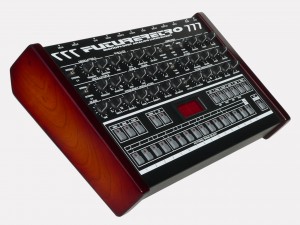
The Future Retro 777 is a monophonic analog synthesizer with a digital sequencer. The 777 is a sleek retro design that has realized the full potential of the monophonic pattern based synth. It’s not just another TB-303 emulator. It uses analog circuitry and has a lot of hands-on knobs for instant sound tweaking. And while the 777 has extensive editing and modulation abilities, the layout is as basic and intuitive as an old SH-101 or MC-202!
The 777 functions quite well as either a standalone bass sequencer or as a sound module in a MIDI environment. Two oscillators (A / B) produce a fat bass sound. Modulation abilities are quite complex, the oscillators themselves can modulate each other for example. The filter is very nice with switchable 3 or 7 pole slopes as well as other sound shaping controls for a wide range of tones. An external sound can be routed through the filter too. The sequencer, OSC B and the decay envelope can also modulate the filter cutoff. The 777 also employs a smart accent effect for that extra bit o’ kick in your bassline.
As a sequencer the 777 shines once again. Bear in mind that this sequencer accommodates a monophonic (single tone) instrument which normally has very basic sequencing needs. Notes are entered using the pseudo-keyboard buttons. Programming is different than other synth / grooveboxes of similar function but is relatively easy to master. Up to 256 patterns can be linked to form up to 16 songs all of which remain in memory. And of course all real-time editing can be recorded into your sequence and are also MIDI controllable. Final goodies include an internal MIDI to CV-gate converter, glide or portamento effects, distortion, chorus and phase effects and more!
Element – new synthesizer instrument plug-in for Window and Mac
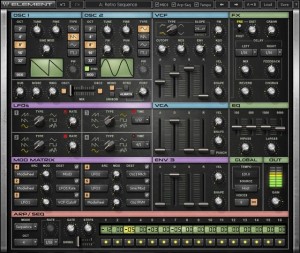
Waves has announced the release of Element, a synthesizer instrument plug-in for Window and Mac.
Introducing Element: The first ever synthesizer from Waves. Powered by Virtual Voltage™ technology, Element is an analog-style polyphonic instrument engineered to deliver the fat, gritty sound of the classics, with all the precision, flexibility and control of contemporary digital synths.
Element includes a vast array of convenient features and functions. Like integrated effects. A 16-step arpeggiator / sequencer. MIDI Learn for all controls. And a massive preset library, with total tweakability. Plus, all parameters are laid out right there in front of you, so when inspiration strikes, there’s no need to scroll through page after page to customize your sounds. Searing leads, booming basses, ethereal pads, electro-percussion, sequential motions, mind-blowing FX and lots more: Element does it all.
Element for Windows and Mac is available to purchase for the introductory price of $99 USD (regular $200 USD).
Electronisounds releases Red Dragon 2 synth plugin
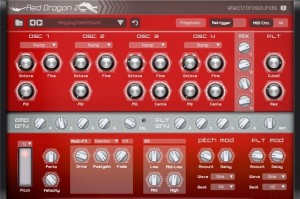
Electronisounds has announced version 2 of its Red Dragon software synthesizer for Windows.
Changes in Red Dragon 2
- Completely re-coded engine.
- NEW GUI.
- NEW built-in FX (Chorus, Delay, Distortion, Flanger).
- 614 ALL-NEW presets, plus the original 384 presets for a total of 998 presets.
- Built-in preset browser.
- and more.
Virtual Model Mini – new virtual synthesizer instrument for Windows
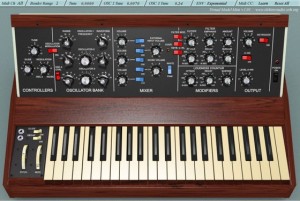
Elektrostudio has released the Virtual Model Mini, a virtual synthesizer instrument for Windows.
Virtual Model Mini features
- Polyphony: Monophonic.
- Timbrality: Monotimbral.
- Oscillator: 3 VCOs, white/pink noise.
- LFO: Oscillator 3 can function as LFO.
- Synthesis type: Analog Subtractive.
- Filter: 24dB/oct, 4-pole lowpass filter, resonance, ADS envelope generator, key tracking.
- Attenuator: ADS envelope generator.
- Effects: Frequency modulation using oscillator 3/noise.
- External Signal: Feedback mode in VSTI version.
The Virtual Model Mini is available as a freeware VST instrument plug-in for Windows.
Checking out the Roland JX-3P synth
The Roland JX-3P is a vintage synth that offers classic Roland analog sound, but without the full-on knobbiness of many earlier synths. The knobs were moved to an optional add-on, the PG-200 programmer, in order to make the JX-3P more affordable. The JX-3P features 6 dual-VCO voices, analog filters, amps and envelopes. A built-in chorus is also available. The JX-3P was one of the first synths to implement MIDI, and has a relatively basic MIDI implementation.
DATAMASKIN

