
“Inside the Grid on Altair IV” – A One-Note One-Patch Soundscape in Absynth 5
My Colorado based electro friend Mark Mosher explores Absynth 5, details below:
“Inside the Grid on Altair IV” is a soundscape created with one patch from scratch using the virtual synthesizer Absynth 5. It is performed be pressing and holding a single note for the entirety of the song. While I have used Absynth as the sole instrument for songs in the past (Tracks 3 & 4 on my last album markmosher.bandcamp.com/album/no-ghosts-just-fear), I’ve never created a patch where one held note triggers the entire composition. Recent works by Absynth creator Brian Clevinger and artist Anthony Distefano have inspired me to do start working on some pieces of this nature and this is my first of many to come.
The audio is CD quality, and the video shows a behind-the-scenes look at Absynth’s wonderful 68-stage modulatable envelopes in action. So all the movement and changes in dynamics, pitch, timber are meticulously drawn and programmed as part of the patch. The envelopes also support LFOs on segments. The envelopes can be extremely long and also loop independently which making Absynth fantastic for evolving soundscapes.
Note, I am also using an envelope to change the “effect time” of the Pipe Effect which is a unique audio effect within Absynth. P. 88 of the manual describes it best “Let’s take the image of a string. A loudspeaker (a contact loudspeaker) is connected to a string, which begins to vibrate as a result. You can determine the position of this virtual loudspeaker on the string via the parameter Input Position. Above the string are two pickups, similar to an E-Guitar. The pickups’ positions can be determined through the parameter Output Positions. Changing those two parameters can be compared with changing two microphones. You can modulate the string’s length and the pickups’ position through the LFOs or a MIDI Controller. This way, various flanging, pitch-shifting and rotary speaker effects can be achieved. These effects are particularly apparent when the modulation of the pickups are modulated in op¬posite directions.”
Checking out the new version of Animoog (V2)
Moog Music has updated their Animoog app to version 2.0. This major update to the iOS synthesizer is free for existing Animoog users and includes many user requested features and product enhancements, including: accelerometer integration which gives Animoog owners the ability to tilt their iPad in any direction as an interactive 3D modulation source; note hold and scale lock, and tools for advanced users like, Load/Save MIDI CC maps, Audiocopy/Audiopaste integration and support for the new Audiobus platform.
“Also, as a holiday gift, Animoog V2 features apowerful 4 Track Recorder, which gives Animoog users the ability to record audio from within Animoog or import audio tracks directly from their iTunes library. Users can then split, loop, copy, paste, and share individual clips, or mix down entire songs and upload them directly to SoundCloud, all from within the Animoog’s universe.” – moogmusic.com
For more info: moogmusic.com/news/animoog-v2-4-track
StudioLogic Sledge VA Polysynth – Sounds Audition
A flip through of various presets, plus a couple of home-grown sounds to go with the full review http://www.youtube.com/watch?v=DCS2Sj2ngNE.
“I dont think the presets show off the synth to its full potential – far better to create your own with a synth like this.”
Elektron Analog Four: Polyrhythmic Sequence
Demonstration of a four-voice polyrhythmic sequence on the Elektron Analog Four.
Introducing Lounge Lizard EP-4
Thiago Pinhero introduces AAS’ electric piano.
Lounge Lizard EP-4 — Electric Piano
http://www.applied-acoustics.com/loungelizard/overview/
Background description:
In the studio
When time matters, simply pick from more than 100 custom electric piano presets. But when sound exploration is on the program, players will dig the real-time controls over hammer hardness, tine color and decay, damper noise, and pickup placement for an unsurpassed level of customization.
Live on stage
Gigging musicians will appreciate Lounge Lizard’s small memory footprint, instant preset recalls, and stability. Furthermore, the huge library of Rhodes and Wurlitzer sounds as well as the complete selection of effects makes it easy to build a set list and get the perfect tone for each songs.
Alive beneath your fingers
There is something quite immersive when a connection develops between the player and the instrument. Whether it’s the perfectly smooth velocity progression or the interactive reaction to your performance, Lounge Lizard makes that connection happen.
Beyond the electric piano
Lounge Lizard achieves convincing electric piano tones with less than twenty synth parameters. That’s a quite a feat by itself, but pushed further, these parameters reveal a realm of other tones. Organs, bells, chimes, leads are all featured in the preset library’s Experimental folder.
Custom tones
Even though famous players shared the same brand and models, they were all acheiving their own signature sound. Nevertheless, that usually meant spending many hours under the hood with screw drivers, wrenches, or even a solder iron. What’s fun with Lounge Lizard is that whether you’re looking to emulate a particular sound or simply find your own, all those tweaks are just a few knob turns away!
Soundiron Intros Ambius 2: Systematik Atmospheric Synth
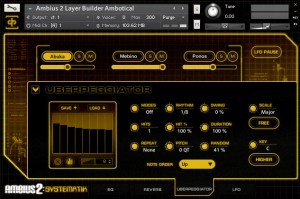
SoundIron has introduced Ambius 2: Systematik – a flexible and adaptive sample based atmospheric synth, details below:
We wanted a broad collection of richly nuanced flavors with the ability to freely layer, blend and reshape a wide mix of percussive, tonal and textural elements into custom multi-layered dynamic and evolving instruments. We wanted a unified and powerful interface to combine detailed performance and tone shaping controls with a wide pallet of experimental and environmental convolution effects. We wanted a built-in tempo-locking step-sequenced filter and LFO engine that could be adapted to just about any other GUI control parameter on the fly without missing a beat. Ambius 2 is all of that and much more.
Here’s a video introduction to Ambius 2:
A detailed walk-through video and tutorial of Soundiron’s new Ambius 2: Systematik library. This cutting-edge hybrid synthetic/organic lead, pad, texture and ambience design library is built on powerful new adaptive groove-building tools and inspiring performance shaping features that you won’t find anywhere else. Create and tweak your own multi-layered instrument concepts with nearly 5GB of freely mixable content and dozens of unique presets, each with nearly limitless creative potential.
http://www.soundiron.com/instruments/ambiences/ambius2/
Propellerheads announces the PX7 FM Synthesizer – Rack Extension
For more information: http://shop.propellerheads.se/product/px7-fm-synthesizer/
The PX7 FM Synthesizer is a six operator FM synth for the Reason rack. As a faithful recreation of the popular DX series keyboards, it provides a wealth of new sounds, ranging from classic 80’s bass and brass to modern textures, leads and growls.
Propellerhead has announced the immediate availability of PX7 FM Synthesizer, a new six operator FM synth for Propellerhead’s Rack Extension format. As a recreation of the popular DX series keyboards, PX7 provides a wealth of new sounds to the Reason rack, ranging from classic 80’s bass and brass to modern textures, leads and growls.
Propellerhead has improved on the original too, with macro controls for easy tweaking of sounds and stereo panning as notable new introductions. PX7 is fully integrated with the Reason rack, allowing users to create layered sounds, combining it with effects, and even control operator levels through CV.
Included with the Rack Extension is a set of new patches for PX7 and Reason’s Combinator, from “talking” bass sounds to evolving pads. Additionally, the PX7 FM Synthesizer is patch-compatible with the Yamaha DX7, and includes hundreds of patches originally created for the DX7. Propellerhead also provides an online patch converter that takes patches in Yamaha DX7 format and converts them to PX7 patches, giving users immediate access to tens of thousands of presets for PX7 covering all styles of music.
Features:
- Six operator classic FM synthesis for the Reason rack
- 32 selectable algorithms
- Advanced envelope generator
- Includes tons of classic and vintage presets, ranging from 80’s bass to keys and brass
- Comes with a set of new, exclusive patches for modern music productions
- PX7 does not require a full understanding of FM synthesis–the macro controls make tweaking sounds fast, easy and fun.
- Propellerhead’s online patch converter lets you convert any Yamaha DX7 patch to PX7 format.
- CV control of operator levels lets you apply modulation from any device in the Reason rack.
- Combine two PX7 synths with the Combinator to easily create layered sounds that never was possible with the hardware it’s based on
Pricing and Availability:
PX7 FM Synthesizer is available for immediate purchase in the Propellerhead Shop, at a price of USD $99/EUR €79. Reason and Reason Essentials users can download a free, fully functional trial version for 30 days to try PX7 FM Synthesizer in their music.
More information
StudioLogic Sledge 8 Voice Virtual Analog Poly
Sonic takes a look at the new 8 voice virtual analog synthesizer – the result of a collaboration between Studio Logic and Waldorf. What makes it rather unusual is the fact that rather than have few knobs and a lot of menus, it has a large format classic synthesizer panel with one knob per function
Details on the Sledge:
For many synthesizer enthusiasts, it is the particular interaction of the sound engine and user interface that makes a great instrument. A quick look at Sledge shows you the generous set of controls available to interact directly with the sound engine. When you touch the knobs and switches of the front panel, you will instantly be aware of the meticulous attention to detail our engineers have refined, during many decades building the best electronic keyboards.
You will experience the logical set-up of the synthesizer modules, mirroring the signal flow of a classic analogue synthesizer. But what really distinguishes any synthesizer is its sound. Fortunately, our friends at Waldorf Music have happily shared their experience and know-how on this crucial part of the Sledge Synthesizer.
So we implanted the DSP heart of the latest Waldorf modelling technology into Sledge. The result: enough power to put the foundations of your studio seriously at risk! And plenty of detail, to create the richest analogue pads you could ever want. Besides the classic analogue synthesizer waveforms, you will find a complete set of Wavetables, derived directly from the mother of all digital synthesizers, the PPG Wave.
The sum of three fat oscillators, plus a Noise generator, are fed into Sledge’s powerful multimode filter with selectable 24 / 12 dB slope. The highly recognizable Waldorf filter algorithms enable a wide variety of sounds, from smooth to harsh, from fat to distinct, from pure HiFi to badass brutal. Ultra-fast, accurate envelope generators deliver ballsy punch. Two LFOs plus 1 extra Wheel-LFO are on board to offer huge, yet easy to understand, modulation capabilities. And two built-in Effect units deliver sophisticated synthesizer effects, such as Chorus, Phaser and Flanger, as well as a rich Reverb or an analogue style Delay.
And the best part – if you are familiar with the operation of a classic analogue synthesizer, you won’t have to spend any of your precious time reading the manual. There are no double or multiple functions on any of the knobs or pushbuttons. All synthesizer parameters are clearly and ergonomically arranged in front of your eyes and directly accessible under your fingertips. This makes sound design a blast, and takes you back to the pure user experience which you’ll soon realise you’ve been missing.
Specifications:
• 32 Pots
• 3 chicken head rotary switches (7 positions)
• 1 rotary encoder with push function
• 2 x 16 digits backlit LCD
• High Quality Pitch and Mod Wheel
• up to 256 Sounds
• fast and efficient sound selection via numeric keypad
• 2 fast LFOs per voice, each with adjustable Speed and Depth
• 1 extra modulation routing for Mod Wheel, with adjustable Speed and Depth
– Shape: Sawtooth, Rectangular, Triangle, Sine, Sample & Hold, Ramp
– Destination: Osc 1, Osc2, Ocs3, PWM / Wave / FM, Volume, Filter Cutoff
• 8 Voices polyphony
• Monophonic mode with single or multiple trigger
• 3 Oscillators per voice
– Range from 64′ to 1′ each
– Shapes: Sawtooth, Square, Triangle, Sine, Pulse (with Pulse Width Modulation)
– Oscillator 1 with 66 Original PPG Wavetables
• Frequency Modulation of sine and triangle
• Oscillator Hardsync (Osc 2 to Osc 3)
• Noise Generator with selectable white and pink noise
• Mixer with Volume and On/Off switch for each Oscillator and Noise
• 1 Multi Mode Filter per voice
– 24 / 12dB
– Lowpass
– Highpass
– Bandpass
– Resonance up to Self-Oscillation and beyond
– Adjustable Keytrack and Drive
• 2 fast Envelopes per voice (filter / amplifier)
• Powerful Arpeggiator
– Latch mode
– syncable to MIDI Clock
– Direction Up, Down, Alternate
– Range up to 10 Octaves
• 2 simultaneuous Effects
– Effect 1: Chorus / Phaser / Flanger
– Effect 2: Reverb / Delay
• sturdy, lightweight enclosure (less than 10 KG)
• high quality, 5 octaves Fatar TP 9 keyboard
Demo: Commodore 64 Synthesizer Sessions DELUXE
This is a video demonstration of Commodore 64 Synthesizer Sessions DELUXE, a KVR Developer Challenge 2012 entry created by Bedroom Producers Blog and Rhythmic Robot.
Commodore 64 Synthesizer Sessions DELUXE is a free sample library for Kontakt 4, SFZ and Zampler. It contains 411 audio samples recorded directly from three different versions of the Commodore 64 home computer.
Download: http://www.kvraudio.com/kvr-developer-challenge/2012/#dc12-6588
The Commodore 64 Synthesizer Sessions Deluxe sample library contains 30 individual instrument patches. These patches cover a range of well known Commodore 64 era video game sounds, as well as some classic synth sounds which were recreated using the SID chip.
Our goal was to capture the true character of the SID chip, from its beautiful analog filter to the gritty digital oscillators. The 30 included patches are only a starting point, from which the users can further sculpt the sounds using the included SFZ, NKI and Zampler mappings.
Vintage Synthesizers I Crumar Performer
A voyage into the heart of the Crumar Performer from the year 1979.
Exploration by Marko Ettlich (RetroSound)
fully polyphonic multi keyboard made in Italia
one oscillator for brass (square wave) and two oscillatos for the strings (8′ and 16′)
one LFO with delay length, rate and depth
analog low-pass with resonance for brass and 3-band equalizer for strings
49 keys
used by Duran Duran and more
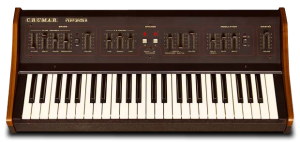
The Performer is a polyphonic analog Strings and Brass machine produced at the end of the 1970’s by the Italian synth company. It is slightly compact with just 49 keys. But it is fully polyphonic – you can play all 49 notes simultaneously! Programming is simple and clearly laid-out with just 15 sliders and a few buttons. A solid black chassis and wood end-cheeks round out this classic and often overlooked string machine.
The Performer is best remembered for its Strings. A simple 3-band equalizer with high, mid and low sliders can be used to give the strings shimmering sparkle or moody dark timbres. The Strings section uses two oscillators per voice with 8′ and 16′ settings. Simple Attack and Sustain sliders give you some control of your string’s envelope settings.
The Brass section is less exciting. It uses a single oscillator with just a square wave to generate a weak Brass sound. It has a low-pass VCF filter with resonance, but it too is pretty weak. Simple Attack and Decay sliders control its limited envelope settings too.
The LFO is pretty nice, with delay length, rate and depth control. It can modulate both Brass and String sections and can be routed either to the VCF or pitch. There are three outputs on the back: main output, brass output and signal output (for external processing) as well as CV and Gate connections.
DATAMASKIN

