
Check out the Rez
Rez is a free Windows virtual analog monosynth. Here is a demo video:
Free Windows Software Synthesizer, Rez http://goo.gl/fb/Lq002 http://j.mp/FreeSoft
1984
Pianovintage in association with Alexander Sylla (programmer) and Minik (Graphic) is proud to present its first virtual instrument VST!
1984 is an emulation of an analog synthesizer with a simple design yet effective.
1984 features
- Two oscillators with selectable waveforms.
- Filter section with ADSR.
- Envelope section (ADSR).
- 2 effect modules: Chorus and Delay / Echo.
- Master section with volume control and panning.
- Compatible with most sequencers (Cubase, Ableton Live …)
- Controllable via MIDI (host automation).
- Includes 8 original presets.
PianoVintage 1984 is available to download as a freeware VST instrument plug-in for Windows PC.
More information: PianoVintage / 1984
Three freeware virtual synthesizer plug-ins by Chris Roberson
Roberson Audio has launched a new website.
The website offers three freeware virtual synthesizer plug-ins by Chris Roberson.
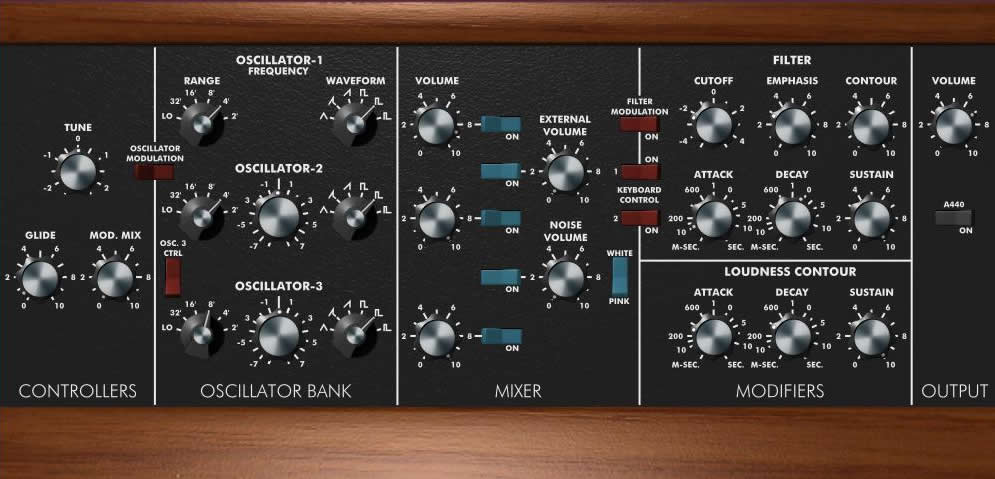
Roberson Audio Synthesizers: RA Mowg, Oddy-Free, and Prophanity
Roberson Audio Synthesizers
- RA Mowg, a Minimoog Model D clone. From the deep, full-bodied filters, to the mellow analog-style oscillators, to the distortive drive from feedback-looping the output, this instrument can give you the feeling of playing a Minimoog without spending a small fortune to do so.
- Oddy-Free, an emulation of an Arp Odyssey MkII. Much attention to detail was given in the layout of the signal path to have it behave as accurately as possible. It does have just a touch more umph than most originals would – this particular emulation was based on the “illegal” filter versions based on Moog’s -24dB Low-Pass filter, so it sounds quite a bit smoother and richer but at the same it can produce the harsh metallic tones known from the Odyssey.
- Prophanity, a Prophet 5 clone. There isn’t a terrible lot to say for the synth, other than one major bug with the unison section. You may notice it isn’t present, and that has been done on purpose. It is a goal for a future release to re-include a unison feature.
Roberson Audio’s synthesizers are available to download as freeware VST instrument plug-ins for Windows PC.
More information: Roberson Audio
Overdrive and amplifier effects
 MANTRA OVERDRIVE by BLACKOUT EFFECTORS: equally capable of invoking the sacred sounds of a classically refined overdrive AND summoning wickedly raunchy drive, with more crunch on tap than the “overdrive” moniker usually entails. With such a wide palette of tones and character the MANTRA will feel just as at home at the feet of the stalwart blues crowd as it will the quintessential rock & roll protagonists. The MANTRA utilizes amp-like circuit architecture, with multiple cascaded MOSFET and JFET gain stages to insure the most natural, touch-sensitive overdrive conditions possible and a seemingly endless range of clean-up with your guitar’s volume knob. We burned a lot of midnight oil to make sure that the MANTRA could get down with vintage-type, low output single coils and hot humbucker pickups alike. From gently fingerpicked melodic phrases to bludgeoning riffs that you’ll want to play over and over and over…More info and to purchase CLICK !
REVIEW: Beatstation – anything you want it to be
I have had the opportunity to test Toontrack’s new software the Beatstation (will be launched in June), for some time now and I must say that I am excited about this product. Beatstation is equally an inspirational tool, to find the beat and rythms you want, to a full fledge drum machine and bass line player. Supporting a range of different formats it is very easy to import whatever you have into the Beatstation and play around with it.

When you first open it up it reminds me very much of some of the iPad instruments that has been launched recently, but once you have gotten used to it there is a lot more to explore. Running it via MIDI you can really play around with the pre-loaded drum beats or tweak them as you plase, adding your own flavors to the sound.

Speaking of the sound, the drum beats are of excellent condition, especially the snare drums which really kicks it. The easiest way to get started is to load any type of sample or loop, I used some old REX loops that I had in a recent project and added a selection of drum patterns – and this is when the fun starts because you have som many ways of altering the beat and perfect the groove.
The flexibilityto be able to load just about anything and the fact that it works equally well both as a stand alone inspirational sound system and as easy to use VST. I tried it using Reaper as the host and I had no problems hooking it up with Reapers built in Virtual keyboard and start improvising with different sound sets. Another good thing when using Beatstation is that you have the option of configuring the layout of the drums and synths in order to be in sync with what you are accustomed to, the illustartion below shows a bit of an overview on this.


Would i want something more? Well, most of the effects are hidden i drop down menus, see illustration below and for more live situations it might have been better to have a few more controls visible in order to tweak the sound on the fly.

Beatstation seems to fill a gap in today’s plethora of software music instruments, since it focuses on experimentation and your creativity in finding new grooves and rythms.
About Beatstation
Beatstation is a Windows and Mac, stand-alone and/or VST, AU and RTAS compatible virtual instrument. Beatstation plays Percussion Pads, Lead Instruments and Melodic Bass.
It uses a flexible and skinnable open playing surface, records samples, supports external samples (MP3 and WAV), MIDI Grooves and REX Files. The Beatstation expansion format, the BTX, contains high end sampled drum, percussion, bass and lead instruments with MIDI and REX files. Beatstation harnesses the power of percussion samples and melodic instruments in one virtual instrument and has been developed from the feature requests of the current Toontrack users in need of a completely open interface to create their own personlized sound-set as well as for a new generation of music creators.
Beatstation will roll out to stores in June of 2010. Up until store release Toontrack will build an array of videos and tutorials showing the products potential at the product site http://www.beatstation.com.
Combined drum machine and bass synth

Cerebrum is a pattern based drum machine with an onboard bassline synth. There are 8 drums total, each with it’s own sequencer with various randomization and velocity features. Designed with live operation in mind, Cerebrum can be used for making complex beats on the fly, with features like the Pattern Playlist and Random Probability, that ensure your rhythms stay interesting. Your beats can then be sent into the Multi-Band FX processor, split into three bands, distorted, crushed and destroyed and then squashed with the overall compressor for getting that classic ‘pumping’ effect with ease.
Cerebrum:c4 features
- 8 drum modules.
- Bass arp-synth module.
- Versatile sequencers for each drum module including bass synth.
- Pattern Playlist feature for switching between 4 patterns, manually or automatically.
- Random Probability options for each sequencer.
- Aux module for external audio processing.
- Multi-Band FX section with compressor.
- Host sync or manual tempo.
- Midi triggering of each sequencer on individual keys.
- Toggle behavior options for midi triggering.
- Mute/solo switches.
- Multiple audio outputs.
Price: USD 49.00
Visit: Psychic Modulation
Guitar groove for free

Save and print your own chord songs with this easy to use chord groover.
Now with solo notes and chords, edit your own tabs and songs and watch them play on the screen. Real sounds and a two handed animated display to help understand how to play chord changes, with major, minor and 7ths chords. Solo note editor helps you learn the fretboard as you play. Add lyrics and play along with the PC, and save up to 12 bars. Includes crotchet and quaver eighth note rhythms. For beginners or for practice, you can play slow or fast, or use as a backing track. This software is free
Visit: guitartab.co.uk
Patternarium from Sonic Charge

The first is the introduction of the Microtonic Patternarium, what Sonic Charge refers to as an “online collaborative patch randomizer”. This tool will create random sounds and rhythms that you give the thumbs up or thumbs down to in order to influence their evolution.
The second is the announcement that the next version of Microtonic is currently in beta testing. The company is currently accepting applications for a limited number of beta testers, so if you’d like to give it a go, just fill out the application. No new details as of yet aside from the fact that it will support MIDI program change and drag and drop of patterns as MIDI files.
New patch library for the Arturia MiniMOOG
Kid Nepro has introduced the Arturia Minimoog V Collection, a new patch library for the Arturia Minimoog software synthesizer:
Kid Nepro purchased his first original Minimoog back in the mid 80’s and has been using them ever since. We still have one in our studio which continues to get lots of use when we are looking for that certain sound – that only the Moog can provide. So for us, programming a Minimoog is like riding a bicycle – you never forget how to do it! The collection of sounds that we have programmed for the Arturia V collection is done with expert care from someone who knows the Minimoog very well – so you can be sure that the sounds are well crafted and sound great.
The Minimoog V patch library is available for download for $25.
|
The original Minimoog was released in 1970. By the time it was discontinued in 1981, about 13,000 were produced. One of the true landmark synthesizers produced though the 70’s – it’s compact design, great sound and easy to use interface made it popular with both Rock & Jazz keyboard players ranging from Keith Emerson to Chick Corea. The Minimoog was designed to include the most important parts of a modular synthesizer in a small package, without the need for patch cords. The original Minimoog is monophonic and its three-oscillator design gave it its famous fat sound. The Minimoog Model D adapted some of the circuitry (such as the filter section) from earlier modular instruments, but designed other circuitry (such as the oscillators and contour generators) from scratch. You could not save patches in it’s internal memory – so just one sound at a time could be stored and played. Yeah, that’s the way things were back then! Original Minimoogs did not have midi, but you could get several midi retro kits which could be installed to give you basic midi features. Kenton makes a good own which we have installed on our vintage Minimoog.
Kid Nepro purchased his first original Minimoog back in the mid 80’s and has been using them ever since. We still have one in our studio which continues to get lots of use when we are looking for that certain sound – that only the Moog can provide. So for us, programming a Minimoog is like riding a bicycle – you never forget how to do it! The collection of sounds that we have programmed for the Arturia V collection is done with expert care from someone who knows the Minimoog very well – so you can be sure that the sounds are well crafted and sound great. Our Minimoog V Collection is available as a download via our free e-mail delivery. Just open the file in your Arturia software and your ready to roll! Pick the Mac or PC “patches” format when ordering online at our web site. Please contact us if you need any more info. |

The Trekker synth

Intellijel has announced 5 new modular synth modules, which are expected to be shipping this month.
I guess it will be the love of all Star Trek fans, however I suspect he will get into some legal hassle. Remember that the swedish synthpop band S.P.O.C.K. had the same problems, hence the dots between each letter in their band name
- SPOCK: CMOS Boolean Logic device 4HP
- FLIP FLOP: CMOS JK and D flip-flop 4HP
- BUFF MULT: Buffered Multiple 2HP
- MULT: Passive Multiple 2HP
- QUAD INVERT: Quad CV Inverter / Quad Audio Buffer 2HP
- UNITY MIXER: dual 3:1 / 6:1 unity gain mixer (CV /Audio) 2HP
DATAMASKIN

