
Chaka Kahn goes Moog
This me like  I Feel for You To…
http://www.youtube.com/watch?v=0JlPP8MuL0s
“How the track was put together:
The original Chakakhan version is extremely over produced, so it took me a while to get the same sort of result.
The machine drums at the start, which keeps on running throughout the whole track, was originally done using a DMX, Linn and TR808. All these can now perfectly be recreated inside Reel Machines by XLN-Audio.
I wasn’t really pleased with Reel Machines initially, but having given it a second chance it’s rather convincing and pleasant to work with.
After the rap intro Addictive Drums kick in, to put another layer of drums ontop and to give it a live feel, which I do with all my tracks.
My aim is always to find the middle between the original recording and a live feel.I could have left Melle Mel rap out, unless I had the original isolated track, but no one has that luxury, so I did it myself.
Only then I realized how difficult that rap was. Not having an American accent and of course Melle’s deeper voice makes it somewhat sound silly, but it’s effective enough (I hope?).A lot of Prophet-5 and Jupiter-8 was used, especially all the brass sounds.
The harmonica was another difficult thing to replicate.
I used a sample from my TR-Rack.
The Minimoog is completely unprocessed.”
Shared by Geeljasjes
Assemble a acrobatics
If you are, like us, into making electronic music you will definitely enjoy this video. The video features things like Rolands and KORGs as well as the Evans EDV-1000 Digital delay and a lot of other goodies.
“Roland TR-626, Roland TR-727, Roland EF-303, RolandDG CMU-810, KORG MS-2000R, KEIO GIKEN MiniPops-7, YAMAHA EMT-1, YAMAHA ED-10, SEQUENTIAL CIRCUITS Drumtraks, Futureretro REVOLUTION, NOVATION BassStation and Talking calculator” – Caknobs
ULT-SOUND DS-4
Need one of these
Movie of ULT-SOUND DS-4 Yuuki plays.
Cryoacoustic Orb
Cryoacoustic Orb is a sound installation involving multiple illuminated acrylic orbs filled with slowly melting ice. Hydrophones frozen inside the ice amplify the sounds of the melting process, which are electronically processed and spatialized throughout the darkened gallery space. The result is a unique ambient soundscape that evolves over the course of several hours.
Free MIDI sequencer
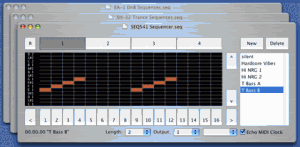
SEQ541 is a free MIDI pattern sequencer for OS X.
The program is designed to be extremely flexible, all it requires is that you have an external MIDI device generating a clock and it will output notes in time to a pattern sequence you specify.
Features/Limitations:
- you can’t record patterns, only input them via mouse
- 128-note polyphony
- you can run as many pattern sequencers simultaneously as your CPU can handle
- you can store as many patterns as you want per sequencer
- while playing, transitions to the next pattern don’t occur until the current pattern is done playing
- variable pattern length: 16, 32, 48 and 64 notes
- variable note length: 16th note through whole note in 16th note steps
- fixed note-on velocity 0×64
- play/stop must be driven from an external MIDI source
- MIDI clock must be from an external MIDI source
- can drive any hardware or software MIDI device
- can echo MIDI clock to the external MIDI device (for arpegio or whatever)
M-Audio VENOM mapped to an Ozonic via MIDI CC
Really nice video
I wanted to try out my new M-Audio Venom synth with an external knob controller, so I hooked it up to my old school M-Audo Ozonic via MIDI , mapped out 16 CCs to the knobs and sliders (ADSR on the sliders, cutoff, resonance, ocillator pitch etc on the knobs), and it worked great!
After tweaking around with that for a bit , I recorded some basslines right from the phrase sequencer in Venom into Ableton Live while tweaking them in real time. Then I added some drumloops, and a synth accent from Ableton’s Operator FM synth, which actually is the only MIDI sequenced part here.
Here’s what I came up with.P.S.-I am really digging this Venom! It’s a pretty inspiring piece of kit, has killer sounds and the audio interface works great with Ableton. Next vid, I’ll try some stuff with the audio inputs.
Shared via rudiedisone
Cubase 6 – New Features and more
Wumpscut are back
Rudy Ratzinger, who debuted with his project Wumpscut back in 1993, is arguably one of the electronic industrial scene’s greatest luminaries and has been an inspiring source of information many new bands through the years. Wumpscut’s early albums “Music for a Slaughering Tribe” remains a classic. Beyond that, Rudy released another 17 albums with the project. Now it’s time again. “Schrekk & Gaus” is the sequel to last year’s “Siamese” and the album is released in three editions, a regular CD, a special vinyl edition and a limited box with extra kind of frippery.
“Schrekk & Grau,” released April 22 via Betonkopf Media.
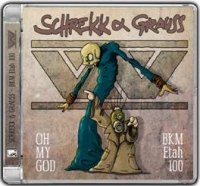
Tracks:
1. Rudolf Wolzek
2. Schrekk & Grauss
3. Muselmann
4. Elende Buben
5. Patient A.
6. Jiddisch Is a Zwillink
7. Wumpelstilz
8. Kikeriki
9. Zombibikini
10. Alles Aus
Shared by Skull
Maschine 1.6 is now available in public beta
Checking out the new Maschine 1.6 update beta which includes vst support, pad linking, clip renaming, scene drag and drop and more. In depth tutorials soon at maschinetutorials.com
Native Instruments’s Maschine 1.6 is now available in public beta, available to registered Maschine owners. Above, SoundsAndGear takes an informal look at new features in the beta.
If you are a Maschine owner, you can download a fully functional 1.6 beta version, and submit eventual bug findings to the Maschine team over a special “bug tracker” web page.
The public beta version has already been tested extensively by our internal testing team, but for general reasons it should still be used with caution in performance-critical environments.
Here’s what’s new in Maschine 1.6:
- Plugin hosting for VST/AU instruments and effects
- Increased number of effect slots (3 per Sound, 4 per Group, 4 on Master)
- New “Pad Link” function with 8 pad groups and Master/Slave option
- Individual swing setting per sound
- Clip naming
- Sample renaming
- Improved scene duplication
- External audio input/output increased to 16 stereo channels
- Improved Drag&Drop mapping for samples
- Improved Drag&Drop from OS for Maschine files and audio files
- Drag&Drop rearrangement of scenes and patterns
- Snap-to-grid when moving events via mouse
- VST plugin operation under Mac OS X 64bit
- Rex import under Mac OS X 64bit
Introducing mlrv 2.0
mlrv is a hypersampling instrument for grid-based music contollers like the monome, livid ohm/block, novation launchpad, and akai apc/mpd. the software allows a sound file or live recording to be mapped across each row (or grid cell) and assigned a triggering behavior. within this simple set of constraints and a complete MIDI + OSC remote control system, the performer of electronic music can be freed from the laptop, and at the very least appear to be doing something interesting. mlrv is an refactoring of brian crabtree’s original mlr, extended by trent gill (galapagoose) and michael felix (%) of /parallelogram/
more infos: parallelogram.cc/mlrv
DATAMASKIN

