
BENDING SOUNDS – NYC SUBWAY
“For the best experience, watch it with headphones!! 
Shot within a couple hours on a sunny Saturday afternoon, “Bending Sounds” is a test/experiment to capture the inspirational sounds and visuals of the NYC subway.
.
Thanks a lot to all the musicians featured in this video – and obviously a big thanks to the Vimeo staff for featuring it!!
.
If you like my work, please subscribe to my Vimeo and follow me on Twitter: twitter.com/#!/TimSessler
Cheers! “
HUBO robots perform the Beatles
Four of Drexel’s HUBO robots perform the Beatles’ “Come Together” in a demonstration that combines cutting-edge engineering technology and research with creative expression, produced by the Music & Entertainment Technology Laboratory (MET-lab). The HUBOs are operating autonomously (not human-controlled). Their movements are directed by student-developed software to perform the gestures necessary to produce the appropriate notes and beats as dictated by a musical score. Every sound in the video was performed by the robots.

MET-lab student Matthew Prockup created the musical arrangement for drum kit and three “Hubophones”, novel percussion instruments designed and constructed by the lab for this performance.
HUBO was designed and developed by the Korea Advanced Institute of Technology (KAIST) Hubo Lab (Dr. Jun Ho Oh, Director). Drexel Engineering kicked-off National Engineers Week by unveiling seven HUBO humanoids at an unprecedented showcase event on February 20, 2012. Their presence at Drexel is part of a large collaborative project with KAIST and seven other U.S. universities with the goal of rapidly advancing humanoids research.
More information: http://drexel.edu/engineering/news/archive/2012/RoboticsAtDrexelTheCenterpiec…
Saurus – new soft synth with true analog sounds
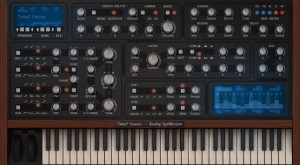
Tone2 has released a new software synthesizer for Mac & Windows, Saurus.
According to Tone2, Saurus is ‘not just another synthesizer with character, but one that truly represents the analog sound.’
Here’s what they have to say about it:
We carefully measured and modeled the circuits of many classic performance synthesizers, including even single capacitors and resistors to provide an extremely accurate analog model, faithfully capturing the spirit and character of these old machines. All without placing heavy demands on your CPU or budget.
Highlights:
- True Analog Modelling Technology
- High-end sound quality
- Low CPU and high reliability
- Easy-to-use interface
- ‘Unique sounds which no other synthesizer can create’
- Huge sonic range
- Flexibility, expandability
- Ships with 563 presets from 21 sound designers
Features:
- Covers all important aspects of traditional analog synths
- Mono, Legato & Polyphonic modes employing analog voice management
- Two Syncable Oscillators and two Sub Oscillators
- Not just standard waveforms but also a large number of exotic ones
- Pulse Width Modulation and Oscillator Sync applicable to every waveform
- Oscillator Drift, Phase and Noise Modulation controls
- Noise FM, AM and Ring Modulation for Oscillators
- Analog filter with self-oscillation, nonlinearity, 6 filter types, FM and feedback
- LFOs and modulation capable of running at audio-rate
- Arpeggiator with extensive configuration possibilities
- Flexible Modulation Matrix with new features, including a filter
- Programmable gate
- 4x Stereo Unison modes with spread and panning control
- Analog modeled Distortion and Tube amp
- Optional Psycho-Acoustic processing
- High-end quality Effects
Tone2 Saurus is available now for US $119. See the Tone2 site for details, audio samples and a demo version.
VSP-330 r2 VST plugin Sound Test (Roland VP-330)
Background data:
http://gstormelectronica.blogspot.com/
For r2.0 I’m re-developing the VSP-330 from the ground up. The VSP-330 VST plugin is based on the vintage Roland VP-330 choirs and strings. This time around my goal IS to provide a faithful emulation replacing the instrument itself.
The difference that sets this emulation apart from all others out there: absolutely no samples are used in this plugin. I have taken great time and effort emulating the exact same synthesis and effects-processing architecture as the original vintage hardware.
The sounds you hear are testing the plugin against a real MKI VP-330. Which is the real one and which is the plugin? You might hear sustaining notes getting robbed….um yeah that would be the MKI (because it is PARAphonic, the whole key range sharing a single envelope) – a problem not encountered on the POLYphonic plugin.
The visuals are frequency spectral analysis and psycho-acoustic spatial imaging provided by Ozone 3. Sorry the spatial imaging is blurry and indistinct….cheap video camera.
Quicksilver 303 Introduction
The Quicksilver 303 CPU upgrade for the TB-303 is now available! For more information please visit http://www.socialentropy.com/quicksilver
The Quicksilver 303 is a complete drop-in replacement for the TB-303 CPU. It includes a completely rewritten operating system that extends and improves both PATTERN and TRACK modes.
The Quicksilver 303 CPU can be used with or without MIDI. So, you can still benefit from the new features of the CPU without drilling any holes in your TB-303!
Of course, there are also great new MIDI capabilities, such as “MIDI Control mode” which allows the 303 to be “remotely controlled” from any device that can send MIDI note messages. The sequencer can send and receive MIDI notes and MIDI clock and you can also record incoming MIDI to patterns in realtime.
Commodore 64 Synthesizer Sessions Part 2 – free samples
Bedroom Producers Blog has released Commodore 64 Synthesizer Sessions Part 2, a collection of free samples.
Two different Commodore 64s were used for creating the sounds in this sample pack, although both have SID 8580 installed. The original plan was to record some bits from a SID 6581 this time, but my old C64 died literally 5 minutes after I plugged it in. To make that major bummer even major-er, there were no original C64s (aka C64 beige) to be found in the local ads during this three week period.
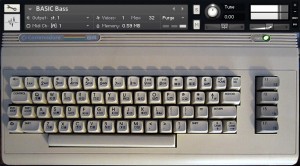
However, I did manage to get ahold of a C64G, which was sampled for one of the instruments in this sample pack (the BASIC Bass patch, pictured below). C64G also has a SID 8580 installed, but they do say that every SID chip is different, so there’s still a bit of variety in the hardware sense I guess. All other sounds were captured from a C64C which was also used in the previous pack. Hopefully, a C64 beige will pop up in the ads before I start working on part 3.
Commodore 64 Synthesizer Sessions Part 2 features
- 14 multisampled instruments and one multi patch.
- Total of 142 samples in 16-bit WAV format (download size is 79.4 MB).
- Incluides Kontakt 5 and Shortcircuit 1 patches.
The sample pack is a free download at BPB.
Circuit Abbey – Gravity Well demonstration
Here’s a nice video featuring the gravity well, background data below:
The gravity well uses cv to shape audio.
Where a filter removes certain harmonics the Gravity Well modulates
the existing waveform to create new sounds.
I’m using a doepfer A110 VCO (sequenced with a Modcam touch sequencer)
Square & sine waves are fed into a A114 ring modulator. Its output goes into the
Gravity Well.
The Gravity Well has 4 CV inputs.
I’m feeding a sine wave LFO into the first input (called latitude)
Into the second input (called Longitude) I later (1m,55 secs) feed a random CV.
This was generated using a combination of a noise generator, a sample/hold & a comparator.
A 4MS Noise Swash, Buchla 265 (Source of uncertainity) or the MakeNoise Wogglebug
would also prob work well as random sources of control voltages.
Modules used:
Circuit Abbey Gravity Well
Doepfer A110 VCO
Doepfer A114 Ring Mod
Modcan Touch Sequencer
Doepfer A118 Noise Gen
Doepfer A148 Sample/H
Circuit Abbey TripFire (Comparator)
Many thanks to Matt from Rhythm Active for supplying the Modcan Sequencer, The Circuit Abbey Gravity Well and Tripfire
http://www.rhythmactive.com.au/
Rob Papen Blade Harmolator
Note, this version of Blade with ‘spectrum’ display is released first week of April.
Celemony Capstan updated to v.1.1
Capstan – An end to wow and flutter
Celemony Software GmbH releases version 1.1 of its professional recording restoration software Capstan. Starting from the analysis of just one audio file, the new version makes it possible to remove identical wow and flutter from an unlimited number of additional audio files. At the same time, the introduction of a rental model brings Capstan 1.1 within the budgets even of home studios.
Capstan 1.1 is now capable of transferring the correction of wow and flutter from a mono or stereo file to additional files, thereby removing identical wow and flutter from multi-channel or multi-track recordings. This new feature is seamlessly integrated into the Capstan interface and there is absolutely no limitation on the number of files that can be repaired in this way.
Background info:
For over 100 years, music has been recorded on mechanical storage mediums, and for over 100 years such recordings have been plagued by the same problems: wow and flutter. Who isn’t familiar with the wobbling and warbling, the droning and dragging? Mechanical degradation caused by defective devices or sticking tapes, by aging or defective storage. Furthermore, wow and flutter were for the most part irremediable.
Countless recordings of renowned orchestras, big bands and rock groups are currently slumbering deep in archives because precisely this problem has rendered them unusable. The tapes worthless, the recordings lost to posterity. Until now.
For with Capstan there is now for the first time a program capable of removing wow and flutter from musical recordings — whether on tape, compact cassette, wax, shellac or vinyl. Capstan detects wow and flutter by analyzing the musical material itself, so the medium is of no relevance. In this, Capstan is clearly superior to solutions such as bias tracking, because Capstan still works even if the tape has already been copied several times or digitized only in low resolution.
Being musically intelligent, the Capstan algorithm is capable of recognizing not only the minutest amounts of wow and flutter but also continuous speed variations within the musical material itself and makes possible detailed editing that extends even to drawing in the curve manually. It is based on the patented DNA Direct Note Access technology made famous by the award-winning program Melodyne, which is used worldwide in all major studios for the editing of pitch and timing.
Whilst the precise detection of the wow and flutter represents the actual technological revolution, repairing the recording is easy: the musical material is simply played back with the velocity curve inverted. Pure varispeed — guaranteed free from artifacts.
More info:
http://www.celemony.com/cms/index.php?id=capstan
Using Grain Science to turn just about anything into a synth patch
Canis at Wooji Juice shared an interesting demo, embedded above, showing how you can use Grain Science to turn just about anything into a synth patch

“So, a parcel arrived in the post the other day from IK Multimedia, with some of their gear inside to try out. I spent some time yesterday running around with the iMic plugged in, recording things I find around the office, and then turning them into instruments
I’m not a professional when it comes to miking stuff up, and this wasn’t in a studio or anything like that. But I like the results a lot better than the built-in mic, and Grain Science has always stood out for the ways it allows you to synthesise based on captured audio. So it was fun putting that side of it to use with higher-quality sound.
These aren’t designed to be presets, they’re just me experimenting with different effects and seeing what variety of stuff I can make from a given recording. I’ve marked the original recordings on the timeline — every sound, no matter how weird it sounds, is based on the same recording (until you reach the next marker).”
DATAMASKIN

