
Moog Factory Tour: Minimoog Voyager
Jim Debardi from Moog Music takes us on a tour of the Moog Factory to give us a history of the Minimoog synthesizer and to show us how they handcraft the Minimoog Voyager.
Maschine Meets Modular – A Lo-Fi Hip Hop Instrumental
Maschine Meets Modular in this grimey, lo-fi hip hop instrumental featuring the Intellijel Korgasmatron analog multi-mode filter. The faux-sample is the sound of the frequency modulated Korgasmatron self-oscillating low pass filter. No oscillators were used. The bass and drums are Maschine.
Logique Analogique – Simulation of a real circuit board on iPad
http://apps4idevices.com/read/logique-analogique
Logique Analogique is a simulation of a real circuit board that includes an 8-bit binary counter, analog implementation of logic functions, and 4 channel, 1-bit sound generation.
To quote the developer, “The Logique Analogique sequencer consists of an 8-bit binary counter and four tracks which generate pulse waves when a user-defined majority function depending on the counter bits is true. Switches which select the counter bits (or their logic inverse) and a threshold voltage define the majority function. The output is calculated as the XOR function of the four tracks’ signals, which produces a ring modulation like effect.”
“Complexities aside, this app creates incredibly powerful sounds, with a seemingly endless amount of rhythmic possibilities. The sounds can be layered to create ring modulation type effects, with both pitch and threshold control to further shape the sound. The sequencer makes it possible to create evolving patterns or complete songs, using the tap & drag method to easily create your sequence. I would suggest starting slowly with this app, to hear the effect of each switch or dial, but then dive in and explore. It has to be noted that this app does not offer any method of recording yet, but both MIDI and Audio Copy are currently being considered for the future. Despite these missing necessities, I have to say that I’m incredibly impressed with the power of this app, and for the first time, I’m willing to connect my iPad to another source to record my creations. I haven’t found another app that creates such intense sonic delights as this does. I’m so taken with Logique Analogique, that even without recording or MIDI, I still have to rate it … A Killer App!”
NAMM 2013 – Rumors of a MonoMoog coming
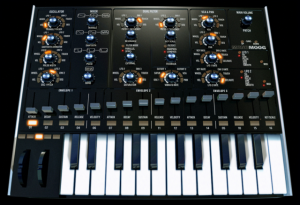
As we are well accustomed to rumors are starting to spread on what will be released at the NAMM show, only three weeks away now. Expectations are high for a new synth from Moog Music – perhaps something like this MonoMoog, which likely comes from the special category of Photoshop synths.
The Yamaha CS-50 – The Oscillator
Here is part 1 of a series of demonstrative videos regarding the Yamhaha CS-50. This is a demonstration of the oscillator section of the Yamaha CS-50.
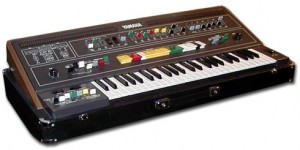
The CS-50 was released just one year before its famous big brothers, the CS-60 and CS-80. The CS-50 looks like a scaled-down version of the monstrous CS-80, and it is! This will benefit those who crave the famous classic Yamaha synth sound without the struggle of lugging around the 215 pound CS-80! The CS-50 weighs in at about 100 pounds. The CS-50 is also just 4-voice polyphonic, and lacks the quality weighted 61-note keyboard of the CS-80. The CS-50 has just a 49-note standard keyboard. It does feature pressure (aftertouch) sensitivity route-able to several destinations, however.
The CS-50’s sound is unmistakably related to other classic CS-series synthesizers. At just four voices with one osc. per voice and lacking warm filters (at just 12dB/oct) the CS-50’s sound can be thin. There are 13 preset sounds of various instruments and synth sounds but, unfortunately, no on-board memory storage for your edited presets. At its low street price, the CS-50 makes a great way to get your hands on these classic sounds without going broke! It’s too bad their tuning is just as unstable as the other CS-series synths. It’s housed in a built-in travel-case like the other (big) CS-synths.
30th Anniversary of MIDI – by Roland
One standard started it all. One technology allowed different musical devices and computers to all speak the same language and make beautiful music together. Thirty years ago, MIDI was born…and the rest is history.
Time machine – Exploring the Moog Taurus 1
A voyage into the heart of the Moog Taurus 1 bass pedal from the year 1976.
Exploration by Marko Ettlich (RetroSound)
analog bass pedal
2 VCOs, VCF, VCA
three basic preset sounds: Taurus, Bass, Tuba + Variable Sound
used by Genesis, The Police, Pink Floyd, Marillion, Saga, Jarre, Yes and many more
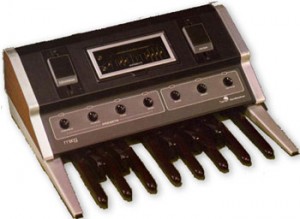
Inspired by organ pedal boards, Moog released the Taurus Pedal Synthesizer – a monophonic analog bass synthesizer you play with your feet (so you can play other instruments with your hands). Originally, the Taurus was going to be part of a larger ensemble system called the Constellation. It was to include two keyboard synthesizers, the Apollo (polyphonic) and the Lyra (monophonic), and the Taurus foot pedalboard synthesizer. The Constellation project never made it to production, but the Taurus was released on its own, while the Apollo keyboard went on to evolve in to the Polymoog.
The Taurus has three Preset sounds and one User programmable. The three preset sounds are Bass, Tuba and Taurus. Most users prefer the Variable preset which lets them synthesize their own sounds using the simple VCO, VCF and VCA controls. The shaping controls are hidden behind a plastic window to prevent accidental foot tweaking.
The Taurus is monophonic, with sound generation coming from a simple two-oscillator design that can be tuned across a 5-octave range. An Octave button lets you shift the pedal keyboard up or down an octave, the direction must be set using the Octave switch in the Variables section. There’s also a Glide (portamento) effect and a Decay effect. The amount of Glide and Decay are also set in the Variables section. Like any Moog, there is a 24 dB/oct lowpass filter with controls for Emphasis, Contour Amount/Attack/Decay and Cut-Off. Two gigantic foot-sliders flank the sides of the Taurus and they are used to adjust the Filter cut-off and VCA Loudness on the fly using your feet.
Anushri build final – glamour video
“My final results from my Mutable Instruments Anushri build. Sound is all Anushri with a generous helping of reverb. Great kit, well engineered, fine for newbies like me. Get yours today, way fun.”
Anushri is a monosynth like no other. In addition to its analog VCO/VCF/VCA and digital modulation sources, it includes a fun and immediate note sequencer with step-by-step recording, and a gritty 8-bit drum machine with a truly original control interface.
Just like its elder sister the Shruthi, Anushri is not designed for industrial assembly but is instead sold as a kit – you can assemble it, modify it, expand it and service it without any specialized expensive equipment. Open source firmware and schematics give you full access, control and ownership of its circuitry and code.
iPad Music Jam: Korg iMS-20, Magellan, GarageBand, Geo Synthesizer, iRIg MIDI and more
iPad Music Apps are improving fast. Now you can do almost everything using only one device. In this Jam I’m playing with Geo Synthesizer controlling iMS-20 (Lead) and Magellan (Synth Bass and ARP). The arp was programed in Magellan but played by Moog Slim Phatty (using the iRig MIDI interface). Drums by GarageBand.
MIDI Bridge was used for splitting notes played with geo synth for Magellan and iMS-20.
The Mobile Homes – Disappointment (Preview, demo version)
Preview of a new song from The Mobile Homes – Disappointment.
Note: This is a demo version of the song.
DATAMASKIN

