
Vanderson – Winter Improvisation
New electronic music video from ‘grooveproject’, details below:
Hello everyone. It’s my first video in 2013 from last night 
I create simple two sequences with pad sound on the Radias, add choir from Virus, pad from Supernova and some effects and solo from AN1x, Supernova and Miniak.
Enjoy the sounds and all the best in New Year !
BeetBox – touching the beats
BeetBox is a simple instrument that allows users to play drum beats by touching actual beets. It is powered by a Raspberry Pi with a capacitive sensing board and an audio amplifier in a hand-made wooden enclosure.
Concept
BeetBox is primarily an exploration of perspective and expectations. I’m particularly interested in creating complex technical interactions in which the technology is invisible—both in the sense that the interaction is extremely simple and in the literal sense that no electronic components can be seen.
Enclosure
The enclosure was created from .5″x8″ poplar boards, which I cut to size and finished using various hand and power tools. I used a router for both the edge details and for grooves in which to conceal the wires, and a drill press to create the speaker grill and to bore holes for the beets with a hole saw. I then stained the wood and, after assembly with wood glue and a nail gun, sealed the enclosure with polyurethane.
Internals
Touch sensing is handled by an MPR121 Capacitive Touch Sensor from SparkFun, for which I ported existing Arduino code to Python. This board communicates with a Python script on a Raspberry Pi via I2C. The script watches for new touches and triggers drum samples using pygame. Audio from the Pi’s line out is run through a small amplifier I built using an LM386, which is based on a circuit straight from the data sheet. The amp is connected to a salvaged speaker mounted under the holes in the lid.
Source code for the BeetBox is viewable on GitHub.
Learn more at scott.j38.net/interactive/beetbox.
Alpha Plus – free advanced trance synthesizer
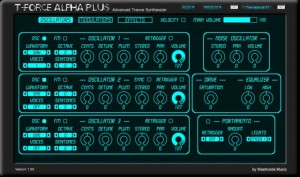
Alpha Plus is a free ‘advanced trance synthesizer’ for Windows.
It’s a three-oscillator subtractive/FM synth with built-in delay and reverb.
Details and audio demos for Alpha Plus below:
Features:
- Synthesis: Subtractive/FM.
- 3 Multiwave Oscillators with voice control (adjustable from 1 to 8 voices per osc), adjustable stereo width and panning, with Sine, Saw, Ramp (reversed Saw), Triangle, Pulse (square with PWM) waveforms and retrigger option for each oscillator (with “retrigger off” the oscillator is in free running mode, the oscillator starts with random phase positions everytime played a note, with “retrigger on” the oscillator’s phase starts from position 0 everytime played a note.
- 1 Noise Oscillator with adjustable stereo width and volume.
- 1 Resonance Four Pole State Variable Filter, switchable between Low Pass, High Pass, Bandpass and switchable 12/24 dB slope, Resonance can be driven up to self oscillation.
- 1 ADSR Filter Envelope.
- 1 ADSR Amp Envelope.
- 2 ADSR Mod Envelopes.
- 2 host syncable LFOs.
- Adjustable Drive function for Saturation/Distortion.
- two band Low Freq/High Freq Equalizer.
- Bitcrusher.
- Portamento.
- 32 step Envelope Controlled Trance Gate.
- Velocity control (on/off).
- Dual Delay, switchable between Stereo mode and Ping-pong mode (right and left channels have their own tempo settings).
- Stereo Reverb.
- integrated Sidechain FX, optional with internal bpm synced triggering or external triggering via MIDI In (triggered by MIDI Note On, on MIDI channel 2). Note: see the manual of Your DAW for informations how to route a second MIDI Track to a VST/VSTi, because some DAW’s have different ways of MIDI routing.
- all functions fully automatable.
“SOUNDS FOR A TRS-80” ARP2600 & MAKE NOISE RENE PATCH TUTORIAL
Nice tutorial from Kip Kubin, details below:
I was trying to stretch my use of voltage inverters to create more interesting and varied timbres in a sequence using Ring Mod as the sound source.
I also wanted to use the Rene as a playable instrument and allow the grace notes to be random. I’m still wrapping my head around the RENE but it’s already has opened me up to new ways of using sequencers in my work.
Oberheim Matrix 6 Editing
A frightening programming session on the nightmarish data entry of Oberheim Matrix 6. It seems an eternity, but in the Eighties this was the most common way to program the less expensive synthesizers: one parameter at time, first select then entering desired values!!!
God bless potentiometers and encoders (and Editor programs…).
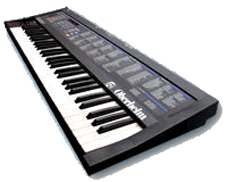
The Matrix 6 was one of the last few synthesizers from Oberheim to come out during the mid-eighties following the classic OB-series. The Matrix 6 utilized high-tech but less expensive digital and midi features and still retained a totally analog sound. It did this by using DCOs (digitally controlled oscillators) to provide stability, programmability and more. All the Matrix synthesizers featured Matrix Modulation which allows for extremely wild virtual patching for almost unlimited range of sounds and modulation capabilities!
The Matrix 6 is a very popular synthesizer today because it offers access to the legendary sounds and power of the Matrix 12, though not as meaty but at a fraction of the cost. The Matrix 6 is also like the Xpander, but with only 6 voices of polyphony and slimmer programming. Each of its 6 voices has a pair of DCOs, a low pass filter, 2 VCA’s, 3 envelope generators, 2 LFO’s, and 2 ramp gens for a variety of complex analog pads, basses and sounds.
The programmability is vast, but it can be very tedious. As was the growing trend in synthesizers during this time, knobs and sliders were replaced by just a few membrane buttons and a simple data slider. This is accompanied by gobs of programming and patch data written across the face of the unit. Fortunately Midi SysEx is fully supported so you can get patches on-line and transmit them into the Matrix. Access, makers of the Virus, used to make the Matrix Programmer which gives you much more user friendly hands-on controls too. And software editors such as Unisyn make graphic editing possible for much easier programming.
Sound of Science: The Great Vintage Synth Unpacking
Here’s Tom, one half of Sound of Science (soundofscience.org) unpacking some of the tools of the trade — all of which made their transatlantic journey without incident!
Synths for Studio A!
Gotta watch those peanuts…
ARP 2600
EML 200
EML 101
Studio Electronics MidiMii
Swedish Electro Scene – Free 27 track electro album
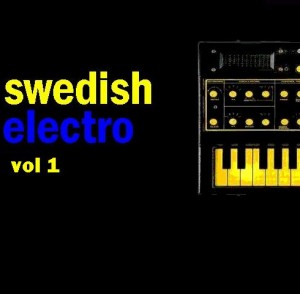
On January 5th 2013 a new album was released via the Facebook group Swedish Electro Scene featuring 27 tracks of some of the best electro artists in Sweden right now. So to get a snap shot of what Swedish electronic artists are up to and to see how vibrant the Swedish electronic music scene make sure to download this free album. Artists on the album include well known acts like Cryo, Code 64, Emmon, The Pain Machinery, Social Ambitions, Unitary, Spark!, Steelberry Clones as well as more unknown / new ones like Vanguard, DPoint, Neurobash, Radiant and Cold Connection
Check it all out right here:
In collaboration with these electro labels:
Progress Productions, Electric Fantastic Sound, Wonderland Records, Stereoklang Produktion and Complete Control Productions
Breakaway Vocalizer
Demotrack of the breakaway vocalizer, all sounds from the vocalizer, some reverb and delay
The vocalizer has a pitch to midi converter build inside
It contains 74 sounds wich can be expanded by extra cartridges (mine has the new age cartridge)
The soundchip inside is the same as the Ensoniq ESQ-1 synthesizer.
This machine can be controlled by midi but is also has an external input.
In this demo i fed all kinds of things into the input like a radio, a mic, a drumcomputer and multitracked it.
The results can be somewhat unpredictable wich is good for experimental music.
Return of the Sigma
Utterly shameless synth noodling.
“I did this a few months back after digging my old Korg Sigma out of the spare room and dusting it off. I bought it secondhand in 1989, it was pretty old and beaten up already then, and it’s never been serviced and has sat completely unused for the past 6 years or so. At first it didn’t make any sound at all, but after leaving it on a while and wiggling all the pots a bit, it started to cough and splutter back to life. I really liked the noisy, slightly broken sound – the crackly filtered hiss makes it sound very woodwindy and reedy, like some weird alien durduk.”
The Sigma is a marvelously expressive beast. Two X-Y joysticks, one controlling pitchbend and noise/vibrato and the other controlling high and low pass filters, and, unusually for a synth of this vintage, keyboard aftertouch controlling vibrato.
Access Virus B – Ambient chillout arpeggiator demo
Background description:
Dreamy and relaxing instrumental ambient space music performed & improvised live on Access Virus B synthesizer.
Created using 2 oscillators, delay, filter/envelope/LFO adjustments, resonance, and a simple repeating arpeggiator pattern.
All sounds you hear were played live and manipulated in real-time, no external processing. Excerpt taken from a longer session.
=====
For more:
http://synth4ever.bandcamp.com — download tracks or buy album
http://www.facebook.com/synth4ever.music
http://www.soundcloud.com/synth4ever
http://www.youtube.com/synth4ever
DATAMASKIN

