
KORG Mini MS-20 additional information and specifications
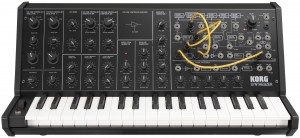
Korg is celebrating their 50th company anniversary this year, the MS-20 turns 35. This suggest paying homage to this cult synth. And indeed, on NAMM 2013 Korg presents a “real”, fully analog MS-20, just as we know and love it.
Called Mini-MS-20, it is ca. 15% smaller than the original, and sports a MIDI In and a USB MIDI port. This isn’t using surplus Legacy cases as some have speculated (which were 20% smaller) but instead individually designed cases, equipped with a specifically developed keybed. The main PCB is more or less euqivalent to the original, including the components selected to be as close to the original as possible. It is not yet known which filter variant has been chosen, although it may be assumed that, just with the Monotron, it will be equivalent to the Korg35 chip, with slight modifications.
BTW, project management were the same engineers who did the originals. As a consequence, the instruments include the original manual, including patch sheets. You don’t have to be a seer to expect a golden future for the Mini MS-20. With a suggested price of 600 Euros, this will find many friends, and will make all those happy who couldn’t afford a ‘real’ MS-20 due to their exorbitant 2nd hand prices
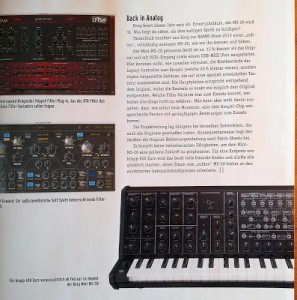
The MS-20 is reborn! 1978 original circuits come to life
Presented in 1978, the MS-20 monophonic synthesizer, thanks to its rich, robust sound, his powerful, iconic analog filters and flexible patching options to be popular today. The typical sounds of the original MS-20, the Korg MS-20 synthesizer plug-in the Legacy Collection and the iMS-20 app for the iPad, now attracting more than 300,000 users.
Now the sounds of the MS-20, MS-20 are in the mini wakes to new life. The same engineers who developed the 1978 MS-20, today’s circuits reproduced faithfully and its physical size reduced to 86% of the original size, without changing the traditional and timeless look of the model or to waive details!
The MS-20 mini fascinated today with absolutely authentic analog synthesizer sounds of his ancestors.
Developer comments
The 50-year anniversary KORG we again engaged in an analogue synth and this effort to create flowing parameter settings that characterize analog synthesizer especially. The original specifications of the MS-20 should remain intact. The developed by us 35 years ago, analog circuits still deliver the same unbeatable, powerful sound, from the lowest bass to the extreme heights. To experience the depth of the MS-20 mini, you have to play it yourself!
Highlights
The MS-20 mini was realized by the engineers of the first MS-20 and used a complete reproduction of the original analog circuit
2VCO / 2VCA / 2VCF / 2EG / 1LFO structure
Self-oscillating high pass / low pass filter with a unique distortion
External signal processor (ESP)
Extremely flexible patching system
Reproduction of the MS20 at 86% of its physical size
Reproduces every detail of the original, down to the packaging, the manual in the original style, the template for the patch panels and patch cables
MIDI IN and USB port”
Update 3: some additional specs:
“Keyboard – control voltage output (exponential) (0 – +8 V)
Keyboard – trigger output (+5 V -> GND)
VCO-2-1 + VCO control voltage input (linear response) (0 – +8 V)
VCO-2 control voltage input (linear response) (0 – +8 V)
Second VCO:
VCO-1 + VCO-2 external frequency control input (OCT / V) (-5 V – +5 V)
Third VCF:
External signal input (max 3 Vp-p.)
External control input for the cutoff frequency of the high-pass filter (2oct / V) (-5 V – +5 V)
External control input for the cutoff frequency of the lowpass filter (2oct / V) (-5 V – +5 V)
4th VCO + VCF:
Total external modulation input (T.EXT) (-5 V – +5 V)
5th VCA:
External control input of the initial gain (0 – +5 V)
6th EC:
EC 1 envelope – Normal output (-5 V – 0 V)
EC 1 envelope – turned output (+5 V – 0 V)
EC EC 1 + 2 trigger input (-> GND)
EC 1 trigger input (-> GND)
EC 2 envelope – turned output (+5 V – 0 V)
7th MG:
Delta output (sawtooth positive – Triangle – Sawtooth inverted) (5 Vp-p)
Square-wave output (pulse width – rectangle – narrow pulse) (0 – +5 V)
8th Noise Generator:
Pink noise output (5 Vp-p)
White Noise output (5 Vp-p)
9th Sample and Hold:
Clock trigger input (-> GND)
Sample signal input (5 Vp-p max.)
S / H output (5 Vp-p max.)
10th Modulation VCA:
Control voltage input (0 – +5 V)
Signal input (-5 V – +5 V)
Signal output (-5 V – +5 V)
11th Game Help Manual:
Control Wheel-output (-5 V <-0 v=””> +5 V)
Non-locking switch output (-> GND)
Arturia Minibrute Oscillator Test
Background video description:
I just bought a MiniBrute. Being the synth geek that I am, I had to see the waveforms! I plugged in my new synth and began testing starting from the sub oscillator. This is a video of each oscillator being tested one by one.
The large draw for the MiniBrute lies within the fantastic oscillators. Each one offers an extra timber control to sculpt a unique sound with out even adding any more effects. This is what the waveforms look like with a clean signal.
Antidote Signature – new ReFill for the Antidote Rack Extension
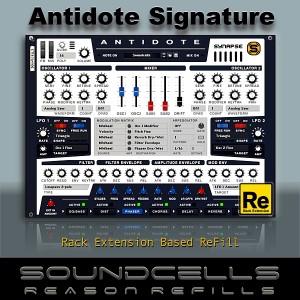
Soundcells has announced Antidote Signature, a ReFill for the Antidote Rack Extension by Synapse Audio.
Antidote Signature for Reason 6.5 and up is based on the Antidote Rack Extension from Synapse Audio – a synthesizer that offers a powerful architecture to produce more than mere ‘bread and butter‘ sounds, combined with a clear and logical user interface. Thanks to its high quality oscillators and the zero-latency filter design – among some other great features -, the user can be sure always to get a very clear and powerful sound out of Antidote.
The Antidote Signature ReFill is an impressive proof of this, and it brings highly playable and great sounding patches to the user´s hand. It´s not genre-specific, so Wurlitzer-like pianos, modern screaming but also classic hardware-like leads, punching basses, warm & rich pads and surprising textures emphasize why this little gem should be part of everybody´s portfolio…
Antidote Signature features
- 70 Combinator patches.
- 100 Antidote patches: Atmos & Textures, Bass, Keys, Leads, Pads, Rhythmic, SFX.
- Well programmed mod matrix assignments.
- Well balanced volume settings & carefully assigned modwheel and combinator buttons and knobs.
The ReFill is available to purchase for 8.90 EUR (requires Synapse-Audio Antidote RE, not included).
Confirmed the KORG MS-20 is back – Mini MS-20
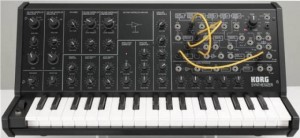
The news has just came in from winter NAMM 2013. Korg are officially reissuing in the MS-20 in a smaller, more compact size. It will be using mini-jacks (1/8″ instead of 1/4″) and have USB-MIDI as well as regular MIDI… all this while of course being fully analogue.
Price is a very reasonable €600 and will be shipping in late february 2013.
Let’s hope it sounds as good as the original!
Cubase iC Pro for iOS
Connecting deeper to Cubase than any other app, Cubase iC
Pro is the most advanced Cubase control app with a clear focus
on recording, making it your very personal recording assistant.
The project overview page and the mixer allow you to see your
project as you know it from Cubase, while the key command
page gives you a powerful tool to set up your most-used
keyboard shortcuts and macros. Up to four dedicated cue mixes
can be set up with Cubase iC Pro, giving musicians the
freedom to adjust their own mix with a phone or tablet. Cubase
iC Pro is Cubase’s perfect companion!
www.steinberg.net/cubaseicpro
New from Roland: V-Combo VR-09 Introduction
Travel-ready, affordable, and outfitted with top-level Roland sounds, the V-Combo VR-09 is the ideal all-in-one solution for performing keyboard players. Dedicated piano, organ, and synth sound engines—organized in three intuitive blocks on the front panel—provide all the essential tones you need, right under your fingertips. The powerful real-time controls give you maximum expression on stage, with nine sliders for tone shaping and a large array of knobs and buttons for tweaking the seven simultaneous effects and various parameters. Other great features include an onboard looper, a drum section stocked with a library of rhythms for practice and jamming, and more. With its versatile sound selection, inspiring operation, and smart user interface, the V-Combo VR-09 is a dream come true for gigging musicians
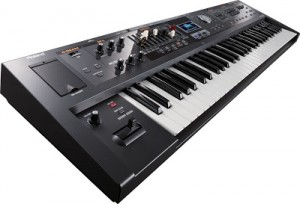
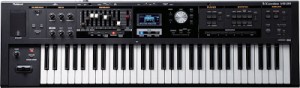
Professional keyboard with instant-access operation for performing musicians
Light and mobile; battery or AC power
Pro-quality acoustic and electric pianos, including grand piano with 88-note stereo multi-sampling
SuperNATURAL-powered Virtual Tone Wheel organ with nine harmonic bars, plus newly developed transistor-type ‘60s organ tone
Wide range of synth tones, from vintage classics to modern essentials
Seven simultaneous effects with dedicated real-time controls
Looper and built-in rhythm patterns; WAV/MP3/SMF song playback via optional USB memory
Free VR-09 Editor app available for iPad
Intuitive Operation for Expressive Stage Performance
The V-Combo VR-09 was designed from the ground up with the needs of live players in mind. An intuitive front-panel layout and clear LCD screen offers quick access to Roland’s top piano, organ, and synth sound engines, along with plenty of real-time controls for expressive tone manipulation. Seven simultaneous effects include rotary, delay, reverb, tone, overdrive, compressor, and customizable MFX, with dedicated knobs that tweak multiple parameters with a single twist for powerful sound shaping with minimal effort. The smart interface makes it simple to set up splits and layers on the fly, and to save all your keyboard settings in user memory locations for instant recall on stage.
Pro Acoustic and Electric Pianos
Piano is a cornerstone sound for live playing, and the V-Combo VR-09 is filled with a wide selection for covering all musical styles. The gorgeous acoustic grand piano features 88-note stereo multi-sampling, delivering pro-level tone that rivals Roland’s dedicated stage pianos. Many popular vintage E. Piano sounds are onboard as well, along with complimentary effects such as vintage phaser and tremolo. The compressor—accessible via a dedicated, easy-to-reach knob—transparently boosts the level of the piano sounds, ensuring that your playing always cuts through when performing in loud bands.
World-Class Organs
Roland’s renowned SuperNATURAL technology powers the V-Combo VR-09’s classic tonewheel organs, while nine harmonic bars provide authentic real-time performance control. A newly developed transistor-type organ is also included, offering the unique sound of combo instruments from the 1960s. The 61-note keyboard has an extremely fast response, perfect for essential organ techniques such as trill, sputter, glissando, and percussive hits. Rotary speaker and amp simulators reproduce the characteristics of vintage organ speaker cabinets and overdriven tube circuits with astounding realism, while a new “Twin Rotary” option delivers a deep, aggressive effect never before heard.
Vintage and Modern Synth Tones
The V-Combo VR-09 is packed with a ton of ready-to-play synthesizer sounds, from vintage analog classics like JUNO strings and ‘80s synth brass to textured, modern-era digital tones and beyond. Front-panel controllers allow you to tweak the synth tones intuitively in real time, including convenient ADR and cutoff/resonance adjustment with the harmonic bars in the ORGAN block. Onboard effects like “Bit Crash” provide the ability to create modern synth voices for current dance music, including dubstep
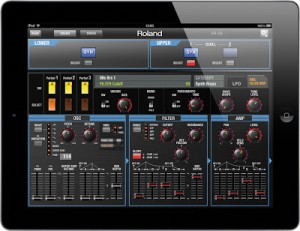
VR-09 Editor for iPad
The free VR-09 Editor app for iPad gives you powerful, intuitive control of the organ and synth sound engines via your tablet’s full-color touchscreen interface. Quickly edit organ sounds and customize vintage tonewheel characteristics such as leakage, click noise, and rotary speed, and easily access synth sounds to build custom tones and layers. After tweaking sounds at home, you can take your iPad to the gig and use the app for extra real-time control on stage. Convenient, cable-free communication between the V-Combo VR-09 and iPad is simple to set up with Roland Wireless Connect. Alternately, you can link up with a USB cable via Apple’s iPad Camera Connection Kit.
http://www.rolandconnect.com/product.php?p=vr-09
01. (00:00 – ) Overview
02. (01:33 – ) Piano Ballad
03. (02:09 – ) E.Piano with 80s Pop Music
04. (03:30 – ) Piano and Pad Split (Dual), Write Registration
05. (04:40 – ) Funky Groove with Clav
06. (05:48 – ) Dance Music with Tweaks
07. (07:02 – ) Dance Track by Looper
08. (08:53 – ) Rock Organ and Progressive Rock Organ
09. (10:47 – ) Jazz Organ
10. (11:48 – ) Transistor Organ with 60sPop Music
11. (12:28 – ) VR-09 Editor (Organ mode)
12. (13:14 – ) VR-09 Editor (Synth mode)
Performed by Keiki Uto, Japan
NAMM 2013: Sneak peek at the new SWAGG Kontakt library
More NAMM Updates coming –http://namm.soundsandgear.com
This is a sneak peak of a new kontakt workstation from VIP Loops (MVP Loops) and distributed through Big Fish Audio. It’s called SWAGG and it’s a new urban/pop workstation with a bunch of instruments and a custom interface.
I will be getting an exclusive interview with the creators as well as more footage this week at NAMM. It will be debuted at the Big Fish Audio booth.
Modular synths: interstitial space
Background info from Todd Barton:
This is a serendipitous sketch that arose from preparing for an upcoming live concert with my friend, composer and video artist Robert Coburn. I did a free improv by looping my small Buchla system and Robert created a video sketch — the music and video crossed in the email and I merely laid in the music to his video. You can hear a higher resolution of the music here: soundcloud.com/user7621213/buchlidian-interstitial-space
and more on the concert SoundImageSound here:
go.pacific.edu/conservatory/soundimagesound
NAMM 2013: Wheelharp
Antiquity Music is premiering the Wheelharp, a keyboard musical instrument that gives the player the ability to ‘orchestrate’ with a chromatic scale of sixty-one 61 actual bowed strings at one’s own fingertips.
When the player presses any key on the Wheelharp, the action moves the selected key’s respective string toward a rotating wheel with a rosined edge, thereby bowing the string.
With the right pedal, the player controls the speed of a motor that turns the wheel, which varies the bowing speed of the wheel against the string and thus changes the dynamic effect. For instance, the wheel speed and the key depth can both be used to create swells and decrescendos. The action for each note can easily be removed as necessary for maintenance or string replacement.
The left pedal controls a full damper system that extends across the strings. An electromagnetic pickup floats above the strings and a piezoelectric pickup is mounted to the soundboard, allowing for the player to fully control the amplified timbre of the Wheelharp.
Moog Sub Phatty: New Machine For Living
In honor of the new Moog Sub Phatty analog synthesizer’s release today, experimental multi-genre music producer, Flying Lotus, and Adult Swim veteran, Adam ‘Lilfuchs’ Fuchs collaborated on a short animation called Moog Sub Phatty: New Machine For Living. You can hear the new Sub Phatty analog synthesizer in Flying Lotus’s original score for the animation.
To learn more about the Sub Phatty visit: www.moogmusic.com/subphatty
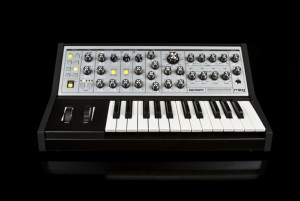
Say hello to the Sub Phatty, the grittiest Moog Synth ever.
Moog Music’s engineers have crafted the Sub Phatty’s oscillators to perform with extreme accuracy and require almost no warm-up time. Just power up, dial in your settings, and put your fingers to work on the keys to summon crisp and detailed waveforms, a vibrant and articulate sound that more than honors the rich sonic density synonymous with Moog creations.
The Sub Phatty is the first analog synth to feature Moog’s transformative new Multidrive section; at low settings Multidrive adds warmth and girth, but when pushed, it delivers a screaming snarl that is highly reactive to resonance, waveshape, and oscillator level. Experiment with this new circuit and unlock an undiscovered world of vivid analog tonalities.
The mixer section offers innovations of its own, including a sub oscillator that outputs a square wave one octave below Oscillator 1. Use this powerful tool as a third oscillator for added depth, or to craft your own customized incarnation of monstrous Moog bass. Also in the mixer section is a noise generator voiced to deliver low-frequency content, rich with body and punch. If your goal is to sculpt analog percussion and sound effects, look no further.
The Sub Phatty features a wide range of parameters just below the surface, and all features are easily accessible from the instrument’s front panel, or via the free standalone/plugin editor. Select filter poles, assign wave mod destinations, or specify pitch bend amounts — it’s all there.
The Sub Phatty brings a fearless new voice to the Moog family of synthesizers. With its streamlined interface and dynamic sound design flexibility, this new synth fuses an unparalleled connection between human & machine, opening the door to unprecedented sonic exploration.
Price about $1000.
· Sound Engine: Analog
· Number of Keys: 25
· Type of Keys: Semi-Weighted
· Other Controllers: Pitch Bend, Mod Wheel
· Polyphony: Monophonic
· Sound Sources: 2 Variable Waveshape Oscillators, 1 Square Wave Sub Oscillator, 1 Noise Generator
· Oscillator Calibration Range: 22Hz-6.8KHz.Guaranteed note range at 8’ of Note 18 to 116
· Mod Sources: Triangle, Square, Saw, Ramp, SH, Filter Envelope
· Mod Destinations: Pitch, Osc 2 Pitch Only, Filter, Waveshape
· Filter: Moog Ladder Filter 20Hz-20Khz
· Audio Input: 1xTS
· Audio Output: 1xTS, 1xTRS Headphone
· Presets: 4 Banks, 4 Patches Per Bank
· MIDI I/O: DIN In, Out, and MIDI over USB
· CV/Gate Inputs: Filter CV, Pitch CV, Volume CV, KB Gate
· Transposition: +/- 2 Octaves
· LFO: 0.1Hz-100Hz
UNDER THE HOOD FEATURES:
· Filter Velocity Sensitivity
· Volume Velocity Sensitivity
· Ext. Audio Level
· Osc2 Beat Frequency
· VCO Gate Reset
· LFO Gate Reset
· Pitch Bend Up Amount
· Pitch Bend Down Amount
· Glide Legato
· Glide Type
· Filter Poles
· Wave Mod. Destination
· LFO KB Tracking
· LFO Range
· Filter EG Reset
· Amp EG Reset
· Legato
· Gate On/Ext.
· MIDI Ch. In
· MIDI Ch. Out
· Local Control
· 14-Bit MIDI Output
· MIDI Path In
· MIDI Path Out
· MIDI Merge DIN
· MIDI Merge USB
DATAMASKIN

