
Introducing the Midi Fighter Spectra
The Midi Fighter Spectra is a brand new redesign of the Midi Fighter Classic, with full-color button lighting, a variety of customizable color and material options, and additional controls to make playing this device like an instrument.
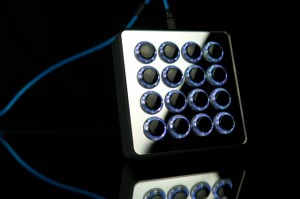
audio: Klangkarussell – Sonnentanz
Want your own? Grab on on the DJTT store: http://bit.ly/13V6Ac5
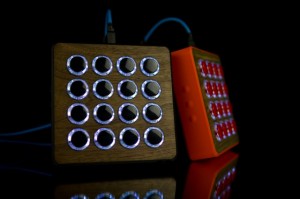
Specs:
- 4×4 arcade button matrix
- Class-compliant USB MIDI operation
- Custom-built colors for your buttons, faceplate
- Silicon case
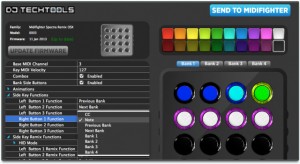
- Full-color ring lighting, customizable with included software (including animation functionality)
- Six function buttons on the side
- Mappings for Traktor, Serato, Ableton Live
Free vintage VST rhythm machine – RHYTHMUS
RHYTHMUS by ELECTROSTUDIO
A free vst plugin that is an emulations or inspired by of vintage classic rhythm machine and drum machines
for more information visit
http://www.elektrostudio.ovh.org/
http://www.elektrostudio.ovh.org/index2.php
Rhythmus is inspired by an old rhythm machine. There are ten buttons available, each button can play two different rhythm sections so essentially there are about 20 different rhythmic loops offered, such as samba, mambo, tango, waltz, rumba etc. When you click “open”, you can change the tune, volume, pan of each rhythm component such as snare, bongo, cowbell, hi-hat, etc. You can mix these rhythmic sections with Tambourine, Guiro, Quijada sounds.
Kebu – Interlude #4, The Lunar Effect
http://www.facebook.com/kebunator
http://kebu.fi
These tunes are also available on Kebu’s debut album, “To Jupiter and Back”, released in 2012 by Secret Entertainment: http://www.inverse.fi/store/?p=en.levyt.item.html&pid=17004
The tunes and the video were recorded live at Kulttuuritalo Dux, Kristiinankaupunki, 18th of May 2012. BIG thank yous to Tomas Karlsson and KRS Jazz for arranging this concert and to the audio engineer students at Axxell, Lappfjärds folkhögskola under supervision by Kalle Teir and Staffan Svarvar for setting up and handling all the audio and light at the show! Just amazing work. And many thanks to Kim Påfs and Heidi for the great camera work!
The tunes were performed using only analog synthesizers, either played live or sequenced. Equipment used: Roland TR-808, Juno 60, Alpha Juno 1; Korg Micro-preset M500, Polysix, Poly-61, PE-2000; Moog Source; Jomox Air Base 99; Oberheim Matrix 6R; MAM MB33 II; Yamaha RM1x (only for MIDI sequencing); Behringer DDX3216; Lexicon MPX500, as well as a midi patchbay, CV/gate converters, and additional preamps for my mixer.
Modular Wild presents SOUNDS-Subconscious Communications/Plan B Model 15
An exploration of the Subconscious Communications/Plan B Model 15 using FM.
Sound and Video by Raul Pena.© 2012 Raul Pena
The Yamaha CS-50- The Sub-Oscillator (L.F.O.)
Here is a demonstration of the sound and functionality of the low frequency oscillator of the Yamaha CS-50.
Roland TR808 FMing Doepfer A 111
Doepfer A-111 Oscillator’s frequency is FMed from audio out of Roland TR-808. A second A-111 is acting as Modulator for first A-111/Carrier. Both Carrier and Modulator signals are enveloped and triggered from AC Trig Out of TR-808. On stereo out, there’s the handy EHX Cathedral Reverse Reverb.
Brand new video from UK electronic music act Mesh
The video for Mesh’s new single ‘Born to Lie’, taken from the new album ‘Automation Baby’.
Performed by Mesh:
Richard Silverthorn-Mark Hockings-Sean Suleman-Richard Broadhead
Music
Written and Recorded by Mesh
Produced By Mesh and Olaf Wollschläger
Mixed by Olaf Wollschläger
Mastered by Jon Cremer at Railroad Tracks GMBH
Released by Dependent Records (www.dependent.de)
Published by Warner/Chappell Music GMBH
Distribution by AL!VE (www.alive-ag.de)
Booking by Pluswelt Promotion (www.pluswelt.com)
Film
Camera and production by Bennet Switala and Ahmet Tan
Camera and production by Mark Hockings
Final Editing by Mark Hockings
Camera grip and technician Andy Goss
Thanks to:
All the fans for your support
Bennet Switala and Ahmet Tan
Kulturfabrik
Home made theremin: Optical synth + KORG Emx + Kaoss pad
A home made theremin by Gavin Howe, description below:
Made my first “synth theremin” yesterday, sending it through the audio in+comb on the emx with flanger pitch shift (-12) and some short delay, then into kp3 for stereo delay, just playing around with different capacitors and korg effects. All sounds originate from the optical synth.
KOMA Elektronik announces the RH-301 Rhythm and Utility Pedal
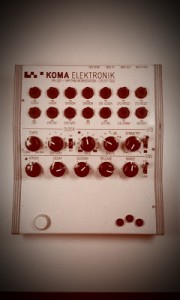
KOMA Elektronik announces the RH-301 Rhythm and Utility Pedal!
New pedal features master clock with tap tempo, versatile LFO, envelope generator, MIDI and 14-point CV patch bay.
Berlin based musical instruments manufacturer KOMA Elektronik are very happy to announce a brand new pedal: the KOMA RH-301 Rhythm Workstation / Utility Tool! The RH-301 is KOMA Elektronik’s solution for a problem many musicians are struggling with: analog and digital equipment that needs to run side by side in sync without running out of control, which is not always an easy task! That is why KOMA decided to build a ‘Master Sync Station’ that helps electronic musicians get the most out of their equipment by properly syncing (a large amount of) devices in many different ways and add some cool tricks along the way…
Master Clock
The beating heart of the pedal is the master clock, of which the tempo can be set by turning the tempo knob, by tapping a tempo on the tap button, by syncing it to MIDI or to an external CV clock signal. Besides the normal clock output the user can also divide the signal with the Divisions knob and send a faster or slower clock signal via the two Division Outputs. The generated clock signals can be passed on via CV with the two Clock Outputs, two Division Outputs or via the MIDI Output. An incoming MIDI signal can also be passed through via the MIDI Through and Out jacks.
LFO
The second feature of the RH-301 is the LFO, which can be synced to the master clock or run freely from 0,25 Hz to 260 Hz in five different shapes: sine, triangle, square, S&H and noise. This means the pedal can also be used as an oscillator, when the user turns the LFO up into the audible ranges. When the LFO is in Sync-Mode the user can choose the same divisions as the divisions of the master clock. The LFO has two separate outputs on the patch bay: LFO Out and LFO Inverted Out. All the features of the LFO are also controllable via control voltage, the pedal boasts CV inputs for LFO Speed, LFO Reset and LFO Symmetry.
Envelope Generator
The third feature of the pedal is an Envelope Generator that can be easily synced to the master clock as, or run in loop mode. Besides the normal controls for Attack, Decay, Sustain and Release the pedal comes with a Range knob to set the range of the envelopes created. The Envelope Generator comes with a normal Envelope Output, but also an Inverted Output. The Envelope Generator can be triggered by an external Gate CV Source through the Envelope Gate Input.
Besides all these features, the RH-301 also comes with a built-in KOMA Elektronik sensor, which has a separate CV Output on the patch bay as well.. Plenty of functions to get creative with, because no matter what your setup is, digital or analog or all mised together, if you use a Modular synthesizer, DAW, drum computer, synthesizer or KOMA’s own BD-101 and FT-201 effect pedals, the RH-301 is a effective tool to make sure they all walk in line!
The RH-301 will be on display and ready for testing at NAMM’13 at booths 1170 in Hall E (Analogue Haven) and 6735 in Hall A (Big City Music).
MRSP: To Be Announced! The RH-301 will be available in the beginning of Q2 of 2013 at KOMA Elektronik dealers worldwide and directly from KOMA Elektronik’s webstore at www.koma-elektronik.com.
Follow the updates concerning this product on http://www.facebook.com/KOMAelektronik !
PPG WaveMapper – Show and Tell
An extensive show and tell of the new PPG WaveMapper app from Wolfgang Palm.
For more info visit http://www.wolfgangpalm.com
PPG WaveMapper is the second next-generation iOS based synth from Wolfgang Palm, who in 2012 released the PPG WaveGenerator to critical acclaim from both press and public.
In final development the PPG WaveMapper offers iPad users a second synthesiser to compliment the already loved PPG WaveGenerator from Wolfgang Palm. PPG WaveMapper allows the user the opportunity to create limitless sounds from this unique and powerful new technology.
PPG WaveMapper features the Sound Map, which maps the various sounds in a way to easily access and experiment with them, more importantly the PPG WaveMapper features a new synthesis system which maps the waveforms of a sound into a new kind of wavetable which preserves the sound characteristics better than classic Wavetable synthesis and at the same time allows for the manipulations which make WT synthesis so unique.
The Mapping window is the visualisation of a pool of programs on which “modules” float. Those modules represent certain parameters of the synthesiser engine and each module can be placed on one of 32 programs. The moment an item is placed on map then the parameters of that module will take on the settings of those parameters in the underlying program on the Mapping window.
People who do not posses synth-programming skills can use this mapping technology as a starting point to create complex sounds. For example a user can drag a string sound source onto a drum envelope, or a guitar sound onto a string envelope – the concept is simple, yet incredibly powerful.
DATAMASKIN

