
Teaser from Swedish synth pop act PAGE’s new album
Out in August 2013 the new studio album from Swedish synth pop pioneers PAGE, in the mean time this teaser has been published on SoundCloud
The track is called “Lyssnade på min radio” >> Listened on my radio”
To know more about PAGE read our interview with them here >>
Enjoy!
Jam on the Prophet 12 & Tempest: Peter Dyer & Carson Day + Zach Rudulph on bass
Not sure the music is really up to my taste, but they are clearly having a blast LOL
A collection of short jams from the Dave Smith Instruments booth at the 2013 NAMM convention featuring Peter Dyer on Prophet 12 & Mopho x4, Carson Day on Tempest, & Zach Rudulph on bass. Camera mic only.
Roland V-Combo VR-09 Tricks and Tweaks for Effects and Synth Sound Modifications!
V-Combo VR-09
Tricks and Tweaks for Effects and Synth Sound Modifications!
PART 1. [SYNTH BRASS] (00:00 – )
PART 2. [MODIFY “SYNTH BASS” TB-303 at the end] (02:18 – )
PART 3. [SYNTH BASS] (03:36 – )
PART 4. [ORGAN] (07:42 – )
PART 5 [CELESTA] (11:29 – )
Performed by Peter Schreurs from Belgium and filmed in Japan
Marcomm pitch:
Travel-ready, affordable, and outfitted with top-level Roland sounds, the V-Combo VR-09 is the ideal all-in-one solution for performing keyboard players. Dedicated piano, organ, and synth sound engines—organized in three intuitive blocks on the front panel—provide all the essential tones you need, right under your fingertips. The powerful real-time controls give you maximum expression on stage, with nine sliders for tone shaping and a large array of knobs and buttons for tweaking the seven simultaneous effects and various parameters. Other great features include an onboard looper, a drum section stocked with a library of rhythms for practice and jamming, and more. With its versatile sound selection, inspiring operation, and smart user interface, the V-Combo VR-09 is a dream come true for gigging musicians.
- Professional keyboard with instant-access operation for performing musicians
- Light and mobile; battery or AC power
- Pro-quality acoustic and electric pianos, including grand piano with 88-note stereo multi-sampling
- SuperNATURAL-powered Virtual Tone Wheel organ with nine harmonic bars, plus newly developed transistor-type ‘60s organ tone
- Wide range of synth tones, from vintage classics to modern essentials
- Seven simultaneous effects with dedicated real-time controls
- Looper and built-in rhythm patterns; WAV/MP3/SMF song playback via optional USB memory
- Free VR-09 Editor app available for iPad
LaunchPad Push Emulation Ableton Instrument Rack
AfroDJMac has a new Ableton pack out for you – starting out in a chill ambient way on a Gibson synthish style
LaunchPad Push Emulation for Ableton Live.
Free Download: http://bit.ly/freesynth72
I decided to try and make my Novation Launchpad function like the new Ableton Push. I’ve created an instrument rack that allows you to play your LaunchPad in a manner similar to Ableton’s Push. It’s not an exact replica, in fact it is quite different. It’s a fun way to play around with your LaunchPad and allows you to use put different synths on each side of the instrument.
Visit my site for more stuff like this, including Live Instrument downloads, tutorials and music! http://www.afrodjmac.com
French electro pop act Indochine are back with new album
The new album from Indochine was released this week and we must say that they are returning in grace 
Music video by Indochine performing Memoria. (P) 2012 Sony Music Entertainment France
« Memoria » – clip officiel
Téléchargez ‘Memoria’ sur iTunes : http://bit.ly/TLlix2
1er Extrait de « Black City Parade », nouvel album sortie le 11 février 2013
Torsion – new monophonic Audio Unit instrument plugin for Mac
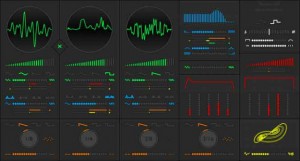
Sinevibes has announced Torsion, its new monophonic Audio Unit instrument plugin. They tell us that Torsion is built upon a unique combination of multiple synthesis technologies and modulation sources, wrapped into an intuitive interface which makes working with it as fun as playing a game. Sinevibes believes that it has a very distinctive, original sound character – and is ready to push your musical creativity in a fresh new direction. Here’s the details in Sinevibes’ own words…
Reinvented classics
At first glance, Torsion’s sound structure is similar to a traditional subtractive synthesiser – three oscillators going into a low-pass filter and into an amplifier – and it’s certainly as easy to use. But Torsion’s oscillators are completely different: they produce simple additive waves based on just a few partials, which are then enriched with lots of new spectral content using a technique called waveshape modelling (which literally “curls” the wave in real time). To further spice the sound up, there is a ring modulator and an audio-range oscillator for filter FM.
Modulation galore
Torsion features as many as four separate LFO generators – one for each oscillator and one for the filter and output amplifier. In addition to precise synchronisation, each LFO cycle can be self-randomised, which makes the modulation rhythmical yet non-repetitive. There are also two AHDSR envelope generators, as well as a two-dimensional chaos oscillator.
Interactive experience
The interface of Torsion is designed with high-contrast, colour coded elements, which lets you operate the instrument intuitively in just a few minutes. It also includes graphic representations for every building block – oscillator waves, LFO phases, envelope shapes and filter spectrum all change as you modify them, making sound design with Torsion a truly engaging, fun process.
Specifications
• Three oscillators each with four basic additive waveforms and four waveshape models.
• -24 dB/octave resonant low-pass filter.
• -12 dB/octave high-pass filter.
• Ring modulator.
• Modulation oscillator for low-pass filter FM.
• Four tempo-synchronised LFO generators with four waveforms and per-cycle randomisation.
• Two AHDSR envelope generators.
• Two-dimensional chaos modulation generator based on Lorenz attractor.
Pricing and Availability:
Torsion is immediately available as an Audio Unit plugin for OS X 10.6 or later (32/64 bit Intel), and costs $49.
More information
Akasha Synth Sound Art (at NAMM 2013)
A short demo at NAMM of the first Akasha Synth object. It’s a modular system with geometric shapes in order to build sounding 3D art objects. The modules or nodes provide analog sound circuits and a digital interconnection that can be controlled by Midi. Touch sensitive pads and bright LEDs show the interconnection VCAs and their modulations. There are triangles, squares and pentagons to obtain any platonic or irregular body or planes.
The synth line comes from the Akasha Modules, it’s synced to an XBASE 999 and controlled by Midi CCs or the internal touch sensitive pads.
Sorry for the noisy environment;)
Scoring Battlestar Galactica: Blood & Chrome
Composer Bear McCreary introduces his score to “Battlestar Galactica: Blood & Chrome,” a continuation of the musical ideas from his scores to “Battlestar Galactica” and “Caprica.” All these tracks will be available March 12, 2013 on the limited edition soundtrack album from La-La Land Records at http://lalalandrecords.com/
For a more detailed breakdown of the “Blood & Chrome” score, check out McCreary’s blog entry:
http://www.bearmccreary.com/#blog/bat…
Many more synth tutorials and videos from the Moog Foundation
The Moog Foundation has really been busy over night – uploading some 20+ videos, below you will find a snapshot on what you can explore on their Youtube channel
This is the introductory video for the Bob Moog Foundation/macProVideo series “The Foundation of Synthesis.” In it, Marc Doty sets the stage for the intent of these videos, which is an integrative instruction which not only describes synthesizer function and operation, but also gives a historical foundation for the functionalities and their implementation.
Pulse Width Modulation is a pleasing aural effect generated by the voltage-controlled adjustment of the width of a square wave. In this Foundation of Synthesis video, Marc demonstrates this function on several classic synthesizers. The video includes an oscilloscope, which shows you exactly what is happening when the width of the square wave output of the oscillator is changed!
In this part of the 3rd Tutorial of the Foundation of Synthesis, Marc outlines the history of the filter from its origin in the telephone to its application in electronic devices in order to give a firm understanding of how the filter came to be an important part of modern synthesizers. The filter is a function which removes harmonics from a sound. Since harmonics define the timbre of the sound, this is a fast and easy way to create new timbres.
Control voltage is the concept synthesis had waited for for 60 years. This technology united the synthesizer into a single device as well as allowed that device to become fully controllable and automated. Control voltage was a revolution in synthesis. In this video, Marc gives a short history to this amazing development.
OMD – Metroland
Metroland, the first single from the forthcoming album English Electric.
Preorder English Electric and the Metroland 12″ single at http://omd.firebrandstore.com/
DATAMASKIN

