
Another Moog Voyager XL Production
Background description:
Yet another Video of the Beast,
Best listened to with the volume up and Headphones or a decent pair of Speakers….
There is an attempt at humour for people liking Synth Porn, yes that good old fashioned love for all things Synth, regardless of what brand it is.
The music is all recorded live into Logic Pro 9 track by track, only the drums were sequenced. Bass, Phantom bass line and the twiddly bit to the left., apart from the drums, all tracks were recorded in Mono and panned. some processing as usual.
Yes the Guts and innards of my Voyager XL. Footage taken before I sent her away to be serviced. Hope you enjoy this one…lets see how many of you make it to the end…
The video is of me videoing the event where I am checking connections inside and pointing out to Moogmusic my findings, before I sent her away. I have to say, the guys and support at Moogmusic are excellent, well done guys for sorting this out, I knew you would anyway, but the support I got was brilliant.
Cheers Andy
Music and Video is sole property of ©Andy Barrow 2012
Yazoo and Front 242 gets a DubStep treatment
This is not any official remixes but it sure sounds nice. Out now on the download streets is a dubstep remix of the 80s classic “Don’t Go” in a remix by Dominatrix aka Andy Motke.
We asked Vince Clarke what he thought of it, here was his answer: “Uber cool!”
It’s not the first time that Motke has been remixing electropop acts. He also had a take on Bigod 20 vs Front 242.
Via SL
“Time Synthis” a tour inside the Ensoniq SQ-80 Hidden Waves
An electronic piece called “Time Synthis” explores some of the hidden waves of the SQ-80 “Cross Wave Synthesizer”.
Photo slide show of pictures Jack Girouard took showing the steps of the upgrade as well as other shots inside and outside.
“This is an improvisation done on two tracks, (did not use the sequencer, all done live) it’s all SQ-80 sound with a Lexicon MX-300 doing some effect processing. Note: these are patches I’ve created, the upgrade to 1.8HW doesn’t give you a new set of patches, it just gives you 52 more wave types that can be used for the three oscillators. They simply add to the list of waveforms simply as numbers 75-127. The patches used in this video used hidden waveforms 78, 79, 80, 82,”
The SQ-80 is basically a reved-up ESQ-1 with a total of 75 waveforms, a 61-note keyboard with velocity & aftertouch, floppy disk drive for storing patches and sequences, and an enhanced sequencer. Great for organs, analog-type sounds, pads and sound effects. Like the classic ESQ-1, the SQ-80 functions in providing analog-type 4-pole lowpass filtering and editing of digital waveforms. Each voice can combine up to 3 of the 75 waveforms. These waveforms include multi-sampled transient attack waves such as violin bow, plectrum picks, mallet, hammer, breath attacks and percussive sounds. There are also 5 sampled drum sets. Three LFOs are onboard for some pretty wild modulation of the sounds you create or edit. Complete MIDI implementation makes the SQ-80 great for any studio or live use too.
As for playing the SQ-80, it is a dream! Its 61-note keyboard is full, responsive and has polyphonic aftertouch. Polyphonic aftertouch simply means that each key pressed will respond to aftertouch independently of the other keys. The aftertouch can be used to control a variety of modulation parameters such as the LFO. Pitch and mod wheels and plenty of front-panel buttons and a few sliders make accessing and editing fairly easy and hands-on. The keyboard can be split or layered. The pattern-based 8-track multitimbral sequencer is great for creating short to complex sequences live, or in step time with quantization, bounce-able tracks, 60 sequence patterns and 20 songs. And they can be saved to disk along with any patches you’ve created and any SysEx Midi data. Unfortunately, the SQ-80 has no built-in effects. The SQ-80 is certainly a classic analog/digital hybrid of the late eighties which still holds up well today.
Rheyne Jammer for Lemur and Ableton Live
http://liine.net/en/products/lemur/premium/rheyne-jammer/ – Man of the moment Rheyne gives us a behind the scenes tour of his live electronic music improvisation setup. All the patches used in this video are available as a FREE download so you can play around and learn the magic.
Download this Lemur template for free at Liine.net, including the Ableton Live Session: http://liine.net/en/products/lemur/premium/rheyne-jammer/
Rheyne on Facebook and Twitter:
http://facebook.com/rheynemusic
http://twitter.com/rheynemusic
A performance using the new “RheyneJammer” Lemur template, demonstrating how live looping can be mixed with the included instruments and audio clips. This video is part of a longer video on Liine’s YouTube channel which contains a tutorial on the template. The full version of the video can be seen here: http://youtu.be/-_ax_BQxPTw
The template is a combination of live looping with the included Ableton instruments as well as an audio input. In addition, there is a page dedicated to a new live jam never heard on YouTube or SoundCloud, which can be remixed with the included Ableton instruments. Everything, as well as the instruments, have already been mapped to the included Ableton Live Session. Audio input will be enabled as long as you have an audio interface with a line-in.
The only software requirements for this to work is Lemur on an iPad and the full version of Ableton Live. Wifi or wired MIDI is required to connect the iPad to a computer.
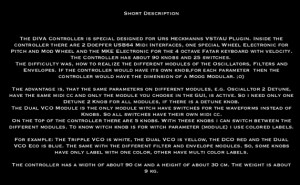
DIY: The Diva Controller – An overview and function test
more infos: http://www.synth-project.de/diva.html
Just an overview and function test of the DIVA Controller. Nothing more nothing less !
Native Instruments Maschine 2
http://ohdratdigital.com
Native Instruments Maschine 2, with gold faceplate and stand, arrived in the OD Studio yesterday. Subscribe to make sure you’re the first to see the review and demos…
Music and Games: Commodore 64 – 8 Bit Legend
FOR ALL YOU C64 FANS OUT THERE, ENJOY 😀
Video info:
I’ve been a big fan of the Commodore 64 since its release way back in 1982. As 2012 is the ’64’s 30th anniversary, I wanted to produce something in honour of this great little machine that has given me countless hours of pleasure, frustration, and head-banging! Here it is. For reasons of time and space, I had to cut a few scenes that were originally planned (and have been created) but I will probably use them in another C64 video in the near future.
If you’re able to recognise all the games/references in this video then you truly are an Old School Commodore geek. I’m proud of you!
Please check this description out again shortly, as I’ll be uploading some HD Windows desktop wallpapers featuring many of the 3D models used in this video, plus some more that didn’t make it into the final edit.
Credits:
Video by Mike Berry, AKA The Kernal.
Music from Terra Cresta, arranged and remixed by Jess D. Skov-Nielsen.
Originally composed by Martin Galway.
Thanks to Jess D. Skov-Nielsen for giving his kind permission to use his music.
Thanks also to David “Jazzcat” Simmons for helping to supply most of the group/scener logos.
Modular beatbox
Mutable Instrumensts is testing if one of his current projects was able to generate gates for triggering a modular:
“… and got carried away a bit patching classic beatbox sounds from my limited set of modules.”
Clock: MIDIpal
Sequencer: Custom gate generation code (running on an Arduino dev board), sync’ed to MIDI
Platypus: Grotypus
AD Envelopes: Quadra
Kick: Quadra -> Dr Octature FM (with high Q)
Snare: A-118 Noise -> A-148 S&H (clocked by A-145 LFO) -> A-106-5 SEM Filter HPF -> A-132-1 VCA
HH: A-118 Noise -> Dixie FM -> A-132-1 VCA
Synth: A-110 VCO -> Dr Octature IN (with low Q)
All sources into A-138 mixer
The Foundation Of Synthesis: Control Voltage
Additional videos for this title: http://j.mp/SZauJ3
The Foundation Of Synthesis 104: Control Voltage by The Bob Moog Foundation
Video 1 of 22 for The Foundation Of Synthesis 104: Control Voltage
Marc Dotylead educator for The Bob Moog Foundationis back with a series of tutorials in this course on Voltage Control.
But what is Voltage Control and how do you use it in the world of hardware synths? Well, here’s the story: In the early days of sound synthesis, if you wanted your sounds to change or evolve in any way whatsoever, you had to do it manually. Need the pitch to go up? Grab the the oscillator knob and turn it! Want the volume to change? Again, grab the volume knob! What about sequencing a series of notes? Well, before voltage control, you had to record every pitch onto magnetic tape and cut them all together in the order and rhythm that you wanted. It was hard work to create electronic music way back when!
Voltage control forever changed all that! And in this course Marc Doty shows how different hardware synth designers harness the power of VCs to transform and supercharge electronic music composition. Taken one step further you’ll see how Voltage Control was the mother of MIDI… and we all know how powerful MIDI is!
Bob Moog was an early pioneer and inventor of voltage-controlled analog synthesizers. He revolutionized the music industry and his ideas, inventions and musical instruments have dominated the sound of music for more than 30 years. Aside from being an innovator, Dr. Bob was an outspoken advocate of education. The Bob Moog Foundation, created by his daughter, Michelle Moog-Kousa, continues his legacy with Dr. Bob’s SoundSchool, the preservation of his inventions and the development of the Moogseumthe only museum of its kind dedicated to the advancement of sonic education. We hope you will help support the BMF’s efforts by watching these courses with the knowledge that a large portion of the proceeds go to support their awesome efforts!
So sit back, hit the play button, and proceed on your journey into the Foundation of Synthesis with Marc Doty, and the Bob Moog Foundation. Be sure to watch all 6 of the BMF’s courses on filters, modulation, oscillators, sound design and more!
More info on this title: http://j.mp/SZauJ3
Welle:Erdball – Alles Lüge
Tuesday morning synth music, enjoy
Welle:Erdball Live in Glauchau, Alte Spinnerei!
DATAMASKIN

