
Moog Source “Get The Drive”
Synthesizer demo track by RetroSound
“Get The Drive”
Moog’s Source was their first to offer patch memory storage as well as some other new features. It boasted 16 memory locations so you could finally save and recall your synth patches. A casette-tape jack was also implemented to transfer your patches to and from an external tape and free up the on-board memory for additional new patches. But in an effort to modernize with the eighties, the Moog had replaced all buttons, knobs and sliders with flat-panel membrane buttons and a single data-wheel assignment format. At the time, this may have seemed far-out, but in all actuality it is the Source’s downfall.

Parameters are edited not with hands-on sliders and knobs but by assigning a selected parameter to the dedicated data wheel. This is very tedious and does not allow for true hands-on tweaking during performances nor can you adjust different parameters simultaneously or while playing. These days, the membrane buttons don’t always seem to work quite right either. However, those famous monophonic Moog sounds are still inside this synth which has two fat analog oscillators and the legendary 24 dB Moog filter.
all sounds: Moog Source Analog Synthesizer + EHX Big Muff guitar effect pedal
drums: Korg ES1 MkII
recording: multi-track without midi
fx: a little bit delay and reverb
Attention! this is not a soft ambient track! 😀
the track @ soundcloud:
http://soundcloud.com/retrosound-ii/moog-source-get-the-drive
Native Instruments – Maschine Stand in the Studio and on Stage
Apart from showing off quite a basic stand for the Maschine, the song played definitely makes it worth while watching, details below:
For studio and stage – demonstrated by Berlin beatsmith Comfort Fit. The Maschine Stand fits both first generation Maschine models and the new black and white MK2 hardware controllers. Find out more: http://www.native-instruments.com/maschinestand
Credits:
Music and performance by Comfort Fit:
http://www.facebook.com/comfortfit
Demo Video: uPhase+
uPhase+ is an instrument geared towards live play. It has many features and shortcuts to enable complex improvisation with spatialized patterns. Browse the documentation or head straight to the Video Tutorials to learn how to play, or take a look at the demos below to get a feel of what is possible. uPhase+ will be released in the app store worldwide on November 27th, 2012. Until then, it will only be in the swiss app store. If you have downloaded uPhase Client without reading the app’s description, sorry , uPhase Client does nothing on it’s own. It’s only function is to connect via local wifi to an iPad running uPhase+.
Enjoy
Time machine: Sequential Circuits Prophet VS “1986”
The Prophet VS uses Vector Synthesis as its revolutionary new means of sound creation. It uses a total of four oscillators per voice with 127 waveforms (32 user) and dynamic waveform crossfading via the joystick. This was Sequential’s first digital synth, and it was also their final synth unfortunately. But after Sequential was gone, Vector Synthesis technology went into the popular Korg Wavestation and Yamaha’s SY-22 and TG-33.

Synthesizer demo track by RetroSound “1986”
all sounds: Sequential Circuits Prophet VS Vector Synthesizer from the year 1986
drums: Roland TR-707
recording: multi-track without midi
fx: a little bit delay and reverb
this track at my soundcloud channel: http://soundcloud.com/retrosound-ii/sci-prophet-vs-1986
Ellipsynth 1.0 Sound scrubbing demo
If you make Ellipsynth monophonic (by setting the polyphony to 1), it’s pretty easy to make a sound scrubber. You can actually do this polyphonically as well, but it’s easier to control with just one voice. Here, I’m not playing with the pitch or the playback speed too much, but you can see what that might get you.
The history of synthmate UI
“I finally grabbed all my small screen casts i made of synthmate as i developed it. It begins with the original concept, inspired by and using Matt Gemmell’s multi-touch demo (mattgemmell.com/2010/05/09/ipad-multi-touch/). It then moves on to the control panels and initial look and feel. Later, there are some different visual ideas i played with before arriving at the final look.”
LushOne 202 – Using the Voltage Controlled Amplifier – VCA
Introduction to the LushOne Contour module. Demo of the VCA for controlling note dynamics and as a control voltage multiplier. For more details see http://lushprojects.com/lushone/contour/
Go to 06:40 for sound samples with VCA connected to ADSR to control dynamics.
Go to 13:44 for sound samples with VCA as a control voltage multiplier.
Additional details:
The LushOne Contour kit is the perfect second module to add to a LushOne system. The LushOne Contour provides a range of features that allow the LushOne to create richer, more exciting, more natural and more extreme sounds.
The LushOne Contour kit continues the design principles of the LushOne base. A single board design is used to keep costs low. All effects in the LushOne are generated using analogue electronics to capture the real experience of old-school synthesizers.
The LushOne Contour provides:
- Full Attack/Decay/Sustain/Release (ADSR) envelope generator
- Generates a control voltage that changes according to the ADSR parameters as a note plays
- Use to control the dynamic of a note creating more natural sounds
- Use to control other circuits such as the filter on the LushOne base for more wild electronic sounds.
- Voltage Controlled Amplifier (VCA)
- Modify the volume of a sound based on a control voltage. Provides tremolo and note contour effects.
- The VCA is DC coupled and can also be used as a control voltage multiplier. By multiplying control voltages together all kinds of complex electronic sounds can be generated. Try combining two LFO control voltages in this mode!
- Ring Modulator (RM)
- The ring modulator provides a rich, complex sound that evokes famous analogue synthesizers of the past. Ring Modulation is most famously used to provide the voice of the Daleks and the Cybermen in the television series Doctor Who.
- Utility Low Frequency Oscillator (LFO) with square and triangle outputs
- Ideal as a control voltage input to the VCA or ring modulator to provide periodic effects
- Can also be used as a control voltage feed to any other LushOne CV input
- Signal breakin/breakout
- Connect the LushOne 2mm patch leads to phono/RCA sockets to allow easy interconnect to external systems
- Single board design including all controls and connectors (except power-in) providing straightforward construction and neat presentation. A laser cut case is available that contains the LushOne base and the Contour or it can easily be housed in a project box.
- Open-source access to schematics
For even richer effects one LushOne Base can be used with two Contour modules. One Contour will provide dynamic control of the note and the other will provide additional control voltage features like ADSR and multiplication.
The LushOne Contour is straightforward to build but it does have quite a high component count. It is recommended that you have some experience in building electronics before starting on this kit.
Doepfer Dark Energy I & II Comparison
Doepfer exploration by ‘creativegallerysynth’, details below:
Doepfer Dark Energy 2 mounted to Dark Energy 1.
Trying to compare the sounds of the two machines.
First part is cv controlled by SH-101.
Second part MIDI controlled by Dark time Sequencer.
Just turning the knobs to check out differences…
QuNexus CV/MIDI Routing and Conversion Examples
QuNexus Kickstarter Update #2
In this video we demonstrate a handful of CV/MIDI routings and conversions.
The Analog Lab NYC – EMS VCS3 mkII
An EMS VCS mkII was recently in for service at The Analog Lab in NYC. The joystick was repaired, VCO2 was brought back into cal, and the unit had a general cleaning/tuneup.
The VCS3 (nicknamed the Putney) is an analog monosynth housed in a distinctive angled wooden case, a truly classic synth. EMS (Electronic Music Studios) was created in England back in 1969. The VCS3 was one of their first synths and it is still a great, unique, funky little unit! Pictured above is the Mark I model. Pictured is another unit with the small wood-cased DK2 voltage-control keyboard required to play the VCS3.
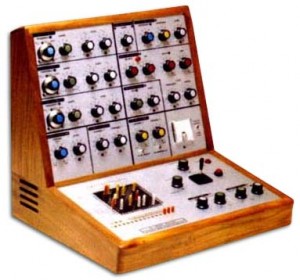
It has three oscillators, and a unique matrix-based patch system. Instead of patch wires, the VCS3 uses a patchbay grid in which the synth components are laid out, and signal routing is accomplished by placing small pins into the appropriate slots. The VCS3 was, in actuality, a modular type synthesizer reduced down to an extremely portable size.
It generates familiar sci-fi sounds (Dr. Who) and other truly analog sounds. Unfortunately, the oscillators tend to drift out of tune. There’s a Noise Generator, 2 Input Amplifiers, 1 Ring Modulator, 1 Voltage Controlled Low Pass Filter (VCF), 1 Trapezoid Envelope Generator, Joy-Stick Controller, Voltage Controlled Spring Reverb unit and 2 Stereo Output Amplifiers.
Additonally, the VCS3 was also sold in a plastic breif-case and called the Synthi A. The major Synthi 100 system was based on three VCS3’s strung together. Some ultra-rare commercially unavailable synths EMS made include the VCS4 in 1969 which was basically 2 VCS3’s plus a keyboard. And the Synthi Keyboard 1 of 1970 was just a VCS3 with a mini 29-note keyboard.
DATAMASKIN

