
Jordan Passmore Demo, NI Maschine, U-He’s Diva
Here is a demo Jordan Passmore composed with Native Instruments’ Maschine (loaded with DMX samples, courtesy of ToneBldr, http://www.drivenmachinedrums.com), U-He’s Diva and Native Instrument’s Kontakt. Maschine is loaded as the host and is doing sequencing and drum machine duties. Diva is doing the bassline and the HPF’d lead. Kontakt is playing back a string sample I captured from the Roland Juno-60. A few effects were used, namely the Valhalla DSP’s Ubermod on the lead and the reflex verb (built into Maschine) on the strings.
Roland Jupiter 8 1983 Demonstration by INHALT & Bunker Studio SF
This is the first part of an upcoming series of videos showing some of the instruments used by group INHALT. This is our Roland Jupiter 8 14 bit Revision from 1983.
12″ Vehicle EP Available on Dark Entries Records
http://www.darkentriesrecords.com/bands/inhalt/
12″ Single Walking on Glass Dance Mix
available on World Unknown Records
http://www.phonicarecords.com/product/view/103204
Digital Available:
http://itunes.apple.com/us/artist/inhalt/id524892048
http://boomkat.com/downloads/528908-inhalt-vehicle
contact/booking:
contact@inhalt.us
www.inhalt.us
https://www.facebook.com/INHALT.US
Bitwig Studio Beta video – VST support and plugin crash protection
For more information visit http://www.bitwig.com !
Previous betas of Bitwig Studio lacked VST support, and it’s been a bit too early to really evaluate them. In this new build, though, we not only get the ability to load VSTs, but a way of treating them that isn’t quite like other hosts.
- Parameters in easy reach: The default interface for plug-ins shows all their parameters in a list, and you can find them quickly as you type. (Most other hosts have a hidden screen with a mess of faders and require you to sort through them.)
- Quick automation: When you select a parameter in a plug-in – such as a fader or knob – that parameter is automatically selected for automation in the track view. (Note: this is a feature straight out of Ableton Live, which will be more useful with the introduction of curves and better automation recording in Live 9.)
- Faster loading: Folder monitoring is automatic, so the program doesn’t have to rescan your plug-ins with each launch – reducing load time
- Crash protection: Plug-ins are protected from crashes by instantiating each as a separate process.
Via CDM
Anushri kit now available at the MI store + new demo
New demo from Mutable Instruments featuring the Anushri, details below:
Another Anushri demo… Recording a pattern, tweaking the synth section, then playing with the drum section. My egg-laying, shrimp-eating, electro-sensitive friend typus keeps my fingers away from the dangerous filter mode and fuzz controls.
Mutable Instruments Anushri – a cheerful analog synth (that doesn’t suck at drums too)
Now available in Mutable Instruments online store.
Analog synthesis
- Analog VCO with saw and pulse waveforms, freely mixable.
- Optional automatic VCO calibration in software for those who don’t like messing with trimmers.
- -1 or -2 octaves sub-oscillator.
- Auxiliary square oscillator (DCO) with accurate digital tuning. Can be mixed in the audio path, used as a FM modulator or as a sync master for the VCO (yes, it means “ewwwwwwiowwww” and “wongwong”).
- 12dB/octave multimode filter, with smooth self-oscillation.
- Post-filter overdrive/fuzz circuit.
- Linear VCA.
Modulation sources
- 1 main ADSR envelope routable to pitch, pulse width, cutoff frequency.
- 1 simple 1-parameter envelope (morphing through various stages, including the shape of the main ADSR, and a rigid “GATE” style envelope) routed to VCA.
- Velocity routed to either cutoff frequency or VCA gain.
- 1 LFO routable to pitch, pulse-width and cutoff frequency ; with 8 waveforms (triangle, square, ascending and descending ramps, S&H, bernouilli process, piecewise linear random process aka “autodubstep”, noise).
- 1 triangle LFO for vibrato and/or growl.
Arpeggiator and sequencer
- Arpeggiator with 4 modes (up, down, up&down, random) ; 1 to 2 octaves ; 6 patterns.
- SH-101-style note sequencer with step by step recording, up to 128 notes. Easy recording of pauses, ties, and glides.
- Tempo set by internal clock with shuffle, external MIDI clock or external 6/12/24 ppqn trigger.
Drum machine
- Algorithmic drum pattern generator using an innovative “pattern sculpting” approach – allowing a large combination of drum patterns to be sculpted from 5 knobs.
- Digital sound generation of BD / SD / HH with tone control.
- Drum sounds can be freely triggered from an external sequencer using MIDI channel 10.
Interface
- 10 pots and 4 switches for hands-on access to synthesis parameters.
- 10 “software-pots” for editing modulations / arpeggiator / drum machine settings.
- 3 dedicated navigation buttons (“modulations”, “arpeggiator / keyboard”, “drum machine”).
- 3 dedicated sequencer buttons (“record”, “play”, “hold / rest”).
In/out
- VCO CV in/out (Note: manual VCO calibration is required for accurate 1V/Oct I/O).
- VCF CV in.
- VCA CV in.
- PWM CV in.
- Gate signal in/out (5V level for output).
- 24, 12 or 6 ppqn clock signal in/out (5V level for output).
- Front panel external audio in.
- External Audio in.
- Drum machine individual out (inserting a jack there removes it from the main mix).
- Audio out.
- MIDI in/out (thru + arpeggiator and sequencer notes).
- CC control over modulations and some of the digitally controlled synthesis parameters. Some parameters like filter resonance cannot be CC-controlled.
“Eurorackable”
- Remove main audio in / out and solder corresponding minijacks on PCB
- Remove LT1054 and solder 2×5 power connector
- Route MIDI in/out to front panel (if you want…). And that’s it!
Availability
- DIY product (full kit)
- Price < 200€ / kit
- Available < November 4 2012
beatMaker DJay simple unboxing
http://youtu.be/NgF_TbALpJQ
A short unboxing video of the beatMaker DJay app by Keith McMillen Instruments
Jordan Rudess and Morphwiz on the Lenovo A720 with Windows 8
Jordan wowing us in his piano room at his home in NY. I just set up the PC (Jordan’s first PC) and installed the apps before Jordan sat down to play. The PC is a Lenovo A720 running Windows 8 RTM, with 10 point multi-touch at 1920×1080. The app is MorphWiz by Wizdom Music.
The Deathlehem Machine portable edition
http://youtu.be/S-IecUvThXk
Background description for this video by Richarius Molindarius:
This is a very short video to give you a rough idea of what my latest noise machine can do! 😀 This one’s a little different though! Not only is he PORTABLE and will be running on a pair of 9V batteries, but he also has STEREO speakers built into him and will have 2 stereo outputs as well! 😀
This is the prototype of my idea that I originally had for my 4th Deathlehem Machine that I built in the mid 90’s. This guy though blows that one away, as this one is operating on 4 x Voltage Controlled Low Frequency Oscillators! 😀 (2 of them USED to be 1V/oct. VCOs in my modular. The other 2 x VCLFOs were taken from the same place.)
The 2 x former VCOs can play then entire audio range as well as drop down to almost pausing speed VCLFOs with the triangle waveform. They can also modulate the other VCLFOs with squarewaves
The 2 x VCLFOs can operate from almost pausing speed up the midrange of audio with either triangle or squarewaves.
Operationally:
Each of the 4 x VCLFOs have the following controls:
– Coarse tuning
– Fine tuning
– Control Voltage #1 amount
– Control Voltage #2 amount
– Triangle or Squarewave
– a speed LED
– a volume control
Each of the 4 x VCLFO’s can modulate 2 others. The connections are:
VCLFO #1 is hardwired to modulate VCLFO #2 and VCLFO #3
VCLFO #2 is hardwired to modulate VCLFO #3 and VCLFO #4
VCLFO #3 is hardwired to modulate VCLFO #4 and VCLFO #1
VCLFO #4 is hardwired to modulate VCLFO #1 and VCLFO #2
There be some huge amounts of modulation potential in this guy as well as audio screaming that’ll scare not one but BOTH of your grandmas! 😀 Lol.
I’m seriously debating putting this prototype up for sale on e-Bay once he’s completed. I only have a couple of small things to do now to finish it up in a nice carry-around portable package.
Lemme know what you think he would be worth to anyone out there he gets a kick out of making sounds that you wont find everyday in your nearest CD store! 😀
Thanks for any input! 
Bye buy boys and girl! 😉
Unkle Ryk
Time machine: PPG wave 2.2 synthesizer – “Dark Voices”
all sounds self-programmed: PPG wave 2.2 Wavetable Synthesizer from the year 1982
recording: multi-track without midi
fx: a little bit delay and reverb
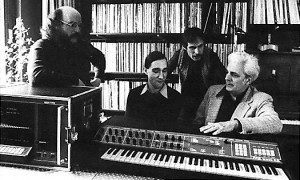
The German made PPG (Palm Products GmbH) Wave 2 series of synthesizers are incredibly great sounding analog/digital hybrid vintage synths. They use digital samples of wavetables and feature analog VCA envelope and VCF (filter) sections for a classic and warm sound. The Wave 2.2 has oscillators that can generate over 2,000 different single-cycle 8-bit digital waveforms! Covered by knobs, the Wave still looks analog and this comprises the “Analog Control Panel”. More complex and new-wave editing of the wavetables and samples is covered by the “Digital Control Panel” where there are several key-pad buttons and an LCD screen. Another familiar treat to analog junkies is the inclusion of an 8-track sequencer which features automation of pitch, loudness, filter cutoff, waveforms and more. A cool feature – its onboard sequencer will also record any filtering and wave changes, in real-time!!
The more commonly encountered Wave 2.3 followed the 2.2 and had enhanced sample-playback capabilities. The sampler was pretty full-featured for its time and included upgraded 12-bit digital waveforms, Fourier analysis and linear playback of samples. The 2.3 model also featured 8-parts multitimbrality and MIDI implementation. The PPG Waves are know to create excellent pads, brass and bass sounds.
In fact it was Tangerine Dream who helped the company and the Wave develop. 1978 saw the development of the PPG Wave Computer 360. But the Wave Computer sounded harsh and tinny. In 1981, the PPG Wave 2 was released which added analog VCF and VCA filter and envelopes to warm the digital sound. The original Wave 2 had 8-voice polyphony, like the 2.2 and 2.3, but it had only one oscillator per voice. The 2.2 offered two oscillators per voice which opened up a whole new realm of sonic possibilities because two separate wavetable sounds could now be combined.
more info: http://www.retrosound.de
MacBeth – tape delay synthesizer demo
Seen here- A Micromac- D Analogue Synthesizer being played via a MacBeth Touch Capacitataive Keyboard and being fed into something that they just knocked up! This is what MacBeth calls a ‘Tape Delay Synthesizer’!….it’s lo fi- mildly grungy- but mesmorizing to work with! Still to be refined- but I hear the potentiontial- it’s ‘breaky wakey’ at moments- but it seems to work well- this shall be partnered into my complimentary synth to the micromac. It’s a twin delay device- stereo in other words- but here we have delay 1 being fed into delay 2- so it’s mono…..but mad!
Jordan Passmore Demo of the Roland JX-10, Roland SH-2, Akai MPC-60
This is a demonstration of two Roland analog synths, a JX-10 and a SH-2, combined with the sequencer/sampler the MPC-60. The MPC-60 is loaded with Linn LM-1 samples (courtesy of ToneBldr, http://www.drivenmachinedrums.com ) and is also sequencing the JX-10 and SH-2. The SH-2 is doing the bass while the JX-10 is doing the melody; Jordan is playing lines over the melody on the JX-10 occasionally. All sounds are mixed on a StudioMaster mixer and there is an analog delay (Washburn Accellerator) on one send and a EH HolyStain on another.
“The MPC-60 is sort of out of shot so near the end I bring the camera around to show what I’m doing with that.”
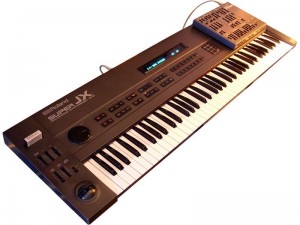
Released in 1985 the JX-10 (Super JX) combines two individual JX-8P’s for an outstandingly warm, rich and analog sound which is still used in many modern studios all over the world. This synth was the first Roland Synth to be fitted with a quality 76 note keyboard with velocity and aftertouch. Two DCO’s per voice, two ADSR envelope generators per voice, and a resonant lowpass & non-resonant highpass filters are only the beginning. It has a 12 voice polyphony for a total of 24 oscillators and it is by far one of the most programmable synths of its time! However, as on the JX-8P, knobs and sliders have been replaced by low-profile buttons and a nice LCD display. Although this may look sleek and elegant, it makes editing a chore. Assign parameters to the alpha dial for tweaking, one at a time, or get the optional PG-800 Programmer to provide traditional, hands-on, dedicated sliders for editing the JX-10’s parameters.
The JX10 has a Chorus effect and a chase-play Delay function. The chase-play function allows programmable delayed repeats of voices by alternating patches of the upper and lower modules. The simple chorus effect is either off, slow or fast. It has two programmable sliders (if you don’t use the PG-800) for some real-time control which can be recorded along with other effects and keyboard modes into one of the 64 Program Patches. This is in addition to its standard 50 preset and 50 user patch memory. A simple sketch-pad 1-track real-time sequencer is also on-board. It stores sequence data directly to an M16C card, or an M64C card for Patch/Tone OR sequence data. The M16C has a capacity of 400 notes, the M64C 1440, according to the manual.
The JX-10 also comes in a rack-mount version known as the MKS-70. It’s worth noting that the JX-10 can not be edited via SysEx, however the MKS-70 can which is one reason many have chosen the rack version of the keyboard. The JX-10 can make bulk dumps of its sounds over sysex, but only with (discontinued) Roland M64C RAM cartridges.
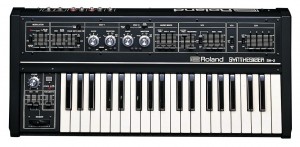
The SH-2 is one of Rolands’ early synthesizers. It is very simple in design, look and function. It sounds much like the SH-101 synth, including the typical SH-style sub-oscillator. But the SH-2 employed 2 oscillators for a much fatter sound. It has the typical Roland SH sound – it’s a monophonic bass synth that’s flexible enough to provoke punchy analog basses, leads and squelchy sounds. The oscillators can be de-tuned as well, another feature the popular SH-101 lacks. But it isn’t very pretty to look at as it shares the same design and layout as the SH09. Still it makes a simple and easily programmable mono-synth that can be used in place of the more common SH-101. However the SH-2 is harder to find and so it usually has a higher price than other SH-type synthesizers from Roland.
DATAMASKIN

