
About time !! Grammy: Lifetime Achievement Award to Kraftwerk
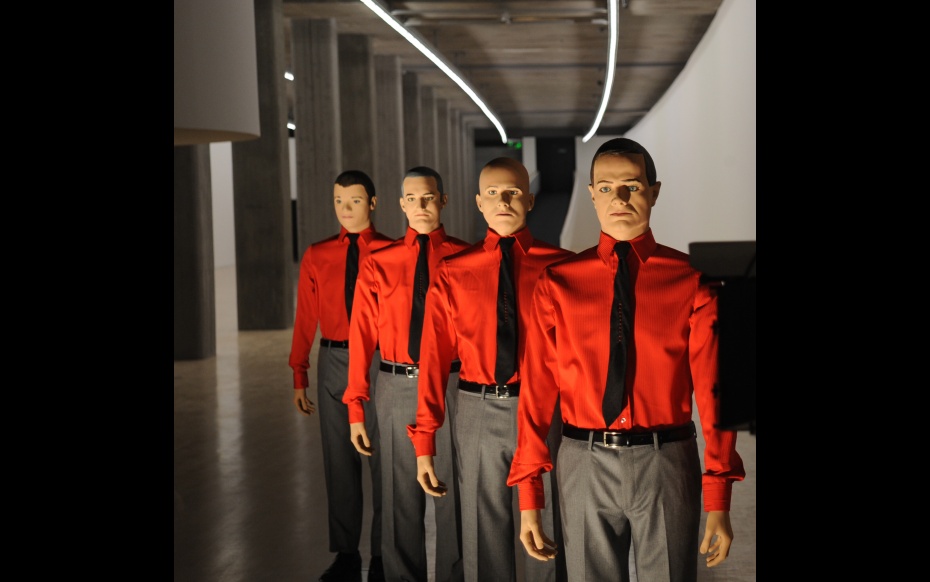
Well apart from the obvious – this is about time that Kraftwerk gets this recognition, my main question would be will all four original members be there to receive the prize 😉
Or perhaps it would be better to send four robots…
From the Grammy.com website:
(In addition to the GRAMMY Awards, The Recording Academy presents Special Merit Awards recognizing contributions of significance to the recording field, including the Lifetime Achievement Award, Trustees Award and Technical GRAMMY Award. In the days leading up to the 56th GRAMMY Awards, GRAMMY.com will present the tributes to the 2014 Special Merit Awards recipients.)
For those listening to radio in the United States in 1975, it must have come as quite a shock. The country was still emerging from the era of granola and natural fibers, and music was still measured by its soul and authenticity. And along came this music that sounded as mechanized as a Ford assembly plant. It was vaguely rhythmic like a busy signal. It had a melody that never stepped out of order. For mainstream audiences, Teutonic pop was born that year in the form of Kraftwerk’s “Autobahn,” and music would never be the same.
Kraftwerk began devising their “robot pop” in Düsseldorf, Germany, in 1970. Their forefathers were such German experimentalists as Can and Tangerine Dream. Kraftwerk founders Ralf Hütter and Florian Schneider met as classical music students at the Düsseldorf Conservatory, originally forming the group Organisation and releasing the album Tone Float in the UK in 1969. They disbanded the group and reformed as Kraftwerk (German for “power station”), inspired to craft music more influenced by psychedelic art rock than machinery. By 1973’s Ralf And Florian, Kraftwerk were truly staring down the ghost in the machine. With their follow-up, 1974’s Autobahn, Kraftwerk hit on a trancelike, pulsing electronic rhythm that would set the stage for the nearly countless acts that followed, from rock (the Cars, Eurythmics) to new wave (Devo, Thomas Dolby, Joy Division), pop (Giorgio Moroder), electronic/dance (Moby), and even industrial (Throbbing Gristle).
Though he was being influenced by a number of outside forces at the time, David Bowie’s late ’70s period in Berlin found him adopting Kraftwerk’s electronic overtones and droning rhythms for his albums Low and Heroes, highly influential works in their own right, and reportedly making a direct nod to Schneider with the song “V-2 Schneider,” featured on Heroes.
In a January 2013 article in The Telegraph, music critic Neil McCormick posed the question: “Kraftwerk: the most influential group in pop music history?” McCormick referenced the literally hundreds of Kraftwerk samples used by artists ranging from Afrika Bambaataa to Madonna, Jay Z and Coldplay. But in an interview for the piece, Orchestral Manoeuvres In The Dark’s Andy McCluskey pointed out that Kraftwerk endured the peril of true genius: a lack of appreciation in their own time.
“When [Kraftwerk] started there was a lot of fear of technology,” said McCluskey. “People said, ‘Look at these robot guys making music on computers; this is wrong.’ Well, it turned out that they were absolutely right, not just about music, but in their whole vision of the future man/machine synthesis. And it’s not been scary, we have all embraced it and got on with our lives.”
Christmas with Kraftwerk Episode 1 – 3
Florian gives Ralf a present
From “The Late Late Show with Craig Ferguson”, aired on Dec. 10th, 2013
Featuring Josh Robert Thompson
Florian and Ralf exchange gifts
A few Kawai K5000S pads
A few Kawai K5000S pads from the ASL4 library
About the synth:
The K5000 was Kawai’s top of the line music workstation digital synthesizer when it was released back in 1996. It’s a bold and elegantly designed synth with a large LCD display, realtime controls and incredible sounds! The look and functionality is rivals the competition from the time…the Korg Trinity and Kurzweil K2500
Programming sounds with the K5000 can be a breeze (once you learn how) although it has over 1,000 parameters per patch! That’s plenty to play with. It combines additive synthesis and PCM sampled waveforms for you to layer and combine to design a whole range of sounds. Plenty of LFO modulation, filters and envelope controls allow you to shape and morph your sounds further. On-board multi-effects add the final touch of life to your sounds.
Once you’ve created some sounds, there’s the on-board sequencer (K5000W only) for creating songs or loading Standard Midi File sequences (via disk-drive). It has a 40,000 note capacity and 40 tracks. Real-time record and step-edit modes are available and the sequencer is pretty straight forward.
The K5000S (pictured above) adds 12 dedicated knobs for hands-on control of filter, LFO and envelope parameters. There are 4 user-definable knobs and 2 assignable switches. The K5000S also has a 40-pattern arpeggiator on-board with 8 user-definable patterns too! K5000’s have been used by Kraftwerk.
.
Reading: New book “Music from Düsseldorf”
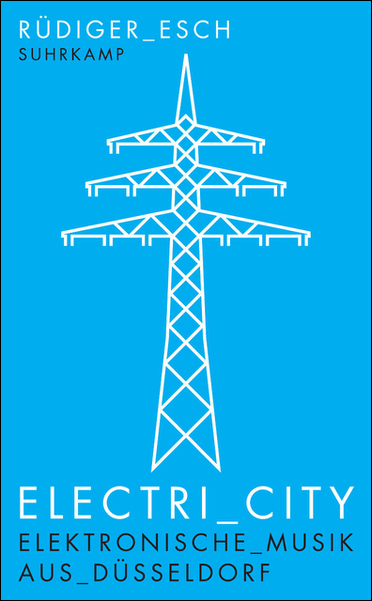
“Electri_City – Elektronische Musik aus Duesseldorf” is a brand new book that is being prepped for release on the 10th of March 2014 via Suhrkamp Verlag. Described by the publisher as ‘Das definitive Buch zu Kraftwerk, Neu!, La Düsseldorf, DAF, Die Krupps, Der Plan, Liaisons Dangereuses, Rheingold, Propaganda’ you can expect a detailed background on the Düsseldorf scene. That scene has since the 70s and 80s been considered as the electronic popmusic Mekka (let’s hope Allah and co won’t kill us for using this description).
The book is written by Düsseldorf resident and Die Krupps member Rüdiger Esch. In the book he covers the period from 1970 bis till the end of the ‘analog phase’ in 1986. Expect feedback in the book from Wolfgang Flür (Kraftwerk), Bodo Staiger (Rheingold), Gabi Delgado (DAF), Jürgen Engler (Die Krupps), Ralf Dörper (Propaganda), plus remarks from Giorgio Moroder, Ryuichi Sakamoto, Andy McCluskey (OMD), Martyn Ware (The Human League), Glenn Gregory (Heaven 17) and so on.
Still according to the publisher the book will also talk about reality versus myth regarding the scene.
You can order the book right here on Amazon: http://www.amazon.de/ElectriCity-Elektronische-D%C3%BCsseldorf-suhrkamp-taschenbuch/dp/3518464647/ref=sr_1_1?s=books&ie=UTF8&qid=1374060902&sr=1-1
John Metcalfe’s micro moments: Kraftwerk
Composer and musician John Metcalfe chooses his favourite ‘micro moments’ in music that changed everything – starting with Kraftwerk’s haunting It’s more fun to compute.
After 8 years Kraftwerk returns to Walt Disney
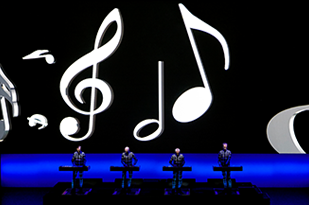
German electronic music pioneers Kraftwerk will play eight 3-D concerts at Walt Disney Concert Hall, March 18-21, 2014 to launch the LA Phil’s Minimalist Jukebox Festival. These will be their first L.A. dates since 2005.
They will perform eight of their albums, spread across eight performances.
KRAFTWERK – THE CATALOGUE 1 2 3 4 5 6 7 8 is a chronological exploration of their work. Starting with Autobahn, each performance will cover one of Kraftwerk’s studio albums in full and in order of their release:
- Autobahn (1974), Tuesday, March 18, 7:30 PM
- Radio-Activity (1975), Tuesday, March 18, 10:30 PM
- Trans Europe Express (1977), Wednesday, March 19, at 7:30 PM
- The Man-Machine (1978), Wednesday, March 19, at 10:30 PM
- Computer World (1981), Thursday, March 20, at 7:30 PM
- Techno Pop (1986), Thursday, March 20, 10:30 PM
- The Mix (1991), Friday, March 21, 7:30 PM
- Tour de France (2003), March 21, 10:30 PM
Contemporary music ensemble Icebreaker will recreate crucial phase in electronic music history – Kraftwerk
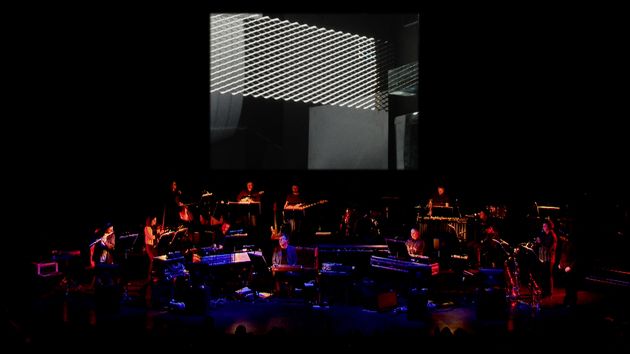
Popular demand for all things Kraftwerk will continue in the new year, as contemporary music ensemble Icebreaker embark on a live show that aims to recreate the electronic band’s experimental early period. The tour kicks off at the London Science Museum on 24 January and is titled Kraftwerk Uncovered – A Future Past.
Announcing the concept, German composer, producer and sound-scapist J. Peter Schwalm said: “Our focus is on Kraftwerk’s early, semi-improvised music that combined acoustic and electronic instruments, [and that period’s] relationship to their career-defining albums from Trans Europa Express to Computer World.
“Where Kraftwerk’s aesthetic moved ever closer to the ‘man machine’ we aim to adopt a more ‘retro-futurist’ approach to find the ‘human’ inside the machine, beginning with Ralf Hütter and Florian Schneider’s own early albums”.
The tour dates are:
- Fri 24th Jan – London, The IMAX Cinema at The Science Museum
- Thurs 6th Feb – Manchester, Royal Northern College of Music
- Fri 8th Feb – Birmingham, Town Hall
- Weds 12th Feb – Nottingham, Lakeside Arts Centre
For more info, visit Icebreaker.
Kraftwerk – The Model Deconstructed (Ableton Live 9 Tutorial)
Ski Oakenfull breaks down one of the best known tracks from electronic music pioneers Kraftwerk. This deconstruction took place at Ableton’s artists meet and greet at Sync Studios, Barcelona.
Buy the digitally remastered version of The Model from Beatport here: http://ow.ly/mqPYh
OR ITunes: http://ow.ly/mqPSe
LIVE REPORT: Kraftwerk
The Quietus has a nice live report on their site featuring a recent gig by Kraftwerk, the first part can be found below, if you get inspired head over to the main article
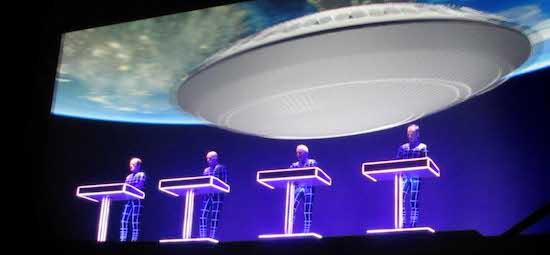
In opener ‘Spacelab’ an image of the Evoluon flies over the heads of the audience. To be honest, the UFO shaped building in the Dutch city of Eindhoven is appropriate for visuals that attempt to express the ultimate challenge of space: being infinite and yet ready to be explored. Incorporating the venue in the opening visuals of the show could easily be mistaken for something that is merely a nice touch; a credit to the remarkable place where the group are playing. Truth is, the Evoluon is the only place where Kraftwerk’s music really makes sense.
Let’s go back to the 50s, the decade of the Marshall Plan, which guaranteed the reconstruction of Europe. In 1952 The European Coal and Steel Community was created, the first step to the federation of Europe that was established after the Treaty of Rome in 1957. The Second World War seemed far away and despite the the Iron Curtain splitting Europe in half, the future looked bright. The optimism cumulated in the World Fair in 1958 (called Expo 58) in Brussels, the new capital of Europe. One of the most, perhaps the most, astonishing contribution was the Philips Pavilion, designed by Le Corbusier. The idea for the building came from Iannis Xenakis, specifically his composition ‘Metastaseis’.
The pavilion turned out to be one of the first real multimedia installations. Within the building, which consists of nine hyperbolic paraboloids, Edgar Varèse’s ‘Poème Électronique’ could be heard through speakers set into the walls. Rapidly changes images of technologic progress and the horrors of mankind were projected on the walls, creating a rich spectacle that the Canadian media theorist Marshall McLuhan would describe as an acoustic space: time and space disappearing in a non-linear story. At the entrance and exit Xenakis’ ‘Concret PH’ was heard.
One of the 41 million visitors of the expo was Ralf Hütter, one of the founding members of Kraftwerk. The Philips Pavilion made quite an impression on the young Hütter, who was twelve at the time. It is not that difficult to the the connection between the naive belief in the future at the end of the 50s and the work of Kraftwerk MK II and MK III – the Kraftwerk of Autobahn, Radio-Aktivität, Trans Europa Express and the Kraftwerk of Die Mensch-Machine and Computerwelt. Although the music sounded astonishingly new and fresh, Kraftwerk was in fact trying to regenerate the future, thus the 50s.
Experimental: Car composes Kraftwerkian music
http://youtu.be/dj-LJQyGjls
Tom Zimmerman created Project: Autobahn, a generative music system that creates music based on an automobile’s control sensors.
Background video info below:
Tom Zimmerman is one of my favorite hacker/inventors. With over 40 patents awarded, Tom’s the creator of the legendary virtual reality navigation device, the Data Glove, and has written a number of fun DIY projects for MAKE magazine. We invited Tom to participate in the Boing Boing Ingenuity: Data Driven hack day on August 17, 2013, and his creation, called Project: Autobahn, was awarded our coveted “Weirdest Hack” prize. He took home a gift basket from our friends at SpikenzieLabs, and a pair of Audeze audiophile headphones.
Project: Autobahn uses OpenXC data as MIDI data to compose and play Kraftwerkian music that matches the driver’s behavior. As Tom says in the video, the style of music the car generates could be used to provide feedback to the driver on how safely and efficiently she or he is operating the vehicle.
DATAMASKIN

