
New freeware release from xoxos
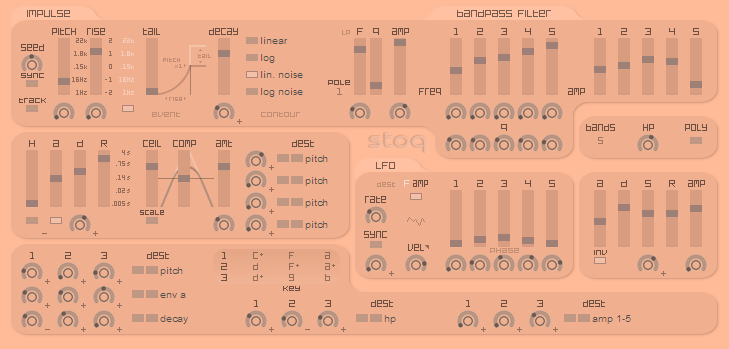
xoxos Stoq – suited for synthesis of maracas and other shaker instruments
xoxos explains the model:
impulse is driven by ‘pitch’ which is a % for event per sample at oscillator pitch. tracking is implemented but architecture is geared towards percussion synthesis.
the event % is shaped with a ‘rise’ envelope that lowers the chance for events to immediately follow other events (ie. hysteresis, good for emulating ‘larger beans’). when rise is locked to pitch it can be shifted by +/- 2 octaves. ‘tail’ multiplies the % after the rise period to reduce longer gaps.
impulses are decay-stage enveloped and consist of either the envelope contour or enveloped noise, low pass filtered for dynamics performance, then routed to a bank for 5 bandpasses (# of bands can be reduced to save cpu).
Plastic Piano is a killer
Knobster.org has released Plastic Piano, a simple electric piano emulator synthesizer VST instrument for Windows PC. download (zip, 1.4 Mb)
Make sure to check this little beauty out 
[youtube=http://www.youtube.com/watch?v=eIjBAjI0qbE&feature=player_embedded]
It has the characteristic of a plastic sound. Especially good for the lo-fi and cheap-tone music. For the production of the synthesizer was spent more than 150 grams of plasticine.
Plastic Piano features
- 2x oscillators with three wavetypes.
- LP-filter for each oscillator.
- Velocity sensitivity.
- ADSR-envelope.
- Magic button.
New awesome (and free) plug-in – Erectifier
Without doing any associations on the name I am happy to announce that my friends in Rusty Trombones has released a new and intriguing plug-in adn better yet it’s free.
Since I have not had the chance to try it out myself yet it would be nice to get some feedback on it so post away >> awesome or sucks

Listen to it here: mp3 sample
So what does it do really…??
So this works as a doubler, or demented phaser, it is designed to widen and phatten. Of course you can misuse that as well. you have an LFO that controls how long back an echo is. You can set the length and speed of this LFO. Then there is a filter that can be LowPass, HighPass or Allpass, and a cut Hz so that you can control where the cut is. oh-yeah!. The distortion is to gritt up the sound a little, or a lot, it’s not the worlds bestest distortion. Then you can amplify the signal, if you want to. The filter can cut away a lot of the volume, that’s why we have it. Then finally there is a on/off. There are two to the left side and two on the right side. and finally one dry through parameter. So if you’d like to test one of your settings, turn the other three off (via on/off parameter) and then tweak away, baby. There are a few presets (yeah, we didn’t feel like making a lot of them, so we forced that shuriken.se guy to make a random-function and make a lot of presets there).
New EQ from Blue Cat – but yikes its expensive!!
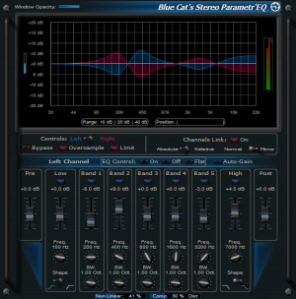
Blue Cat Audio has announced a massive update of all its commercial EQ plugins. The new versions are now available for Mac in VST and Audio Unit formats, and also bring multiple improvements to the existing Windows plug-ins. The Liny EQ series have been completely redesigned for this new release.
The Blue Cat Audio EQ plug-ins include the Liny EQ series (linear phase graphic equalizers), Parametr’EQ series (digital and analog parametric EQs) and the Triple EQ plug-ins (semi-parametric visual EQs). They all come in three flavors, offering a wide variety of capabilities. In particular, the Widening versions propose mid/side processing for frequency selective stereo narrowing or widening.
New for all plugins :
– Mac Audio Unit support.
– Mac VST Support.
– New Windows installer (you should uninstall any previous version before installing this new one).
– New documentation.
New for the Liny EQ series :
– New user interface design.
– The plug-in now offers two types of EQ curves.
– EQ range is now customizable.
– Undo/Redo support.
– Preset import/export in a host independent format.
– Window opacity control for plugin transparency.
Spectrasonics has released Stylus RMX version 1.7
Spectrasonics has released Stylus RMX version 1.7 featuring an innovative and completely new capability called ‘Time Designer’ which intelligently transforms RMX audio loops into different time signatures and features the ability to “Groove Lock” the feel of any groove to another – all in real time.

Stylus RMX is a completely new groove-based virtual instrument plug-in for Macintosh and Windows. Stylus RMX is the first product to offer the combined power of Groove Control™ with Spectrasonics Advanced Groove Engine (S.A.G.E.™) technology giving users dramatic new control over groove production and performance.
Spectrasonics’ in-house development team created the new instrument from the ground up, with dozens of new features including the ground-breaking Chaos Designer™, a completely redesigned multi-page user interface, a new core library of sounds, all with a focus on realtime groove creation and performance.
New Core library
The massive new 7.4 gigabyte core-library in Stylus RMX has thousands of cutting-edge grooves and sounds that were created by Spectrasonics’ international sound design team, and produced by Eric Persing. The new core library contains nearly triple the amount of sounds originally offered in the original Stylus, and contains all the original material as well. The new sounds and grooves in Stylus RMX offer a much wider range of modern musical genres than the original Stylus. Mixes of grooves are broken down into individual tracks called Elements for flexibility and infinite combinations.
Also new in Stylus RMX are thousands of new Kit modules, 250 Kit patches, as well as user Kit construction….Users can create their own customized multitrack remix grooves and kits, save them into the plug-in, and even share them with other Stylus RMX users on different platforms and hosts. RMX 1.5 even comes with 500 new Multi grooves!
“Xpandable”
Stylus RMX marks Spectrasonics’ first expandable virtual instrument, with a series of five new “S.A.G.E. Xpanders” for Stylus RMX at $99US retail each. Stylus RMX also can be expanded with existing Groove Control CD-ROM libraries and even REX files – which opens the door for musicians to utilize their own audio loops within the powerful S.A.G.E. Environment.
Chaos Designer™
Of the many new capabilities in Stylus RMX, possibly the most innovative feature is the Chaos Designer™. With simple controls, the user can introduce musical Chaos into the groove, which allows it to have constantly evolving variations— giving the impression that the audio grooves are improvising. The results can be subtle or extreme by setting the simple to use controls. A Capture feature allows the spontaneous audio chaos patterns to be made into a MIDI file, dragged and dropped into the host sequencer, and played back again for further editing by the user.
Stylus RMX Features Overview:
- First product using new S.A.G.E. technology (Spectrasonics Advanced Groove Engine)
- Realtime auto-sync to the beat so grooves are always in time, even when performed live! Groove Control is always active for optimum sound quality at virtually any tempo.
- Massive cutting-edge 7.4gb Core Library, with nearly triple the sounds of the original Stylus.
(the original Stylus core library also included) - Expandable!
Add more grooves with new series of “S.A.G.E. Xpanders”Expandable with Groove Control® activated sample libraries
Expandable with Propellerheads REX files, which allow a user to import their own audio loops via ReCycle™.
- Thousands and thousands of grooves, sounds, patches and interchangeable “Kit modules” for building grooves
- 500 Multi Grooves
- 250 Kits
- World-Class integrated FX Racks w/27 professional effects: Tube Limiter, Tape Slammer, Modern and Vintage Compressors, Wah-Wah, Power Filter, 6 different Vintage/Parametric/Graphic Equalizers, Flame Distortion, Valve Radio, PRO-Verb, EZ-Verb, Spring Verb, Gate Expander, Stereo Imager, Flanger, 2 different Phasers, 3 BPM Delays, Retroplex Tape Delay and Radio Delay
- Easy MIDI Control of all 20,000 parameters with MIDI Learn: simply grab the parameter and the hardware control
- Hardware Controller Templates provided for Popular models by Korg, Behringer and M-Audio
- Over 9 hours of professional Video Tutorials are included a visual way to quickly learn about Stylus RMX!
- Integrated Documentation – A 68,000 word Reference Guide is accessible directly from the plug-in Help menu
- Multipage user interface design with fully integrated Browser for easily auditioning & organizing grooves
- Innovative Chaos Designer™ adds musical variations and “improvising” within stereo audio grooves!
- 8-part Multitimbral, each part can have dozens of grooves and samples
- Multiple stereo outputs (with supported software)
- Edit Groups offer unique control of individual beats within an audio loop: add ambience to just the backbeat, control the pitch of the snare inside a stereo loop, reverse only specific slices in the loop…non-destructively
- Favorites Menu creation of user defined suites of grooves, perfect for project-by-project work
- Built-in Mixer w/ 8 channels, mute/solo, level, meters, 4 Aux sends, output assignments
- Drag and Drop MIDI files into host sequencer
- User Kit building from core library, User Remixes, cross-platform/cross-host patch compatibility
- Groove Menu mode allows any suite of multiple grooves to be played live from the keyboard on a single MIDI channel
- Grooves can be instantly auditioned at Half Time / Double Time
- Build Multitrack Grooves in realtime!
- Real-time Jamming in sync!
- Powerful sound design features include:
New multi-mode Power Filter, 3 syncable LFOs,
3 AHDR envelopes, Reverse and more - Edit Templates to browse and audition grooves using custom sets of parameter edits
- Easy Edit page with Big Knobs for simple, yet powerful control of key parameters
AudioMulch 2.0 Revealed

AudioMulch 2.0 is not just a new version, it is the next generation of AudioMulch. It will provide a foundation for a new cycle of feature development and improvements that will be rolled out in regular updates after the 2.0 release. AudioMulch has long been a cult favorite for people wanting to patch together unusual sonic tools and performance rigs. That puts it in a category with apps like Reaktor or Max/MSP, but unlike those tools, AudioMulch has a lot of stuff built for you already.
New in version 2.0:
- An all-new UI, built from the ground up, with drag-and-drop patching and faster MIDI control and parameter access
- Gray is out; black is in.
- Dockable windows stretch across multiple screens.
- Up to 2X performance efficiency increase
- Patchable MIDI routing, finally – so MIDI matches up with the power of audio in the first version
- Metasurface, tempo, and transport can now be controlled by MIDI and automated
- Complex time signature support, automated time signature changes, additive meters
- Improved support for consumer multichannel audio (see note below)
- Startup enabling of audio, MIDI, networking
Closer look on Peak Pro 6.0.4

Peak is an unusual tool, in a way, in that it remains a stereo waveform editor only, whereas most of its competitors have added multitrack compatibility. On the other hand, Peak also bundles an unusually rich set of tools in the box, which explains the higher price of the full-blown Pro versions.
Peak Pro comes bundled with a wealth of goodies. There is, of course, the program itself, along with SoundSoap LE, Bias’ excellent noise remover; WireTap Pro, an audio capture tool; a bundle of 32 VST effects from Maxim Digital Audio; and the wonderful SFX Machine LT plug-in, which contains nearly two dozen unusual effects.
Third-party AU/VST effects and instrument plug-ins are supported too.
Additionally, you get a suite of analysis tools in the form of Bias Reveal LE, a gorgeous four-band EQ, Bias Sqweez dynamics, and the dynamite Vbox plug-in matrix.
As if that wasn’t enough, AMG’s ONE sample player is included, along with audio files from PowerFX, Hollywood Edge and Sound Ideas. Believe it or not, the XT version gives you even more, adding SoundSoap 2 and SoundSoap Pro, along with the Master Perfection Suite.
If you’re an experienced Peak user, you’ll notice immediately that the interface has been given a bit of spit and polish for this version. Peak has always had a reputation for being very easy on the eye and, more importantly, easy on the brain, and that approach is maintained here.
What’s New in this Version
– Add support for transferring recordings from iProRecorder via WiFi.
– Fixed a problem where CD-TEXT in a DDP fileset containing accented characters could have those characters missing on discs produced from that DDP fileset.
– Fixed a problem in which Playlist output could contain a burst of noise (i.e., in bounced files or burned audio CDs).
– Many more enhancements.
Launch of Waldorf Largo
Waldorf have released Largo, their first ever software instrument. It’s a synthesizer that the developers say features the same kinds of sounds as the Blofeld and Q hardware synths, giving the user a diverse sonic palette, from complex pads to screaming leads.

Many producers and synthesizer enthusiasts asked for a full-blown Waldorf Synthesizer for their virtual rack. So have I, and now Largo. Largo is the first pure software synthesizer with Waldorf DNA. And again – it is the cutting edge sound that makes the big difference.
Largo has three oscillators with a variety of waveforms that include shapes from the PPG and Wave hardware synths. Two multi-mode filters can be used in parallel or series, and each has a drive section and can self-oscillate. There are three LFOs, one of which has a step sequencer-style waveshape arpeggiator generator, and there’s a selection of effects, including chorus, flanger, phaser, overdrive and delay. Largo runs as a plug-in inside VST and Audio Units hosts.

Product feature: EVE

EVE stands for Electronic Vintage Ensemble, which suggests the design philosophy behind the instrument. EVE was made to recreate in the virtual world of softsynths the exciting and immediate experience of the early age of electronics in pop, rock and jazz music from the 1960’s and 1970’s.
During this creative period in music history, many musicians started to employ the innovative sounds of the ‘electric keyboards’ which were newly available for use on stage and in the studio: Rhodes electric pianos, Hammond and Vox organs, Hohner clavinets, strings machines such as the Arp Solina string ensemble, Moog synthesizers, and all those that are now considered ‘classics’.


EVE takes these vintage sounds and this early approach to ‘electronic’ music production as a starting point, bringing this general philosophy and sound into the modern virtual environment with an intuitive and powerful interface. At the core of the EVE approach to sound design is the basic structure of 3 sample-playing layers, 2 multi-effect racks, and a selected library of multisampled ‘electric keyboards’. This enables the blending of several waveforms and instruments into a vintage wall of sound, or alternatively, the use of the 3 layers multi-timbrally as a vintage workstation. These layers can then be further processed through EVE’s powerful multi-effect racks.
EVE 2 adds several enhancements and new synthesis features to the simple yet powerful EVE design. All the original functionality and ease of use is still there, with the following changes and additions –

• The original LP resonant filter per layer in EVE has been replaced by a multimode filter (LP, HP, BP, BR) with control over cut, resonance and envelope modulation, as well as a special ‘fractal’ modulation parameter. This expanded filter design provides further tools for balanced layering of sounds, and deep pads.

• FM/AM modulation capabilities per layer have been added via the ~FM switch matrix. FM and AM can be used to add interesting harmonic distortions to the original instruments, or to manipulate new sounds from the existing samples.

• The vintage multi-effect racks have been updated, with an expanded ECHO rack, and a new overdrive effect in the MODULATOR rack, as well as various enhancements to other effects.

• New routing options between the layers and the effects allow the MODULATOR rack to function in both ‘send’ and ‘insert’ modes.
• EVE 2 now supports the loading of WusikSND SoundSets, opening up a whole range of extra sample content that can be loaded into the EVE engine. Due to synth design differences, EVE 2 does not load Wusik presets (FXP, FXB, BNK or WusikPRST files). For EVE 2 to read WusikSND SoundSets, they must be installed into the ‘EVE Data’ directory in any subfolder.
discoDSP Discovery Pro for MAC
12 oscillators Virtual Analog VSTi and Audio Units Synthesizer featuring 4 layers, WAV and SoundFont (SF2) support, 2X oversampling/undersampling, built-in arpeggiator, sync, FM, 12 filter types, panning modulation, stereo delay and gate effects, graphic envelope modulation. Imports Nord Lead 2 SysEx data.

Features :
– 128 Patch Memories per bank
– Parameter Morphing using Modulation Wheel or MIDI velocity
– 2x oversampling
– 2x oversampled distortions
– Bank browser (by clicking arrows in display led and bank name)
– More than 300 presets in 3 banks (including a percussion one)
– Nord Lead 2 and 2X patch import
– 4 Layers per Patch, each with :
* 1 Wave Oscillator. Can load WAV files using high quality interpolation. User banks are easily added
* Resonant Filters (LowPass, HighPass, BandPass, BandReject, Formant, 8 taps phaser, X 12/24 dB and Y 12/24 dB are Moog modeled)
* ADSR for Amp & Filter. Amplitude envelope can switch between linear and exponential curves
* 2 LFOs
* Modulation Envelope
* Graphical Modulation Envelope
* Arpeggiator
* Built-in Chorus, Phaser, Panning Delay and Gate effects
* Symmetric, Asymmetric and Asymmetric 2 Distortions
* Limiter
* Portamento
* Poly/Mono/Legato modes
DATAMASKIN

