
Reason 5 – micro tutorial on sampling
If it was good for Trevor Horn, The Beastie Boys, and pretty much every pioneering producer in the last 30 years… then it’s good for us too. Live Sampling is back in Reason 5 and Record 1.5. But before you start pitching your burp noises up 3 octaves we thought we’d teach you the basics of the process.
Demo of a new effect plug-in from Expert Sleepers – Spectral Conquest
Expert Sleepers announce the release of a new plug-in for both Windows and Mac OS X – Spectral Conquest v1.0.0.
Spectral Conquest is an effect plug-in that lets you directly manipulate the frequency spectrum of audio signals.
The incoming signal is analysed via a FFT (Fast Fourier Transform), resulting in the familiar spectrum plot where the full audio spectrum is split into a number of narrow frequency bands. The outgoing audio is then regenerated by an Inverse FFT. The interesting bit is that the plug-in lets you modify the frequency spectrum in between.
Spectral Conquest allows you to modify the spectrum in two ways:
– By setting a multiplier for each frequency band. You can simply draw out the multipliers in the GUI.
– By applying a script to the spectrum. Some basic scripts are included with the plug-in to perform operations such as filtering and gating, but you can also write scripts yourself to do whatever you like.
Playing the 8bit guitar
It sure don’t sound good but it is a funny experiment.
This a CV sequencer with an arduino microcontroller. It Sequences the pulse width of the guitar. The idea came from tracking (composing) in famitracker, LSDJ and Goattracker. When you compose for the NES or the Gameboy, there are tons of effects you can choose from to make square waves more complex and interesting sounding.
The Arduino code will be posted on this site in the next couple of days so, check it: http://animal-style.com
Attack of the clones – NTRQ 1.6
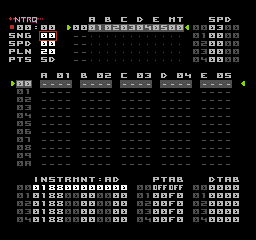
Mr. Baldwin has updated NTRQ to 1.6. New Features include:
Pattern Cloning
Something you should probably be aware of: I had to modify the NTRQ file format slightly to accommodate the clone/purge feature. This means that from V1.6 onwards, older .sav files will not be compatible. However, starting with V1.6, if you load up NTRQ with an older .sav file it will be automatically upgraded to V1.6 data format. The same also applies to the NSF outputter. It has been updated for V1.6 too and is not compatible with older .sav files. To re-output your old .sav files as NSF you need to first “load” and “save” them (however that happens on your platform of choice) with V1.6 (onwards) first.
DPCM Changes
Funnily enough, I’d been working on the changes to DPCM before I was talked into releasing the cloning feature. As such it’s still in a state of flux somewhat but the changes so far definitely make DPCM usage better (or at least more interesting
)
The Mono Lancet is a compact synthesizer with big sound, easy user interface and charm
The voltage controlled lowpass filter has a slope of 24db per octave. On high resonance settings it starts to self-oscillate and produces a stable sine wave that can be played in a range of about 2 ½ octaves.
The Mono Lancet is a compact synthesizer with big sound, easy user interface and charm.
Oscillators
Two analogue oscillators take care of a solid sound foundation. Oscillator one creates triangle-, sawtooth- and square waves and can be set one octave lower than the second oscillator. The latter produces white noise instead of the triangle wave.
The pulse width can be modulated through the modulation wheel (MIDI) and/or an external control voltage (see Extension). The glide generator has a legato mode or can always be active.
Filter
The voltage controlled lowpass filter has a slope of 24db per octave. On high resonance settings it starts to self-oscillate and produces a stable sine wave that can be played in a range of about 2 ½ octaves.
On MIDI site the cutoff frequency can be controlled by velocity and/or aftertouch.
Amplifier
There’s a good sounding VCA inside the Mono Lancet that can be modulated by the ADSR- or a fixed organ-like envelope. On demand it additionally can respond to velocity.
Modulation
The classical ADSR envelope generator can modulate the VCO- and VCF frequency and the VCA.
The LFO generates rectangle- and triangle waveform as well as sample & hold and is modulation source for VCF and VCO.
Extension
There’s a 25pin sub-D connector on the rear of the Mono Lancet. It extents the possibilities of the synthesizer enormously through numerous in- and outputs for control voltages and audio signals. PWM and filter input are just two of them.
Superb electronic remix
Must say that this is a wonderful remix
iamamiwhoami’s N, remixed by Eineinmeier
Listen to the new A-ha single
You can listen to the new A-ha single “Butterfly, Butterfly (the last hurrah)”, written by Paul Waaktaar-Savoy and produced by Martin Terefe, right here at Stereoklang. The news for the single leaked out prematurely on May 5th when the New York-based mix engineer Michael H Brauer posted the following message on his website: “I just mixed the final recorded song to be released by A-ha called “Butterfly” (sic).”
The new single is released to promote a new, double CD compilation, their 3rd already. “Butterfly, Butterfly (the last hurrah)” is the very last single from the biggest Norwegian synthpop band ever. The world premiere will be aired on June 14 on NRK P1, NRK P3 and VGnet Monday at 09.50 AM.
And that’s not all for this year, a new live DVD and a re-release of the book “The Swing of Things” by Jan Omdahl is also in the making. On top of that the band releases “The Singles: 1984 – 2004” in the USA and will re-release ‘deluxe’ versions of “Hunting High and Low” and “Scoundrel Days”
How to get that liquid sound going
This liquid drum and bass tutorial is ideal for producers wanting to learn how to make tracks like Netsky, Logistics, Well Being etc.
Making music with PS2
Found this little demo on Youtube – apart for some glitches here and there, why not
“this is just a test to see if i can make my playstation into a midi master. it seems to work but there is a few glitches too,
its synced with my midi gameboy SP running LSDJ
arduino based.”
Keen on beta testing the Bridge?
Serato would like to invite you to register your interest in becoming a beta tester for The Bridge.
This does not mean the The Bridge is in an Invite or Public beta phase, so please do not ask where you can get it!
Beta testing is an essential and highly important part of the software development process and your help will ensure reliable performance upon final release.
When we do officially invite interested DJ’s and Producers to beta test The Bridge, you will need:
Serato Scratch Live with supported Rane hardware
A Serato.com forum account
An ableton.com account with a copy of Ableton Live 8 registered to it.
DATAMASKIN

