
Summing up the analog modular synth gathering at National Museum of Science and Technology Stockholm
Some 30 modular systems was on display last weekend at the museum of science and technology in Stockholm. The gathering was co-hosted in the space exhibition giving it a nice atmosphere but also giving a quite noise level as the general public was including many kids passing on their way to the toy tech department. On the other hand the Lego builders competition would leave plenty of time for parents strolling around the lovely modulars as their kids where building Lego.
Photos below are from the following sources:
http://www.flickr.com/photos/jiblite/sets/72157625324995360/ jiblite
http://www.flickr.com/photos/possan/5151066561/ possan
http://www.flickr.com/photos/51395145@N08/sets/72157625204619015/ Peter Erikson
http://www.flickr.com/photos/24097552@N06/sets/72157625204866033/ Faxtelius
http://www.flickr.com/photos/pellesten/sets/72157625330505144/with/5153607155/ pellesten
For the last image we refer to http://maxsynth.wordpress.com


Find out more about the green DIY modulator.
The EMS of Stockholm was kind to bring some of their classic Buchlas. Here shown to the public for the first time.

A quite large system from the now defunct Plan B.
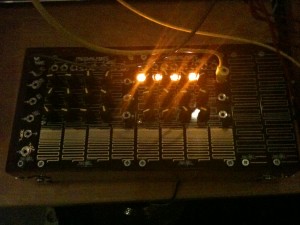


A pure modular synthesizer album, tracking one monophonic line at a time.
The composer Stretta writes: “While modular synths are undergoing something of a renaissance these days with dozens of manufacturers producing interesting new modules, there aren’t a lot of examples of pure modular synth music made today that transcend the banal.
‘A Funneled Stone’ is a pure modular synth release, tracked in the old-shool, 1970’s way: one monophonic line at a time. Every sound you hear was created, patched and recorded for that moment in time. When a new sound is needed, the patch is torn down and a new one is built. Polyphony is achieved by tracking each voice individually.
A modular album is, by definition, unapologetically synthetic. I also tried to take a more minimalist approach to orchestration, so the individual sounds can be more fully isolated and appreciated. I spent much of the final month of production taking elements out, and editing for length. Sometimes this results in the remaining elements merely hinting at the underlying harmonic movement.
As you can imagine, this process is very time-consuming, but fun. I hope you enjoy the results as much as I enjoyed creating it.”
a funneled stone by stretta
Alan Wilder and Vince Clarke to remix Depeche Mode
There are rumours about a pretty special Depeche Mode remix album set for next year. Vince Clarke stated on his Twitter that he’s working on a remix of “Behind the Wheel”, and now www.depeche-mode.com reports that Alan Wilder is making a remix as well. We hope to hear more of this soon.
In other Depeche related news, Vince Clarke and Martin Gore is collaborating on a techno sort of album. Also revealed on Vince Clarke’s Twitter.
Depeche Mode’s “Tour of the Universe – Live in Barcelona” is out now.
Via RM
Space Oscillator plug-in for Mac
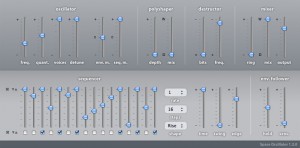
Sinevibes has released version 1.2.0 of Space Oscillator, an audio-controlled synthesizer plug-in for Mac.
Space Oscillator is a unique combination of a synthesizer and a sound processor.
At it’s core, it has a unison oscillator with a spacious stereo sound, which is modulated by input signal envelope follower or a complex step sequencer. The oscillator is then fed into a polyphonic waveshaper, decimator and can be ring-modulated with the input signal. With such an experimental generation and effect chain, Space Oscillator allows you to create new sonic textures with a lot of original character and attitude: from organic synth and bass lines, old-school game boy sounds to rhythmic zaps and noises, extreme lo-fi glitches and much more.
Changes in Space Oscillator v1.2.0
- Vastly redesigned user interface which improves usability and now has the same style as the recently updated Gateboy plugin.
- Improved synchronization in GarageBand, Logic and Live.
- Improved synchronization during sequencer Rate changes.
- New user manual.
- 30 new factory patches (for a total of 100).
Space Oscillator for Mac (AU) is available for to purchase for $29 USD until the end of 2010 (regular price $39 USD). The update is free to all existing owners.
More information: Sinevibes
MeeBlip is a new digital MIDI mono synthesizer
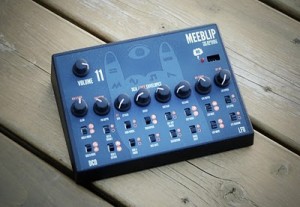
MeeBlip Quick Build Kit, fully assembled
MeeBlip is a new digital MIDI mono synthesizer designed by James Grahame [RetroThing]. It’s designed to be affordable, hackable, and most of all, playable. It’s an open source hardware instrument, but it isn’t just for hackers. You can unpack it, do some very basic assembly of the complete kit, and be making sounds from a MIDI keyboard or other controller within minutes.
Berlin old school synth
Hi lovely Synthfolks, sorry for my bavarien english;-)))
I make a short sequence with four steps with three Oszilators from the GRP A8 Synth, the other three Oszilators go to the leads. The other leadsound comes from the Minimoog. The Noice comes from the Juno 60.
Demo of the Synthetic Sound Labs 1310 Digital Delay module
This is a demonstration of the Synthetic Sound Labs 1310 Digital Delay module. The $199 device is capable of subtle doubling, hard timed delays and super flanging.
Details below.
Synthetic Sound Labs 1310 Digital Delay Description
The SSL 1310 Voltage Controlled Digital Delay is a single width 5U/MU module for producing short to medium audio delays. For shorter delays, short room like slap-backs are killer. At medium delays, you can emulate vintage tape echos. You can even force the module for longer delays, but digital quantizing noise becomes audible – but who’s to say what’s musical and what’s not?
It’s based on the ubiquitous Princeton Technologies PT2399 delay chip which is used in countless effects pedals. The really cool part is that delay times are voltage controllable, allowing everything from a little chorusing effect to a grinding, gurgling mass hysteria.
RECIRC-ulation (repeats) are controlled manually and can go way beyond self-oscillation! The MIX control smoothly blends dry, undelayed signal with the delayed, all the way through delay only (no original signal), thus saving a mixer at the output. Using an external VCA, filters and mixers, you can also create your own feedback patches. Cool and simple. Use two 1310s for cool stereo effects and through-zero-flanging!
CV AMT controls how much of the DELAY CV control voltage input is mixed with the manual DELAY setting. Go from Rockabilly slap to literally audio clicks in a single bound.
INPUT and OUTPUT levels are designed for the hot signals a synth produces, so for minumum noise and best performance, external audio devices such as microphones and guitars should be preamplified before being fed to this module.
See the Synthetic Sound Labs site for more info.
via davidryle:
I mostly am using it as a gentle flanger in this demo but it is far more powerful than what I demo here. You can get one for your 5U MU modular synthesizer by checking out the website at http://www.steamsynth.com/
I also finished a project where I was modifying a stock Q111 Pan/Fade module from Synthesizers.com. I added an attenuator pot to the control input and added an inverter circuit to the output #2. This enables the Panning portion of the module to output audio to two channels of my mixer in stereo. I have control over how wide the panning is and both output channels are normal (un-inverted) so there is no cancellation when sending to effects etc..
I am using several other delay units as well in this demo. TC Electronics D-Two is way in the background so it isn’t really a factor. Strymon ’s Blue Sky Reverberator is the heavy plate reverb in the background. The Korg Kaoss 3 pad is used to have some looping fun, but I tried to keep it low level so not to interfere with the demo of the 1310 delay module.
There are four separate voices playing in this piece from the modular. The sequencers are generating various time signatures and loops but all of the distorted flanging effect is the 1310 Digital Delay. This is one fun unit and a great addition to my modular synth.
The title is about the amount of time since I got serious about building a modular synth to work with. It has been a little over two years (9 seasons) since I made the commitment. No looking back and I am very happy with the move away from dedicated keyboards and soft synths (although I still use them for other things).
Thanks to Doug Slocum at Synthetic Sound Labs for the great delay module. He has other ideas in the works and I am very excited about the future of his endeavor.
Keyboard workstations for gigging musicians
Music Computing’s TriggerGrid™, included with each ControlDAW, is a sample player that allows the user to trigger sampled sounds via controllers such as the ControlDAW or ControlPLAY™. Unlimited number of banks each containing sixty four (64) samples can be loaded and played. Per pad controls included: Frequency, Attack and Release, Gain, Pan and Reverse. Per pad wave editor allows for simple drag to trim/truncate samples. 16 — audio outs for use in a DAW. File formats include: wave and mp3. Save feature allows all 64 pads to be saved as a kit. Unlimited number of kits can be saved that can be instantly loaded for playback. Simple drag and drop interface to populate pads.
Music Computing’s GeoMIDI™ MIDI mapping software provides an interface for changing the MIDI assignments of the ControlDAW and ControlPlay’s buttons, knobs, and sliders. Each slider or knob can send out a variety of combinations of control or pitch-bend data. An unlimited number of MIDI map presets can be created, saved and loaded for use.
SonicSource™ by Music Computing is a virtual synth (VSTi) equipped with three sample-playing layers, two multi-effect racks, and a library of multi-sampled instruments. The sample playing layers allow blending of waveforms and instruments into a wall of sound or alternatively, the use of the three multi-timbral layers as a workstation. These layers can then be further processed through SonicSource’s powerful multi-effect racks.
www.MusicComputing.com
Propellerhead releases ReBirth for iPad
Well after the launch of ReBirth for iPhone I guess it was just a matter of time before it should appear on iPad as well, perhaps we will find Reason there soon as well
Propellerhead Software today released Rebirth For iPad (App Store link) – the original virtual techno music studio, reincarnated for the iPad.
The world of iPad music software has really heated up in the last month, and ReBirth For iPad demonstrates that another major electronic music software manufacturer is taking the platform seriously. It follows on ReBirth For iPhone – which was interesting as a proof of concept, but ultimately fiddly in use because of the iPhone’s screen size.
Here’s what Propellerhead has to say about ReBirth For iPad:
Propellerhead Software’s legendary Techno Micro Composer has been resurrected and customized for the iPad.
ReBirth faithfully emulates dance music’s three backbone devices: The Roland TB-303 Bass synth and the Roland TR-808 and 909 drum machines. Combine these with FX units, fully featured pattern sequencers and a gorgeous-looking interface and you’re ready to make killer tracks on your iPad.
Share your music with friends on Facebook, Twitter and more using the built in sharing features.
ReBirth For iPad is $14.99.
Features:
- 2 x TB-303 Bassline Synthesizer with pattern sequencer – The original Acid House and Techno bass synth. Unrivaled power, unmistakable sound.
- TR-808 Drum machine – Roland’s sub-heavy 1980 beat computer. Instant hip-hop.
- TR-909 Drum machine – The go-to beatbox for everything House and Techno. Press play and you’re dancing.
- Tempo-synced digital delay – Bouncy and hypnotic, always in time with your music.
- Compressor with threshold and ratio – A bare-bones compression unit for added beefiness.
- Distortion unit with amount and shape – Raw and rugged distortion for that extra edge. Works wonders with any 303 bassline.
- PCF effect – Pattern controlled Low-pass / Band-pass filter – a tweaker’s delight.
- Mixer – Device specific mixer sections with pan, delay sends and FX switches
- Mod support – Includes 7 original user mods with alternative sound sets and graphics
- Sharing features – Share function with easy publication of songs to Facebook, Twitter and other social networks.
Here’s some acid performance
Full KORG iMS20 feature list
KORG iMS-20 (App Store link) is virtual analog synth studio for the iPad.
Korg iMS-20 offers a complete recreation of the Korg MS-20 analog synth, an analog sequencer, a drum machine, a mixer, and even Korg’s Kaoss Pad technology.
Korg iMS-20 Details
iMS-20 is a complete music production app for iPad. It consists of a complete recreation of the Korg MS-20 analog synth with the patching capability, plus a 16-step analog sequencer based on the Korg SQ-10, a six-part drum machine which can create drum parts by simply tapping the buttons, and a seven-channel mixer with 14 types of effects.
In addition, iMS-20 offers dual Kaoss Pads allowing you to generate music by simply stroking the pad and moving your fingers over it. And with access to the SoundCloud audio platform, you can publish your songs, or collaborate on ideas with people anywhere in the world from within the app.
The regular price is US$ 32.99; a special introductory price of US$ 15.99 is being offered until January 31, 2011.
Korg iMS-20 Specifications
Components:
- MS-20 monophonic synthesizer: 1 unit
- Analog sequencer: 1 unit
- 6-part drum machine: 1 unit
- Mixer: 1 unit
- Song/Pattern composer: 1 unit
MS-20 monophonic synthesizer:
- Analog modeling synthesizer (MS-20 modeled by “CMT” Component Modeling Technology)
- 2 VCO / 2VCF / 1VCA / 2EG / Patch Panel
- Additional functions: Modulation Key/Tempo Sync
- Insert effect (selectable from 14 effect types as below)
Analog sequencer:
- 16-step analog sequencer
- Control notes, volume, pan, parameters, and voltages via knobs
- Configurable steps (1-16) and sequence mode (6 types)
- Trigger out per channel or step position
6-part drum machine:
- 6-part/16-step drum machine
- Create sounds by sampling a single note from a built-in MS-20
- Controllable notes, volume and pan by knobs
- Configurable steps (1-16) and sequence mode (6 types) per a part
Mixer:
- 7-channel mixer
- Double needle meter indicates VU level
- Master effect (selectable from 14 effect types as below)
Song/Pattern composer:
- Compose a song or select a pattern, built-in mixer
- 16 patterns and 256 bars per a song
- Tempo setting (20-300 BPM) and Swing function
Effect type:
- 14 types: Short Delay, BPM Sync Delay, Reverb 1, Reverb 2, Chorus/Flanger, Equalizer, Compressor, Tube Simulator (Valve Force), Low-Pass Filter, High-Pass Filter, Band-Pass Filter, Talking Modulator, Decimator, Grain Shifter
Controllers:
- Keyboard: Recording function, Variable width (22, 26, or 29 keys)
- Kaoss Pad: 2 units, Recording function
- Performance pad: Key/Scale (31 types) settings
- Parameter control pad: X-Y axis parameter settings
Other:
- Audio export function (Bouncing a song or pattern, and Real-time recording a performance: 16-bit/44.1 kHz stereo WAV format)
- Publish and share songs online with the SoundCloud audio platform
- Various template patterns by music genre are included
- Various template sounds by sound category are included
Note: KORG iMS-20 is a dedicated iPad app ( iOS 3.2 or later) and cannot be used with iPhone and iPod touch
DATAMASKIN

