
Get those synths going: Dekad – New Religion
Nice new synth/EBM video from Dekad
Dekad presents a new single taken from the Monophonic album: New Religion. The single contains two versions of New Religion, a remix of Don’t Try by Neutral Lies and a previously unreleased track ‘Ordinary Love’ taken from the Monophonic recording sessions…A new video accompanies this digital single release.

About the band:
Dekad was formed in 2000, at the time the band was composed of 4 people with similar influences (new wave, punk rock, electro pop, EBM, goth.) The lineup was made of JB, Seb, Yoyo and Manu: 2 guys with cheap keyboards, a singer and a guitar player. Dekad started playing live but soon realized that they could do things differently and JB decided to transpose the live demos on his computer which led to a total re-organization. Things became more serious and live sessions slowly left place to home studio sessions, and the band quickly turned to a trio. In 2003, Dekad sent a demo to BOREDOMproduct including the track ‘Tell Me’ that would be released in the “Synthetique” compilation. This was the start of a new collaboration: the next year JB and Member U-0176 from Celluloide started working on Dekad’s debut album “Sin_Lab”, based on the demos of the band. Sin_Lab was finally released in 2005, with a new version of “Tell Me”, and other tracks such as “Dare” and “Club Devil”. The album was very well received by the fans but got limited media coverage.
The trio returned in studio in 2006 to record their second album “Confidential Tears”. From the sound of the first single “Dive” it was clear that Dekad was evolving and its music was now more solid and focused. The album was once again very well received amongst the fans of electronic pop, and gathered more interest in the media. After participating to the second BOREDOMproduct compilation “Auto-Reverse” in 2007, the band went into hiatus as it became harder for its member to find the time to compose together. In the meantime JB frequently joined Foretaste on stage as second keyboard player, and kept on writing new songs on his own.
As a new album fully took shape, JB decided in 2009 to reactivate Dekad, even as a solo act…Thirteen new tracks have been composed and recorded in the last few months. As always, member u-0176 produces this new album with JB. Its name is in line with the new lineup of the ‘band’: “Monophonic”. The debut single, “So Sorry” is an emotional duet with Foretaste’s singer.
Girls Gone Vinyl: The Untold Story of Female DJs
The kickstarter.com trailer for the documentary movie “Girls Gone Vinyl: The Untold Story of Female DJs” (girlsgonevinyl.com).

“Hyperspace 2011” – performed live by Bruno Ender Lee
VELVET VOYAGE – “Hyperspace 2011” – performed live by Bruno Ender Lee, June 26. 2011 on analog synths…
Synthesizers.com Studio-88 (leads & fx), Moog Little Phatty Stage II (seq.) & ARP Odyssey (bass)…with a little chorus & delay.
Synthesizing a Kick Drum with Surge VSTi
Architecturally speaking, Surge is a rather complex synthesizer. But because of how it’s put together it’s still easy to learn. Surge is an instrument capable of generating truly beautiful sequences of numbers. Synthesizing a kick drum with Surge VSTi, using the FM2 module. The principles are applicable to any decent synthesizer. The Kick is basically a sine wave pith through a short, steep pitch envelope. Some frequency modulation (FM) is added to emphasise the attack. An LFO is applied to pitch to give a little wobble. Using these parameters it’s possible to get a wide variety of tight, punchy electronic kicks. Why waste time browsing samples? Make your own! Sampled using FL Studio’s Edison and dropped into Nerve.
Specifications
General
- Synthesis method: Subtractive hybrid
- Each patch contain two ‘scenes’ which are separate instances of the entire synthesis engine (except effects) that can be used for layering or split patches.
- Quick category-based patch-browser
- Future proof, comes as both a 32 & 64-bit VST plugin (Windows PC)
- Universal Binary for both VST and AU (Mac)
Factory sounds
- 1010 patches
- 183 wavetables
Oscillators
- 3 oscillators/voice
- 8 versatile oscillator algorithms: Classic, Sine, Wavetable, Window, FM2, FM3, S/H Noise and Audio-input
- The classic oscillator is a morphable pulse/saw/dualsaw oscillator with a sub-oscillator and self-sync.
- The FM2/FM3 oscillators consists of a 1 carrier with 2/3 modulators and various options.
- Most algorithms (except FM2, FM3, Sine and Audio-input) offer up to 16-voice unison at the oscillator level.
- Oscillator FM/ringmodulation
- Most oscillator algorithms (except FM2/FM3) are strictly band-limited yet still cover the entire audible spectrum, delivering a clear punchy yet clean sound.
- Noise generator with variable spectrum.
Filterblock
- Two filter-units with arrangeable in 8 different configurations
- Feedback loop (number of variations inside the parenthesis)
- Available filter-algorithms: LP12 (3), LP24 (3), LP24L (1-4 poles), HP12 (3), HP24 (3), BP (4), Notch (2), Comb (4), S&H
- Filters can self-oscillate (with excitation) and respond amazingly fast to cutoff frequency changes.
- Waveshaper (5 shapes)
Modulation
- 12 LFO-units available to each voice (6 are running on each voice and 6 are shared for the scene)
- DAHDSR envelope generators on every LFO-unit
- 7 deformable LFO-waveforms + 1 drawable/stepsequencer waveform
- LFO1 allows envelope retriggering when used as stepsequencer
- Extremely fast and flexible modulation routing. Almost every continuous parameter can be modulated.
Effects
- 8 effect units arranged as 2 inserts/scene, 2 sends and 2 master effects
- 10 top-quality algorithms: Delay, Reverb, Chorus, Phaser, EQ, Distortion, Conditioner (EQ, stereo-image control & limiter), Rotary speaker, Frequency shifter, Vocoder
Jazz session with Jupiter-8, and Motif-6: Vintage 74 Rhodes and Korg Emx
Jazz session with Jupiter-8, (split patch Bass/Xylo) and Motif-6: Vintage 74 Rhodes and Korg Emx preset drum pattern.
This song came about when searching for a random pattern on the drum machine that was completely different and out of the ordinary.
Synths used: Jupiter-8: Bass/Xylo split Motif-6: Rhodes Vintage 74
Kraftwerk sounding tunes from the Doepfer Dark Time sequencer
An uptempo synthmusic. Again de Doepfer Dark Time sequencer with a 16 step sequence triggering the Moog LP (with the punch of the moogerfooger CP 251) and the Waldorf micro Q. The piano is a combination of the Roland E15 and the Kurzweil micro piano with the accent to the E15. Strings from the Roland Juno 106 and the Korg Lamda. Solo synth also from the 106. Some e-piano from the Yamaha DX 27. A lot of echo’s amd reverb.
The title had to do the nice wether today after a rather cold and wet period.
Maximizing viewable area on your screen
Ableton Live Tutorial Video, hiding browsers & maxing your screen Vespers, Ableton Live Certified Trainer, Vancouver, BC, Canada.
http://www.vespers.ca http://www.soundcloud.com/vespers http://www.twitter.com/djvespers http://www.facebook.com/vesperspage
iPod Touch – Pythagoras synth in action
Fielding is using Pythagoras, a new microtonal iOS synth instrument, still in development.
Riffing on classic orchestral tune from The Conan The Barbarian Sound Track “The Orgy” to demonstrate that the iPod touch version of this thing is actually playable. About as playable as Mugician.
Get to know the Vengeance Mastering Suite
Product Video for the new VST plugin by Vengeance-Sound.com: “Vengeance Mastering Suite – Stereo Bundle”. This video shows a quick overview of some of the features.
This collection of high quality stereo processors will change the way you work: Explore new, unexpected deepnes in your productions! The perfect mastering solution for every contemporary producer. But hey, these plugins can do much more for you: beside mastering tasks you can create stereo material out of mono material: Just apply it to vocals, basslines, guitars and synths etc… and make it slamming right into your face!
IMPROVISOR for AudioCubes
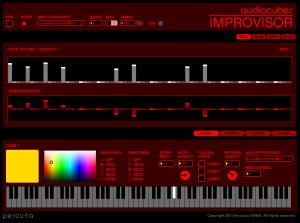
IMPROVISOR is an application that makes it easy to create complex melodies and rhythms, all while staying in tempo, rhythm and in key (if you want), and without having to be a music theory genius. It’s a generative music software application that takes advantage of the unique capabilities of the AudioCubes, our easy to use smart musical blocks.
The idea of IMPROVISOR is that each cube is linked with a groove and a relative note pattern, which is played back in a loop. You can add and remove loops by adding and removing cubes. By placing the cubes next to each other, their note patterns are added to each other, creating completely new melodies, all in key and in rhythm. These can be sent via MIDI to your favourite software or hardware synth. You can enter your own grooves and relative note patterns (in semitones) in the software, using the built in editor and you can choose which cubes should be linked to which patterns. The loops are entered using a step sequencer, which contains 64 steps. What is special about IMPROVISOR, is that you enter the notes in a relative fashion, using the velocity editor and the semitone steps editor.
Why is that interesting?
Well, you can let the cubes each play back their sequences of semitone steps, and you can add them to each other when the cubes are placed next to each other, creating completely new melodies. This is called “following”. Each cube can follow the semitones of the other cubes, which basically means they are added together. The semitone steps are added to a “root note” for playback, which can be set per cube.
Each cube is associated with a sequence of notes (semitone steps), as well as a velocity sequence. The velocity sequence determines which semitone steps are played and how loud. This means you can tell two cubes to play different notes using the same “groove” or you can play the same notes using different grooves, for example. The length of the sequence being played back as well as the length of the notes can be set using a rotary knob in the user interface. Each cube can send notes to its own MIDI output port / channel. So one cube could be playing back bass notes to a bass synth while another one is playing a melody on a lead synth for example. To use IMPROVISOR you just have to have one cube connected to your computer. The other cubes are autodetected as they are added. You can set cubes to have a specific colour using the colour picker.
IMPROVISOR can synchronize to other MIDI compatible hardware or software (e.g. a drum machine) using MIDI clock. You can select the MIDI input port to enable this at the top left in the transport bar. Alternatively you can tap the tempo or enter it manually.
DATAMASKIN

