
Arturia Jupiter 8V review
The original Jupiter 8 was an 8 voice polyphonic analog subtractive synthesizer released by Roland in 1981 responsible many classic 80’s tracks. Arturia have had a crack at recreating this iconic synth in plugin format. I was going to playing some samples but wanted to get you a bit closer so we are going to quickly walk through the original interface and the extras goodies Arturia have added. Sorry there aren’t more audio examples but this episode is already way too long!
Disclaimer: This is no way a complete walk through, please dont get upset because I missed out X function. I know I missed out X function.
Interested to hear what you guys prefer in a review a walk through like this, or more audio examples & over view approach?
Source:
thedspproject.com/arturia-jupiter-8v-review
Charlatan – free polyphonic, subtractive virtual analog soft synth
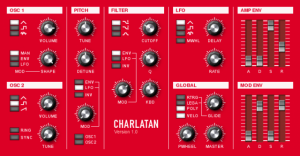
BlauKraut Engineering has released Charlatan – a free polyphonic, subtractive virtual analog software synthesizer for Windows.
Charlatan is a polyphonic, subtractive virtual analog software synthesizer plugin whose design focuses on sound quality and easy usability. The design philosophy was to provide a feature set just large enough to cover a wide range of sounds rather than an infinite number of parameters and modulation options cluttering the user interface and distracting from the creative process. That said, Charlatan’s synthesis architecture is flexible enough to create all kinds of sounds, from conventional classic leads, basses and pads to weird blips and noises.
While making no compromises about sound quality, the algorithms have been optimized for efficient CPU usage making Charlatan well suited as a ”bread and butter” synth even in projects with a large number of plugin instances.
Charlatan is available for free download via BlauKraut Engineering.
Features
Main features of Charlatan:
- 2 oscillators with triangle, sawtooth, rectangle and noise waveforms
- oscillator pulse-width modulation (PWM) and slew rate modulation (morphing between triangle and sawtooth)
- oscillator hard synchronization and ring modulation
- 2 ADSR envelope generators
- 1 LFO
- 3 filter types emulating nonlinear characteristics of classic hardware: 4-pole (24 db/oct) and 2-pole (12 db/oct) lowpass, bandpass
- 3 voice modes: Monophonic with retriggering, Monophonic Legato and 8-voice Polyphonic
- low CPU usage
- 100% coded in C++
- native 64-bit support
New Chromatic Keyboard Foot Controller from Keith McMillen
12 Step is a new Chromatic Keyboard Foot Controller from Keith McMillen Instruments.
The 12 Step controller has some interesting features:
- Plays up to 5 notes per key
- Polyphonic aftertouch and pitch bend
- Velocity sensitive response
- Carbon fiber construction
- Weighs 1 lb
It’s also relatively inexpensive, priced at $289
BEHRINGER NOX Series DJ Mixers released
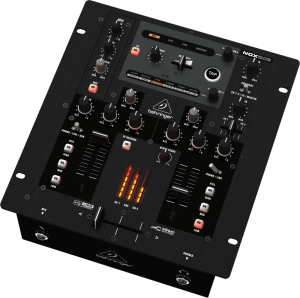
BEHRINGER brand announces that their new NOX Series DJ mixers are now shipping, and will soon be available with the company’s authorized retail partners worldwide. The feature-rich new mixers, which drew a considerable amount of buzz with their 2011 NAMM show debut, are designed to connect directly to PC and Mac computers, allowing the user to record and play back virtually any digital music file—without the need for any special drivers. With models ranging from two to six channels, all feature Infinium “Contact-Free” VCA crossfaders with adjustable crossfader curves, BEHRINGER’s premium-grade phono and legendary XENYX mic preamps, as well as beat-syncable FX for years of flawless performance.
RCA inputs are provided for turntables, tape decks and CD players, plus all NOX mixers feature built-in USB connectivity for unparalleled access to MP3 libraries and other digital file formats, directly via the user’s computer. Thanks to BEHRINGER’s “Planet Earth” power supply, NOX Series mixers can be used anywhere in the world.
Vintage exploration: Demo of the Synergy II+ synthesizer
This is a demo of the Synergy II+ synthesizer. Based on the Bell Labs Digital Synthesizer created by Hall Alles in 1975, the Synergy II+ remains one of the rarest and most sophisticated digital synthesizers in music history. There are only a few dozen of these left in working condition today.
Background information:
The Synergy was a push-button machine and it didn’t offer any programming like the GDS, but it had some interesting aspects to it. One is that it had a sequencer. It was the first keyboard that had a sequencer anything like this. The sequencer allowed you to overdub and play on top of the sequence. It was real easy to use.
“‘Another thing was, the Synergy provided the ability to be able to control multiple sounds [up to four] simultaneously from the keyboard – also a first. You could do that with some analog synths, but you couldn’t before actually figure out which finger on which key was going to play what sound, and have absolute control over that kind of thing. It could track your hands up and down the keyboard. You could get six floating split zones, and there were all kinds of different modes for assigning sounds to keys. The whole idea of the machine knowing things like which hand was playing what sound was very experimental. We thought it was wonderful. We would design this extensive piece of software to do this one thing, and there was really only one neat tune that you could make with it.’
“Wendy Carlos describes some of the Synergy’s controls and capabilities: ‘On the far left of the Synergy’s front panel, there’s a joystick that goes left-to-right for pitch-bend and up-and-down for modulations. I prefer the two Minimoog-style rotary wheels for pitch-bend and modulation but the Synergy had none of those. It also had some rotary knobs for globally controlling timbre, volume sensitivity, vibrato rate, amplitude, and its random rate – aperiodicity is the term they use. Threshold settings allowed keyboard velocity to dynamically control volume or timbre changes and, depending on how the voice was built, could in effect act to change the brightness or inharmonicity in the sound, or some other quality that a live [accoustic] instrument would have if it were played more forcefully.
“‘The keyboard had no aftertouch, and even though release velocity was implemented in the voices, a hardware tie-in was never made. Release velocity would have been nice, but I pushed for getting the microtonality tables, because I thought that was more important at the moment, and I guess I still do.
“‘There were 24 internal patches that you could toggle rather quickly. The Synergy was among the first synthesizers to have a memory cartridge slot. You could get a device that would let you burn your own ROM chips and you could save your own cartridges of voices. I even built DK a library of voices that they later sold when the machine was in its latter stage of being commercially available.’
“To avoid any confusion, Synergy cartridges stored patch data, not waveforms.
“Wendy continues: …’The Synergy’s oscillator table was 12-bit. Its frequency tables were specified to be 16-bit, and then they were interpolated to be 20-bit, which is how they’re able to be used on the microtonality tables. So they’re really a good bit better – and I don’t mean the pun – than the spec might look. And if you’re putting together big additive voices, 12-bit isn’t a big limitation, because you’d have to crank down the level of 16-bit oscillators so that the total didn’t exceed 16 total [at the output DAC] in the end anyway.
MachFive | 3 – the third generation of MOTU’s flagship sampler
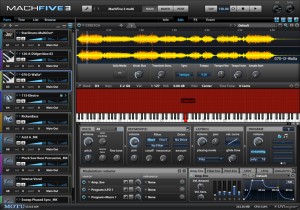
MachFive | 3 is available now for Mac OS X 10.5.8 or later and PC for Windows Vista or 7. MF3 comes in AU, RTAS and VST Plug-In formats and can be purchased for £395/$565 MSRP. As an interesting offer from MOTU, MF3 can also be upgraded from a competing product for a discount price of $295 MSRP and as a cross-grade for $179 MSRP.
“Within minutes after you begin using MachFive 3, you’ll appreciate the years of user interface design and engineering that have gone into this 3rd-generation release. From the configurable part list to the full-screen envelope editor, MachFive 3 has been designed to spur your creative muse while delivering state-of-the-art virtual instrument technology in a streamlined, efficient environment. After all, music, sound design, and audio production are creative endeavors that deserve a worthy partner in creativity.”
• Scripting engine – Instead of guitar presets, you get a guitar player…
• A universe of sounds – 45 GB of included instruments, loops and phrases
• Powerful new synth engine – Twelve forms of synthesis that span music history
• IRCAM Technology.
• Automation and modulation – Twist, morph, and pulsate.
• New flexible effects architecture.
• New filters and effects.
• Convolution reverb.
• Enhanced sample library support – Load anything. Directly, with no conversion.
• Event processors.
• Preset browsing and searching.
• LoopLab beat slice editor.
• Full-screen operation.
• Unlimited everything – Oscillators, layers, parts, effects — add all you want
• Oscillator Editor – It’s way more than just a sample editor
• Mapping Editor – Keygroup mapping so intuitive, you’ll never have to stop and ask for directions
• Tree Editor
• List Editor – If you are a list person, this editor is for you
• Effects Rack – Comprehensive effects processing throughout
• Performance View – Transform MachFive into the ultimate live performance instrument
• Mixer – A complete, self-contained mixing environment
• 3rd-generation UVI Engine XT. – Acclaimed worldwide for its sound quality.
• Multiple outputs. – Submix to 17 stereo output pairs.
• Disk streaming. – Conserve RAM and quicken load times.
• Unlimited polyphony. – With ultra-low software latency.
Pro Tools Preview – upcoming features
Recording of an on stage technology preview at IBC Amsterdam 2011
iOS releases: VidRhythm – Real Instrument Example & MadPad
Available now! http://itunes.apple.com/us/app/vidrhythm/id457548851?ls=1&mt=8
The virtuosos in the Harmonix Audio Department put together this example video with real instruments so you can see how fun it is to get creative with VidRhythm.
Made with VidRhythm by Harmonix on iOS. http://www.vidrhythm.com
Get MadPad for iPhone here: http://bit.ly/MadPad-iPhones, Get MadPad for iPad here: http://bit.ly/MadPad-HD
When you download MadPad you can make your own remix of this set of video clips! It’s like magic!
MadPad for iPad, iPhone, iPod Touch, by Smule.
MadPad from Smule is like Cambox on steroids. It is very similar except it’s iPad native and you can browse other peoples sets. I absolutely love the browsing feature. I can already see people creating some nice modular or synth sets. This is a wicked app that anyone creative will love.
With VidRhythm you record some video clips and auto creates a music video for you. Although it’s more a fun toy than something you are going to create a real music video the concept is great. It’s not too unlike the web service Animoto. EDIT: After playing with the app a little maybe you CAN make something special…
“Remix your life with MadPad! Turn everyday sights and sounds like your car, an empty soda can, or your friends into the ultimate percussive instrument. Oh the possibilities! Woosh, boom, clap…anything can be music. Just aim the camera and shoot the sounds all around you: your local café, car, kitchen, kids, cat, friends… MadPad magic will take care of the rest. Or have fun playing with the hundreds of free premade sets.” – smule.com/madpad
“Remix your world! Introducing VidRhythm, the fun and easy way to make video music from Harmonix, the makers of Rock Band™ and Dance Central™. Video-sample yourself, your friends, your pets, or anything else, and use VidRhythm to instantly mash it up into a crazy video remix!” – vidrhythm.com
For more info: smule.com/madpad and vidrhythm.com
Beeper Recorded with a Neumann U87A Microphone
USB Beeper recorded with a Neumann U87A microphone. 192 KHz / 24 bit, downsampled and converted to 44.1 KHz / 16 bit.
A short tour of the Atomic Shadow sound lab
http://youtu.be/AP3E4bbtmwI
Background information:
Sonic sculpture done with Telex tape machine, sine wave generators, ring modulators and slicer pedal.
DATAMASKIN

