
Reason Wizardry Demo Video
Reason Wizardry is a series of advanced video tutorials for Propellerhead Reason 4/5/6, produced fresh and delivered electronically each month.
A Closer Look at the microKORG
Can’t believe I have already had mine for almost ten years now 
Take a closer look at the microKORG; Korg’s compact analog modeling synthesizer with an outrageous Vocoder built right in — we even include a cool gooseneck microphone. Chances are you’ve seen it on stage or heard it on a favorite song. Now is your chance to see it up close and hear some of 128 Killer sounds that are stashed inside. It’s compact, battery powered, and fun to play. And there all kinds of extras to enjoy: an arpeggiator with mute-able steps, effects, delays, pitch & mod wheels, and more. In addition to keyboard players, the microKORG is great for bassists who need a synth bass-sound, vocalists who want to add some sonic extras, or really any musician. Heck, just watch the video! http://www.korg.com/microkorg
More on Arturia’s upcoming Oberheim clone – SEM V
Ahead of the official release, planned for December 2011, Arturia has exposed the detailed features, graphic interface and the first exclusive sound demos on its website. Not only the Oberheim SEM V, powered by the latest innovations in Arturia’s TAE(R) technology, is a faithful “recreation of the original,” but it will also benefit from polyphony, 8 voice multitimbrality and new innovative modules such as the Voice Programmer, the Advanced Keyboard Follow and a Modulation Matrix.

Check out the Arturia website www.arturia.com for more information. MSRP : USD 249.00 / EURO 229.00 – Shipping December 2011.
As of Oct. 27, 2011, two audio demos have been posted (“Berlin Berlin” and “pad Filter Sweep”), but video has not yet been posted.
MAIN FEATURES:
* All the original parameters of the Oberheim SEM: two oscillators, each offering sawtooth wave and variable-width pulse wave with PWM, sine wave LFO, 12dB/oct multi-mode Filter with low-pass, high-pass, band-pass andnotch, two ADS envelopes
* Added functionalities : New LFO, Noise, Sub oscillator, on board effects (distortion, chorus and delay), Arpeggiator, Portamento
* Polyphony and 8 Voice Multitimbrality
* New 8-voiceProgrammermodule
* Advanced Keyboardfollow module
* Modulation Matrix module
* Works in Standalone, VST 2.4 & 3, 64 bit & 32 bit, RTAS and AU 32 & 64 bit formats
* Compatible with Windows (XP/Vista/Seven 32 bit and 64 bit), Mac OS X (Mac OS X 10.5 or higher, Intel only).
Time machine: TR-505 It’s Totally Digital!!!!
Imagine 1986…the TR-505 by Roland Instrument Company is the hit! Here’s how it makes the jamz!
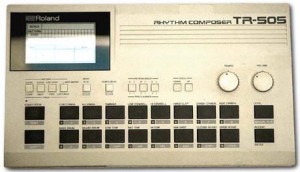
A cheap (budget) drum machine. It features 16 drum tones which unfortunately, are only mediocre samples. Its memory contains 48 patterns and 6 songs. Unlike its TR cousins it does not have individual drum tone outputs. There is no drum tone editing capability either. It does however feature extensive MIDI implementation, even the pads will transmit MIDI data. The 505 works well with a computer and sequencer or as a stand alone drum machine. It is extremely basic and unexciting but does make a good starter or play-along drum machine.
Nice Gameboy Analog Filter demo
http://youtu.be/9KDI3UbW_3w
Video introduction and demo of the Works Limited Gameboy Analog Filter.
Electro pop: patten – Plurals
From patten’s ‘GLAQJO XAACSSO’ album, out now through No Pain In Pop.
Buy limited 12″ and DL : bit.ly/nNuWwg
“…appears as if from some parallel world; prismatic and mirage-like, soaked in the searing heat of urgency.”
Directed by Jane Eastlight.
‘Remarkable. One of the year’s most exciting debuts.’ – FACT
‘Among the albums of the year’ – Boomkat
‘Excellent’ – the Quietus
‘9/10’ – Drowned In Sound
‘4/5’ – Resident Advisor
—
nopaininpop.tumblr.com/
patttten.com/
FGFC820 are back with new material
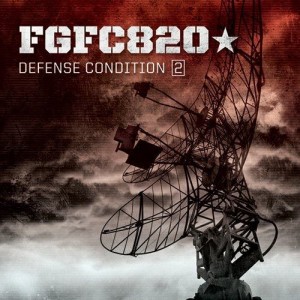
Three years after their last release the album “Law & Ordnance”, FGFC820 are now returning with new EP “Defense Condition 2.”
The New York-based duo formed in 2004 and debuted on its own with the EP “The Hanging Garden” the following year. Now they are on the Black Rain label NoiTekk, where, besides the above-mentioned “Law & Ordnance” they also debuted with “Urban Audio Warfare” in 2006. The next EP contains nine songs and title tracks “Insurrection” and “Revolt Resist” is supplemented with remixes signed Funker Vogt, Accessory, Comoros Command and Arian 1
“Defense Condition 2” is released November 18 via NoiTekk.
Tracks:
- Insurrection (Call To Arms Mix)
- Revolt Resist (Reload Mix)
- We Don’t Need No WWIII
- Insurrection (Fuxxor Mix By Accesory)
- Revolt Resist (Comrade Mix by G.Thomas of Funker Vogt)
- Resolution 9
- Insurrection (Resurrexion Mix by Arian 1)
- Revolt Resist (Billion Dollar Killing Machine Mix by Komor Kommando)
- God & Country
Open source EigenD (Eigenharp) connected to a modular synth
Background information:
Striving for higher resolution electronic instruments to connect the player to the sound the old-fashioned way.
This is a technical demonstration, meaning, I finished the technical coding, hooked it up, patched the simplest thing I could on the modular and started noodling.
The way this works is that since EigenD (eigenharps platform) is now open source, we’ve (with the help of eigenlabs) been able to crack it open a bit for hacking. We now have an OSC agent which pumps an insane volume of raw data out of the harp ready for some experimental harvesting.
In this demo, I have a MAX patch which sanitizes the data, and makes it expressly fit for translation to control voltage of a modular.
Some data points here. EigenD sends 2000 events per control point per second. Per note there are 3 high res control points per note (pressure, yaw, pitch). So that is 6000 events per sec translated over the wire into voltage. 2 more control points require voltage which are pitch and cv. That means using an audio interface for cv, you need 5 audio outs per level of polyphony. 5 outs for monophonic, 10 outs for duophonic, and up.
Luckily, monophonic is pretty amazing, duophonic is an incredible luxury and 3 levels is showing off.
After I have prototyped this, I could see writing an EigenD agent expressly to do this directly, making the eigenharp modular friendly out of the box.
I however have to mention that this would not be possible without Expert Sleepers Silent Way plugins as the OSC to CV bridge. Nor would it be possible without MAX in this prototype stage.
PLEX 2 Demo
This video is showing the PLEX 2 synth, with automatied Icons on the Sound Palette.
“Wavetable synthesis is used in certain digital music synthesizers to implement a restricted form of real-time additive synthesis. The technique was first developed by Wolfgang Palm of PPG in the late 1970s and published in 1979, and has since been used as the primary synthesis method in synthesizers built by PPG and Waldorf Music and as an auxiliary synthesis method by Sequential Circuits, Ensoniq, Korg, Access and Dave Smith Instruments among others.” The PPG Webpages is a great resource for everything PPG.
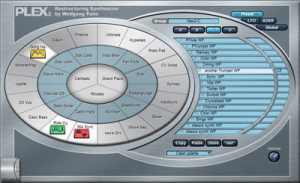
“I had done some extensions on Plex, just for myself during the last years. Doing that, I found the sounds Plex produces interesting again.
So I decided to do a new version, and offer it for free.
The new features are:
Automatisation of the icon positions on the palette.
All filters with emphasis parameter
Tools to easily change the palette content”
Teaser pic for upcoming new synth for Rhythm Studio
Gemini Synthesizer

Details so far:
The most versatile synth created for Rhythm Studio so far…
2 Analog style oscillators
Oscillator 2 >> 1 sync
Oscillator 2 >> 1 ring modulation
Oscillator tune in +/-7 semitone range
24 db/octave resonant ladder filter
Full ADSR envelopes for filter and amp
LFO
________________________
Rhythm Studio balances advanced music making features by using an easy to understand interface resembling real instruments. This means that one button does one thing just like it would with real hardware. Knobs turn, switches slide, and buttons press. You won’t get lost in abstract interfaces, menus, or design.
Imagine having a studio of rare vintage synths and drum machines in the palm of your hand. Beautifully rendered synthesizers make seeing the app as enjoyable as hearing it. Rhythm Studio is the next best thing to having the real hardware.
Rhythm Studio allows you to make music the way you want to by giving you three different ways to create your song.
1. Use the step sequencer like the real hardware.
2. Use the Control Pad to play the synths live.
3. Instantly create a random pattern.
=====
FEATURES
– Dynamic workspace full of awesome audio gear
– Intuitive pinch and tap navigation
– Robust pattern and song sequencer
– 3 easy methods to making your songs
– Recreation of classic drum machines
– Recreation of classic synthesizers
– Mixer
– FX
– X/Y style control pad
DATAMASKIN

