
Demo of the classic Elka string machine
The Rhapsody String synthesizer was built from 1975 till 1980 by the italian company ELKA. It was one of the more widely spread (read sold by thousands) string machines then. The list of users includes EM acts like Jarre, Tangerine Dream (Virgin years and some), Vangelis, Klaus Schulze (only a tour or two in the mid seventies). And also Supertramp and other pop bands used it too. The Rhapsody 490 was the little brother to the better known 610.
If you are looking for a sample pack of the Rhapsody check out this.
Access Virus “A” ambient sound demo
For more info, longer demo and more, please visit the VIRUS “A” page at this URL:
http://www.polynominal.com/site/studio/gear/synth/access_virus/virus.html
How to expand your modulation possibilities – Reason Sound Design
Propellerhead’s product specialist Mattias Häggström Gerdt shows you how to use the Combinator to access more modulation options in Reason’s synths and how you can control this with CV. More possibilities for making interesting, evolving sounds is just inside the Combinator!
Robot Band EOL covers Maroon 5 “Moves Like Jagger”
Background information:
In my previous videos I have received alot of comments requesting the vocal styles of Stephen Hawking so your wish is my command. This is song is based on the group Maroon 5’s “Moves Like Jagger” Please support the band and buy this song.
Vocals Digital DECtalk Express play both the male and female vocals (the same unit as Stephen Hawking used back in the 80’s) and it is controlled by a Genesi linux box
Robot Snare, Robot Bass Drum and Tambourine
Robot Keyboard and my trusty old HP Scanner
Endeavour Evo Keyboard Controller
This keyboard can sense finger position on the key,and this data can drive any software or hardware synth capable of responding to polyphonic aftertouch. Evo also comes with a software synth designed to take full advantage of the controller’s capabilities, and sends data over Ethernet to keep latency around 1-2ms maximum.
Analogue Solutions Leipzig S listening test
Listening test for Leipzig-S; audio rate sequencing, waveform, lowpass filter, suboscillator, etc…
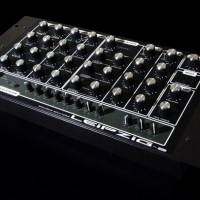
KEY FEATURES OF LEIPZIG-S
- Pure analogue voice and modulation circuitry.
- Fat Moog style filter.
- 2 VCOs with Glide and Sub-VCOs.
- Osc Sync & Cross-Mod
- Plenty of modulation routing possibilities.
- We are a big fan of electronic percussion here, so Leipzig-S modulation choices provide for good drum possibilities
- Analogue step sequencer – with plenty of clocking options.
- Audio input so can be used as a sound processor.
- Rugged steel/aluminium construction.
- MIDI In for software sequencer control.
Evolving from its namesake Leipzig (rack-mounting) and Leipzig-k (keyboard-endowed) analogue monosynth predecessors, the rack-mountable/tabletop Leipzig-S literally goes several steps further by incorporating an in-built eight-step analogue sequencer that can be used to produce simple melodic lines as well as acting as a modulation source to affect the filter cutoff (or to create additional effects, depending on other control settings). VCO1, VCO2, and the VCF are all available as sequencer destinations; seemingly simple, yet favourably flexible, the step sequencer can be creatively controlled (clocked) by multiple sources — at audio frequencies (using VCO2 as a clock source), or using the output of the sequencer itself as an audio source to be ‘played’ via MIDI while the eight step controls then alter the ‘waveform’/tonal content, for example, such are the adventurous advantages of packaging an analogue step sequencer with a true analogue monosynth!
The entire design is traditional early-Eighties analogue (voice and modulation) circuitry, comprised entirely of discrete components and op-amps (bar, of course, the digital sequencer controller and MIDI-CV interfacing); since the Leipzig-S is a strictly no-memory affair, all controls are not quantised, resulting in an authentically vintage sound, replete with musically desirable quirks and subtle artefacts (much in the same way that, say, a valve amp or vinyl record adds sonic character) — unlike some other modern ‘analogue’ synths that arguably sound almost as perfect as DSP analogue modelling.
With electronic percussion having influenced the choice of routings, the Leipzig-S boasts a huge range of modulation possibilities to facilitate creating the widest possible range of sounds, including deep basses, sound effects, analogue loops, and (obviously) electronic drum sounds.
THE ROBOTS BASS
SOUND OF BASS LENI OF THE ROBOTS NADE WITH NORDWAVE SYNTHESIZER AND SEQUENCED WITH DOEPFER DARK TIMEANALOG SEQUENCER
Hands-On: Roland JUPITER-50 (JP-50) synth
Keyboard editor Stephen Fortner get an exclusive first-hand look at the new Roland Jupiter-50 synth. See a further look into the JP-50 at… http://www.keyboardmag.com/article/roland-jupiter-50-hands-on/148040
Features
With its unprecedented fusion of synthesis and acoustic instruments, the new-generation Roland JUPITER has changed the way we play, react to, and feel a keyboard. By combining the supreme expression of the JUPITER-80 with the travel friendliness of the JUNO series, the new JUPITER-50 brings SuperNATURAL sound and pro performance to every stage and studio.
- Stunning SuperNATURAL sounds powered by our most advanced sound engine
- Travel-friendly design; 76-note weighted keyboard
- Fast, friendly user interface with intuitive color-coded buttons and sliders
- Registration function for saving and selecting sounds instantly
- Pro-quality multi-effects and reverb
- Expressive performance controllers, including D BEAM, pitch/mod lever, and control input jacks
- USB Song Player/Recorder
- USB audio/MIDI functionality; bundled with SONAR LE and JUPITER-50 Control Surface plug-in for SONAR
Introducing Serato Video
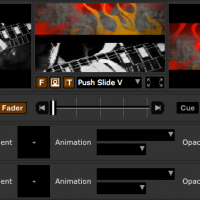
Based on the popular Video-SL plug-in, Serato Video now gives ITCH DJs video mixing tools that Serato Scratch Live DJs have enjoyed for years, with the use of supported ITCH controllers. Scratch Live DJs can use the same tools with their choice of turntable or CDJ control. With a reworked architecture, Serato DJs can experience an even smoother workflow and greater flexibility when using effects and transitions to amplify video mixes, at home, in the club or on-stage.
Features
– Manipulate video playback with Serato Control Vinyl and CDs or an ITCH Controller.
– Visual effects library of transitions and effects.
– Add your own images and text to your video mix.
– Store effects within each video file for instant recall.
– Choice of configurations for external connections to monitors, screens or projectors.
Check out this modified KORG – FrankenKorg 800 Demo
This Korg Poly 800 keyboard is modified with the Moog Slayer mod, FM 800 mod, 12/24 db filter switch, VCF external audio in, an Alesis Nanoverb, and a Toshiba Libretto laptop computer. An Alesis Nanoverb and a Toshiba Libretto have never been built into a Korg Poly 800 synthesizer, until now. In this video I play the FrankenKorg to demonstrate most of its features and sound possibilities. Every sound is generated inside the FrankenKorg; no external effects were used. At some points during the video, I use a foot pedal I designed that connects to the synthesizer and controls the internal VCF cutoff. The video was recorded with a Sony DXC-327 and the audio was recorded with Pro Tools. A Toshiba Libretto 50CT laptop was designed to fit where the programming decal was on the original Poly 800. The Korg’s midi out is connected to the input of the MPU-401 controller in the Libretto and the audio output of the Libretto is switchable to either the VCF ext. in or the input of the Nanoverb. In this video, I used the software wavetable and OPL3 FM synthesis chip in the Libretto. The Alesis Nanoverb circuit board sits underneath the Libretto’s keyboard inside the FrankenKorg. Controlling the Nanoverb is accomplished through five of the eight added knobs on the Korg’s casing. The Nanoverb’s audio out can be routed through its original 1/4 inch outputs as well as the headphone output of the Korg. The Nanoverb provides reverb, delay, flange, rotary and chorus effects.
DATAMASKIN

