
Music Ipad App Korg iKaossilator: Adobe Soundbooth
Music Ipad App for the Korg iKaossilator. I exported the audio within Premiere to Soundbooth, saved the file which automatically updated the timeline in Premiere.
OP-X PRO-II: Platinum Bank Demo
http://www.sonicprojects.ch/opxpro2/description.html
Demo of the new Platinum bank for the SonicProjects OP-X PRO-II virtual Oberheim VSTi synth plugin. No external effects or any other treatment are involved. All sounds are coming directly from OP-X PRO-II which was played live and recorded directly to disk.
The bank features 82 stunning patches capturing the magic and the special character of some of the most sought after early voltage controlled polyphonic analog synths including:
– Oberheim OB-X
– Oberheim OB-Xa
– Oberheim OB-8
– Oberheim Matrix-12
– Roland Jupiter-6
– Roland Jupiter-8
– Elka Synthex
If you know these synths and their special sound and character you will immedialtly recognize which sounds are dedicated to which godfathers.
The bank can be downloaded here:
http://www.sonicprojects.ch/opxpro2/userarea.html
Here’s the reference of the featured patches:
00:00 01 Clear OB Brass
00:08 02 Clear OB Brass II
00:14 03 Matrix-12 ResoPad II
00:39 79 OB-X SL Upsweep
00:58 80 OB-X Space Sweeps II
01:34 29 OB-X Fullanalog Strings
01:57 32 OB-X Slow R-Sweeps
02:11 31 OB-X PWM DS VL
02:25 30 OB-X PWM D-Sweeps
02:31 04 Matrix-12 NR Cembalo II
02:47 53 Matrix Outerspace
02:57 05 FM Midnight Bell
03:05 51 Matrix Strange Tones
03:15 14 MM DL Arpeggio
03:25 15 MM DL Arpeggio FM
03:33 16 MM DL Arpeggio FMS
03:52 55 OB-Xa Sweep Chords
03:57 56 OB-Xa Porta Chords
04:03 57 OB-Xa Slow Upsweeps
04:25 26 OB-8 Superwarm Strings
04:43 58 OB-Xa Warm Sawsolo
04:48 64 OB-Xa P-Sync Solo II
04:54 66 Prophet-5 Lead
05:01 67 Prophet-5 Sine Pad
05:10 68 Prophet-5 Full Brass
05:19 70 Prophet-5 Mod Strings
05:30 72 Prophet-5 Mod Strings L
05:48 73 Prophet-5 Sync Lead
05:55 74 Prophet-5 Wah Chords
06:06 75 Prophet-5 Reso Chords
06:17 76 Prophet-5 LFO Pad
06:31 78 Prophet-5 Upsweeps II
07:16 17 JP-8 Perc Chords
07:22 18 JP-8 Power Chords
07:25 19 JP-8 Power Chords DB
07:33 20 JP-8 Resonant Brass
07:43 21 OB-8 Slow Fullbrass
07:53 22 OB-8 Superfull Brass
08:05 25 OB-8 Warm Perc
08:14 46 Ujiie Matrix Brass
08:20 06 Jupiter-6 Octave Brass
08:28 07 Jupiter-6 HP Brass II
08:33 35 SEM Fat Bass II
08:41 09 Jupiter-6 Sinesync Bass
08:50 49 Ujiie Matrix Clav II
08:53 48 Ujiie Matrix Clav
08:57 40 Synthex Double ARP
09:03 41 Synthex Speed ARP
09:23 45 S-Pulse ARP ST PM
Note that the youtube audio compression takes away a lot of depth and smoothness and makes the sounds small. Played in real using good d/a converters is like night and day.
The download page features a better sounding high quality mp3 demo of the same. For a real reference the bank can be checked with the demo version of OP-X PRO-II:
http://www.sonicprojects.ch/opxpro2/freedemo.html
Moon Modular M592 the “reversible modulation matrix”
The new Moon Modular “reversible modulation matrix” module M592 can route 12 sources via 6 active channels to 12 destinations. In this demo, the sources are 3 sequences to control VCO and VCF. Infos @ http://moonmodular.com
MiniBrute CV Arpeggio
Arturia MiniBrute Arpeggiator as CV/Gate controller for two Doepfer A-110 VCOs; the VCOs goes in a dual Pittsburg VCA under MFB Envelope control; then in a Tiptop Delay AND back into MiniBrute Ext Audio Input. The Steiner Filter works in Notch mode, with a slow LFO modulation.
Music Computing releases ControlBLADE Gen2
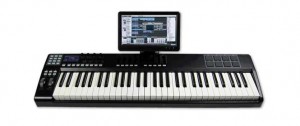
Music Computing has announced its new ControlBLADE Gen2 line of all-in-one music keyboard production stations. Priced from $1,899, the company says that the line represents a new standard in value and performance.
Victor Wong, CEO, Music Computing, told us,, “At Music Computing, we strive to bring the latest technologies to our users. The release of the new ControlBLADE Gen2 models reinforces that fact and our commitment to being the very best at what we do.”
Here’s the details in Music Computing’s own words…
ControlBLADEs are all-in-one music production stations complete with piano keys, drum trigger pads, knobs, sliders, thousands of sound presets and software for live and studio use. They allow users to compose, record, mix, and master songs that are ready for radio or direct Internet distribution.
The new Gen2 ControlBLADEs are powered by high-performance computer cores utilizing Intel® Core i-series® third-generation (Ivy Bridge) processors that are perfect for today’s demanding musicians and the virtual instruments and software application they use. Options include i5 and i7 quad core versions. The Windows 7 (64-bit) operating system is pre-configured for music production and can run virtually any software application or plug-in. Capable of running over 500 plug-ins at once, sequencing thousands of tracks simultaneously, and storing millions of sound presets, the ControlBLADE packs a serious punch for the money.
ControlBLADEs are also available for Mac OS X, which are powered by the latest Mac® mini from Apple®. Both i5 and i7 processor options are also available as well as a variety of RAM, hard drive, SSD drive, and other upgrades.
The ControlBLADE is available as 25-Key and 61-Key models. About the same size as a typical keyboard controller and weighing only 22-lbs (61-key) / 13-lbs (25-key)…FULLY LOADED, the ControlBLADE brings true portability to the keyboard production station world.
New with the Gen2 models is the option for the ProTouch™ piano keybed. The new ProTouch keybed brings higher levels of playability and better feel to the ControlBLADE line via high quality semi-weighted keys with after-touch. The optional upgrade is priced at: $199.
ControlBLADEs all come with built-in Wi-Fi standard. This mean the user can be online anywhere there is a hot spot. Send and retrieve files, log into remote servers, collaborate with others, or download new software and sounds directly into the ControlBLADE. Users now have the freedom to create virtually anywhere they like.
Upgrades for Gen1 models to the new Gen2 versions are available.
Pricing and Availability:
See website.
More information:
Daft Punk Vocoder (Ableton Live Tutorial)
And here are the details:
Hello. My name is Mars. Today we’ll talk about vocal processing through a vocoder. Daft Punk have used this technique in many of their tracks.
I have searched for a long time to find a convenient and easy vocoder, and tried many different devices. When we started work on the PLAYMA track “Cuz We Are PLAYMA”, the vocals weren’t catchy enough, and at the time I had not had the opportunity to ask some of my friends to record vocals for me. I decided to try recording them myself, even though I don’t like my voice.
For the record, I used a standard iPod headset. That sounded funny and my voice was so wrong. Here I was not even in tune, but it’s ok for this example.
To begin, compress the vocal track a little bit to cut some peaks in the sample, then use the vocoder effect. In order to implement this effect, I first need to make a synth, which fills out my voice. For this I used a standard preset of “NI Massive” synth.
To create a melody for the synth, I copied the midi clip, which I used to lay down the guitar track. The Vocoder effect is very simple to use. To make it work you just need to select the source channel as the Massive synth. After this you should tweak up the effect a little for a more pleasant sound.
Next, add a slight delay between the left and right channels to spread the stereo, and cut low frequency a little bit.
Thank you for watching. My name is Alexander Mars and this was my tutorial on “Daft Punk vocoder”. If you are interested in professional, affordable music courses, head over to xssracademy.com. There you will also find more free video lessons and articles, so be sure to check it out. Click “Like” below if you enjoyed this video, see you soon!
MicroTones – microtonal synthesizer for iOS
MicroTones is a microtonal synthesizer, allowing simultaneous playback of up to thirty sinewaves set with accuracy to one hundredth of a hertz.
Available on the App Store: itunes.apple.com/us/app/microtones/id522720716?ls=1&mt=8
Place new sinewaves just by touching the screen, adjust volume, and frequency, add more and listen to subtle changes in soundscape. Easily create ambient atmospheres and drones.

Manipulate multiple sinewaves at once with full multitouch support.
Adjust frequency range using scale displayed at the bottom of the screen – move to lower/higher frequencies, zoom in to adjust sinewaves with more accuracy, or zoom out and see the whole picture.
Remove one or more sinewaves just by dragging them to the bottom of the screen, or all at once by shaking your device.
iYM2151 iPad App Simulator of YAMAHA YM2151 FM Synthesizer
Detune has released iYM2151, a new iPad music app that they describe as ‘the world’s first FM synthesis music workstation’.
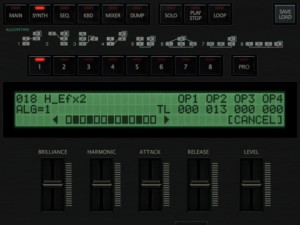
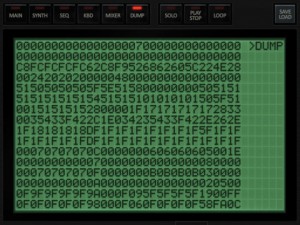
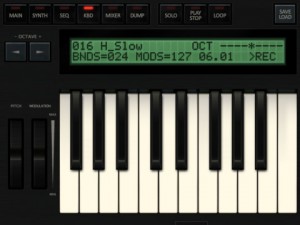
Here’s what they have to say about iYM2151:
YM2151, aka OPM, is a single-chip FM synthesis implementation, an eight-channel four-operator sound chip. it was used in many 80′s arcade games and home computers.
iYM2151 is the The world’s first FM synthesis music workstation app, using YM2151 simulator engine for iApp.
iYM2151 not only tries to recreate the 80′s FM sound, but it also recreates the experience of working with an 80′s FM interface.
Features:
- uses YM2151 simulator engine for iApp
- 4 operators per 8 Algorithms
- 8 voices
- 3 software LFOs
- max 99 scenes (1scene with 64 steps)
- easy FM edit mode
- MML mode : programable huge FM parameters in every steps
- DUMP mode : realtime all FM operator parameters viewer
- song data file sharing and mail attachment
- 80′s design user interface
Guitar Sounscapes with Ebow & csGrain
Background information:
A brief collection of 3 improvised soundscapes and patches on CSGrain for iPad with my guitar and an Ebow. Don’t expect superb playing skills as the guitar is not my main instrument. Also sorry for the ground noise and artifacts, this was recorded on the fly. The audio chain is: guitar to Lexicon Omega to iPad, then processed by csGrain and the audio output goes back to the Omega and this to Sonar on the PC thru the EMU 1820m.
I’ve included the camcorder mic sound on the last patch (from minute 5:03 to 6:30 ) because I loved the sound generated by the collision of strings with the ebow while vibrating and found it fitting pretty well with the soundscape. I hope you like it.
Interview – Synth-Aesthesia: Jean-Michel Jarre’s Favorite Keys

RedBull Music Academy has made an interview with Jean Michel Jarre where he in detail talks about his ten favorite synthesizers:
Ahead of his Academy lecture at the Les Nuits Sonores festival May 16 in Lyon, the synth pioneer Jean-Michel Jarre recounts ten of his favourite pieces of gear.
While, of course, numerous parties are to be praised for introducing synthetic music to the masses, it can be argued that the French composer and musician Jean-Michel Jarre was the first to really foment the electronic music revolution. Though the early successful pioneers like Wendy Carlos, Mort Garson, and Hot Butter primed the public’s ears, their output was mostly either novelty arrangements of pre-existing hits or just plain novelty. Jarre took a different tack and began composing original pop material to be played solely on synths. Selling over 80 million albums and singles thus far during his four decade career, he not only brought oscillators out of the realm of nerdery, his music also served as a late-night soundtrack of the future for music lovers the world over – and spawned a countless number of imitators as well (oftentimes poor). From his first collaborations with Patrick Juvet and Christophe to his epic synth solo albums like Oxygène and Equinoxe, Jarre’s sounds now show up as ghosts in the works of contemporary electronic experimenters as varied as Sébastien Tellier, Oneohtrix Point Never, Emeralds, and Daft Punk, to name a few.
And here is the complete list:
E.M.S VCS 3 (1969)
My first synth, Europe’s answer to the American Moog: a Mini versus a Cadillac. Post-war technology had led us to an European electronic sound which was very different to the American sound. The VCS3 was one of the first real synths to be developed from modular research, a technique with which I was already familiar, as it had resulted directly from the equipment that I was working with at the GRM (Le Groupe de Recherches Musicales or, in English, Musical Research Group) with Pierre Schaeffer. I’ve composed a lot of music with this synth, most notably on Oxygène and Equinoxe, although I’d already tried it out on Deserted Palace [one of Jarre’s first projects] and the music that I composed for the Parisian Opera.
ARP 2600 (1971)
This is an American synth which quickly became the best modular/semi-modular synth on the market – different to Moogs, which didn’t have pre-set sounds. When we switched the ARP 2600 on for the first time, we could instantly start to play and shift potentiometers. It cost much less than a Moog, but it was much bigger with an extremely rich sound. I used it a lot on Oxygène and Equinoxe as well as on the albums I made with Christophe such as Les Paradis Perdues (Lost Paradises) and Les Mots Bleus (Blue Words). ARPs are like the Stradivarius or the Steinways of electronic music. They were invented by craftsmen who, today, we’d place on the same level as the luthiers that built violins, clavichords, pianos – all of the acoustic instruments.
ARP 2500 (1969)
This is the big brother of the ARP 2600, created to compete with the modular Moog. Pete Townshend of The Who was one of the first musicians to use it in Europe. The ARP 2500 is the huge machine that we can hear in “Baba O’Reilly” playing that well-known sequence which would become so essential to The Who’s sound. It’s an electronic sound, not the sound of a guitar! I try to approach people with a similar rapport with synthesizers to my own, such as Pete Townshend or Peter Gabriel, both of whom were amongst the first musicians to possess a Fairlight, along with myself.
FAIRLIGHT CMI (1979)
The Fairlight was the first instrument that I worked with which was directly linked to the training I’d received at GRM under Pierre Schaeffer, electroacoustic music, or what we’d later call ‘sampling’. With the Fairlight, we could record and sample any sound – a natural, urban or domestic noise – play it on a piano and create percussion, a choir, the sounds of chords, a constructive element of music, improbable sounds of which we didn’t know the origin. It’s an instrument with a very lo-fi sound and with a lot of charm and warmth, a graininess that makes us think of the compositions of Bernard Herrmann or of the aesthetic that we find in films from the 30s like Metropolis. It was significant in determining the sound of Peter Gabriel and the sound of the Real World label, as well as my own. It can be heard throughout my back catalogue, on Champs Magnetiques (Magnetic Fields) but especially on Zoolook, which was made entirely on the Fairlight. Oxygène and Zoolook are two very different albums on the sonic map, because as we know, it’s the tool that defines the style and not the other way around.
Roland JD-800 (1991)
This was the next synth to follow the DX7 philosophy and the approach initiated by Japanese synths, which was going to financially sink all of the American makers. I included it in my list because it was one of the first polyphonic Japanese synths that managed to resemble an analogue synth, although what I hated about the DX7 was that it left you thinking that electronic music only aimed to imitate the sounds of acoustic instruments. With the JD-800, you could modify the sound, as you can on an ARP or a Moog, but with a Japanese sound quality, which in some respects, is more refined. I used this synth a lot on Chronology and Revolution. These are the albums which spoke to people the least, but which were important in my career as they marked a period of flux where I still had a foot in analogue and another in what would go on to become digital.
MEMORY MOOG (1982)
The first analogue polyphonic synth. Until then, modular synths such as the VCS3 and the ARP were monophonic. If you wanted a polyphonic effect, you had to play four different sounds at the same time. It’s a practice that’s lost today, which is a shame because it meant you had to compose in the same way that we’d write for a string quartet: violin, alto, cello, double bass. With the Memorymoog, and other synths that came out around the same time, in one fell swoop, we could make complete chords, and that changed everything. For better and for worse. As a result, we ceased to compose electronic music the classic way, as Wendy Carlos did. The Memorymoog was the 8 Moog in the same form but with a new and different attraction: we could store the sounds we created. Before, we had to get our pencil and paper out and write down all of the operations required to produce a sound, but it was never really possible to reproduce the original sound again from the notes we’d made. From this point onwards, you could re-find the sound in its original state, even a year after you’d made it.
RMI Keyboard Computer (1974)
This is an instrument that was created in the 70s and which was revolutionary as it was the first digital synth in a period where everything was analogue. In the electronic music world of the 70s, digital had no place at all. The RMI functioned according to the principle of additive synthesis, whereas the analogue synths were based on subtractive synthesis. To simplify, additive synthesis is like an organ, meaning that you can add frequencies to each other and add layers in the same way that on an organ, you can add 32 pedals, then 16, then 8, then 4, which are actually octaves, or thirds of octaves or quintets. It’s a technique that was used heavily on Deserted Palace and on the track “Oxygène 5”, where the entire sequence is made using the RMI. It created a very different sound to anything else that could be heard at the time, precisely because the digital edge added a certain coolness. This synth was to music what the film Tron was to cinema at the time.
EMINENT 310 (1970)
This synth defines my sound, from Les Mots Bleus by Christophe and the songs of Patrick Juvet, right up to Oxygène and Equinoxe, where I used it heavily. To this day, I still use it frequently. Along with the VCS3, this is one of the fundamental instruments of my music. It’s an organ developed by the Dutch who were the first to figure out how to create chords from electronic sounds. It was from this first string ensemble that the Solina emerged, which is nowadays better known than the Eminent, even if the Eminent is three Solinas together with a notably richer sound. The Eminent can be heard on Oxygène and Equinoxe, adding that gliding, phased feel. The background story to this sound is that it’s the VCS3 and the Eminent passed through a Smalltone, a phase pedal for guitars, which created this very opulent sound similar to that of chords, but of course much more electro.
Teenage Engineering OP-1 (2011)
A little new one that came out less than a year ago and was invented in Sweden [by Teenage Engineering, a company founded by 2003 Academy pariticpant David Eriksson]. It’s a synth which doesn’t even seem like a synth at all – it’s tiny and looks like a Casio toy, but hidden inside is a very sophisticated machine, created using military technology. It’s 100% digital, but defines something completely new in its size and transportability. It’s been a long time since I’ve seen something as interesting, flexible and creative as this. And importantly, its inventors have reintroduced a notion which had been desperately lacking: humour. We have to remember that Moogs, ARPs and all of the first synths had been created by raging madmen, who created completely unreasonable and financially hazardous instruments. The inventors of this synth sold their OP-1 in drips and drabs on the internet, and the instructions are in Japanese to throw us off the scent. I met them after my tour in Sweden – the whole team came backstage and we jammed together. I chose this synth to show that any instrument, from no matter what time, can have a completely timeless value. I’m sure that musicians will still be using the OP-1 in 50 years.
MELLOTRON (1963)
This is another mythical instrument from the electroacoustic scene, since it was one of the first samplers well ahead of the Fairlight. What was interesting with the Mellotron was that it was conceived at a time (the 60s) when the philosophy of sampling wasn’t on the agenda at all. It was, once again, the idea of a luminary who asked himself how to play chords electronically. The principal is to record a choir in a studio onto tape and then to install all sorts of little tape recorders with tapes that last seven seconds to create the notes on a piano. The Mellotron is a kind of small piano which, when you press a key, places the stylus against the tape, releasing a tape which will be read by the head during the seven seconds. That allows you to have a whole range of sounds. When you play a Mellotron, you feel like you’re listening to soundtracks from silent films from the 30s, as there’s this whining contortion that would go on to define the sound of loads of Beatles, Moody Blues and Procol Harum tracks. In fact, pop and rock in the 60s would use this instrument to record choirs with a vintage, retro feel. It’s the sound of the 40s adapted for the music of the 60s.
DATAMASKIN

